
Key takeaways
- Stovetop kettle: no electricity needed, long-lasting and available in stainless steel or enamel, though slower and without auto shut-off.
- Hot water dispenser: convenient for frequent hot-water users, but takes up counter space and costs more.
- Instant-heat tap or boiling-water unit: installed at the sink for hot water on demand, suited to larger kitchens.
For most kitchens, a stainless-steel or glass electric kettle of roughly 1.5 to 1.7 liters with automatic shut-off and boil-dry protection is the best all-round choice, while tea and coffee enthusiasts who need exact water temperatures should look at a variable-temperature model. Small households and desks do well with a compact kettle of about one liter, and buyers who care about avoiding plastic contact with their water have a growing number of stainless and glass designs to choose from.
Our top picks
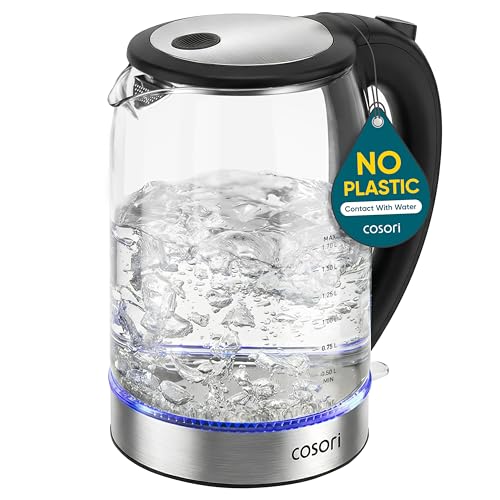


As an Amazon Associate we earn from qualifying purchases at no extra cost to you.
Electric Kettles at a Glance
| Type | Best for | Typical features (as makers describe them) | Limits |
|---|---|---|---|
| Standard stainless-steel kettle | Everyday boiling for a family | 1.5 to 1.7 liter capacity, auto shut-off, boil-dry protection | Outside can get hot unless double-walled |
| Glass kettle | People who want to see the water level | Borosilicate glass body, LED light on some models | Fragile; glass can heat to the touch |
| Variable-temperature kettle | Tea, coffee and baby-formula preparation | Preset or adjustable temperatures and a keep-warm function | More complex; usually costs more |
| Cuisinart CPK-17 PerfecTemp | Multi-temperature use at a mid-range tier | Six preset temperatures and 1.7 liter capacity, according to the maker | Plastic components in some parts; read the manual |
| Fellow Stagg EKG | Pour-over coffee fans | Gooseneck spout and variable temperature control, per maker | Smaller capacity; premium positioning |
| Compact travel kettle | Travel, dorms, offices | Small capacity, foldable or small body | Fewer features; check voltage for international use |
What to Look For in an Electric Kettle
Capacity
Kettles are listed by capacity in liters. A one-liter model makes two or three cups at a time, while 1.5 to 1.7 liters suits families and tea drinkers who make pots. Remember that the maximum fill line is usually below the brim, and that overfilling can cause spitting.
Power and speed
Many kettles list a wattage around 1,500 watts in North America, which is the typical ceiling for a standard household outlet. A higher wattage generally boils faster, though capacity and starting water temperature also matter. Makers sometimes state a boil time for a full kettle.
Materials
Stainless steel is durable and common, glass lets you see the water, and ceramic is more decorative but heavier. Some buyers prefer to avoid plastic parts that touch the water, so read the maker’s description of the lid, spout and interior. Makers often disclose whether the interior is stainless steel, glass or has a plastic lid.
Safety features
Auto shut-off when the water boils and boil-dry protection are standard on most modern kettles. A cool-touch handle, a locking lid and a base with a cord wrap are practical extras. If you have children, choose a model with a lid that closes securely, keep the kettle out of reach and mind the steam.
Temperature control
Variable-temperature kettles let you heat water to levels suited to green tea, oolong, coffee or other drinks. Many offer presets and a keep-warm mode. If you mainly boil water for instant meals and black tea, a basic on-off model is perfectly adequate.
Spout and pouring
A standard spout is fine for general use. For slow, controlled pours, such as pour-over coffee, a gooseneck spout is easier to control. See the separate gooseneck kettle guide for more detail.
Budget Tiers
Budget
Basic stainless-steel and glass kettles from brands such as Hamilton Beach and Mueller are common at entry level. They boil water reliably and include core safety features, with fewer extras like temperature control or double-wall insulation.
Mid-range
Variable-temperature kettles from Cuisinart, Breville, OXO and Bodum, along with higher-quality stainless models from Cuisinart and Zojirushi, are common here. Reviewers frequently highlight keep-warm functions, better build quality and tidier design.
Premium
Premium kettles include the Fellow Stagg EKG, Breville Smart Kettle models and design-led brands. They tend to be chosen for precision, appearance and longer-lasting parts, though a standard mid-range kettle will boil water equally well.
Care and Safety
Descale regularly if you live in a hard-water area. Makers usually recommend a mixture of water and white vinegar or citric acid, followed by a thorough rinse. Check the manual for the recommended ratio and frequency. Avoid abrasive cleaners that could scratch the interior.
Always unplug the kettle before cleaning, and never immerse the base in water. Keep the cord away from the edge of the counter, and place the kettle on a flat, heat-safe surface. Do not use the kettle for anything other than heating water unless the manual says otherwise. If a kettle is damaged, stops shutting off or has a frayed cord, stop using it and contact the maker or replace it.
If you are traveling abroad, check that the kettle works with the local voltage. Some kettles are single-voltage, and using them on the wrong supply can damage them or create a hazard. Read the label on the base.
Pick X If… Decision Table
| Pick this | If you |
|---|---|
| Standard stainless-steel kettle | want a durable, simple kettle for daily use |
| Glass kettle | like seeing the water level and the boil |
| Cuisinart PerfecTemp or similar | want preset temperatures at a reasonable tier |
| Fellow Stagg EKG | brew pour-over coffee and want precision and a gooseneck |
| Compact kettle | have a small household, desk or dorm room |
| Double-wall kettle | want a cooler exterior around kids |
Alternatives
- Stovetop kettle: no electricity needed, long-lasting and available in stainless steel or enamel, though slower and without auto shut-off.
- Hot water dispenser: convenient for frequent hot-water users, but takes up counter space and costs more.
- Instant-heat tap or boiling-water unit: installed at the sink for hot water on demand, suited to larger kitchens.
Everyday Use and Energy Notes
An electric kettle is a convenient way to heat just the water you need for tea, instant oatmeal, pour-over coffee or cooking. Boiling only what you plan to use saves time and energy compared with heating a full kettle, though most models require a minimum fill level, usually marked on the inside. Check that line before turning the kettle on.
Look at the footprint, too. A tall kettle may not fit under low cabinets, and a wide base can crowd a small counter. Cordless bases that rotate 360 degrees make it easier to use with either hand, and a base with cord storage keeps the counter tidy. A lid that opens wide makes cleaning easier, while a wide mouth helps with filling.
Noise is another consideration. Some kettles are noticeably louder than others when boiling, and glass models can be more audible than double-walled steel. If you have an open-plan home, read user reviews for comments on noise. If you share a kitchen, a kettle with a quiet beep or a silent shut-off may be appreciated.
Frequently Asked Questions
How big should an electric kettle be?
A capacity of 1.5 to 1.7 liters is a good fit for most households. Smaller kettles of about one liter suit one or two people. Larger kettles make sense if you often serve groups.
Are glass kettles safe?
Kettles use heat-resistant borosilicate glass, which is designed for the temperature range. The outside of the glass can still become hot, so handle by the handle and let it cool. Avoid knocks and sudden temperature changes, and stop using a cracked kettle.
Do I need a variable-temperature kettle?
Only if you make drinks that benefit from lower temperatures, such as green tea or some coffee methods. If you mostly boil water for hot drinks, instant food or cooking, a basic kettle is enough. Variable models also offer a keep-warm mode that some people find useful.
How often should I descale my kettle?
It depends on the hardness of your water. In hard-water areas, monthly descaling is common, while in soft-water areas it can be much less frequent. Follow the manual and descale when you see white buildup.
Is it safe to leave water in the kettle?
Many makers recommend emptying the kettle after use and refilling with fresh water, which helps limit buildup and keeps the taste cleaner. Check the instruction manual. Do not leave the kettle switched on without water.
Why does my kettle taste like plastic?
New kettles can have a slight smell from manufacturing. Many manuals suggest boiling and discarding a few full kettles of water, perhaps with a little vinegar, before regular use. If the taste continues, consider a model with a stainless-steel or glass interior and minimal plastic contact.


