Our Top Picks

A refrigerator water dispenser with a spigot puts filtered water on tap inside the fridge, with no plumbing, no installation and no counter space given up to a pitcher. You fill the reservoir from the sink, let gravity pull the water through the filter as you dispense, and pour chilled water straight from the tap on the front of the unit. For households that drink a lot of water, it is the simplest upgrade from a small pitcher, because the reservoir holds far more and needs refilling far less often.
The five dispensers below span 22 to 35 cups and three different approaches to filtration, from standard taste-focused filters to a five-stage system with a built-in meter. Every filtration and contaminant-reduction claim in this guide is a claim stated in the product’s own listing or in the certification that listing names. These are gravity filters designed for treated tap water, not purifiers, and none of them should be relied on to make unsafe water safe.
As an Amazon Associate, we earn from qualifying purchases.
Quick answer
Choose the Brita UltraMax for a simple, widely supported 27-cup dispenser, either PUR model for a slim 30-cup body, the ZeroWater if you want a built-in TDS meter and five-stage filtration, and the Waterdrop if fridge space is tight and you want the largest capacity, noting it does not lower TDS.
Brita UltraMax Large Water Dispenser with Standard Filter, 27-Cup

The Brita UltraMax is the default recommendation in this format: a 27-cup spigot dispenser that ships with one standard Brita filter and uses the most widely available replacement filters in this category. The listing states the standard filter lasts two months or 40 gallons, which sets an easy replacement rhythm, and the dispenser is BPA-free per the listing. Twenty-seven cups is a middle capacity: enough for a family fridge without the footprint of the largest models.
| Specification | Detail |
|---|---|
| Capacity | 27 cups |
| Filter included | 1 standard filter |
| Filter life | Listing states 2 months or 40 gallons |
| Material note | BPA-free per listing |
| Dispensing | Spigot |
The case for the UltraMax is simplicity. The spigot format means no lifting a heavy pitcher to pour, the filter schedule is the familiar Brita one, and replacements are sold almost everywhere water filters are stocked. The listing positions the standard filter around taste and odor improvement for tap water, so read it as the everyday option. If your priority is the widest filter availability and the least to think about, this is the dispenser to buy.
PUR 30-Cup Countertop Water Filter Dispenser (DS1800Z)
The PUR DS1800Z raises capacity to 30 cups, stated as 7.09 litres, in a slim body designed to sit on a refrigerator shelf without crowding out food. It uses PUR’s 2-in-1 filtration and includes one genuine PUR filter, which the listing states is certified for up to 40 gallons or two months of use. The spout is a pull-down design rather than a press tap, and the dispenser is dishwasher safe, which makes the periodic deep clean straightforward.
| Specification | Detail |
|---|---|
| Capacity | 30 cups (7.09 L) |
| Filtration | 2-in-1 filtration, 1 genuine PUR filter included |
| Filter life | Listing states certified for up to 40 gallons or 2 months |
| Spout | Pull-down spout |
| Cleaning | Dishwasher safe |
One inconsistency in the listing is worth stating plainly: a specification field reads 18 cups, while the product title and feature bullets both state 30 cups. This guide follows the title and bullets, which agree with each other and with the model’s stated litre figure. Choose the DS1800Z if you want the extra capacity over the Brita in a slim fridge-friendly shape, and you are comfortable buying into the PUR filter line for replacements.
PUR PLUS 30-Cup Water Filter Dispenser (DS1811Z)

The PUR PLUS DS1811Z keeps the same 30-cup slim format as the standard PUR dispenser and changes the filter: the PUR PLUS filter is the maker’s lead-reducing option, and lead reduction is the reason this model exists. The body stays space-saving and dishwasher safe, so it suits the same crowded fridge shelves, while the filtration claim steps up from the base model.
| Specification | Detail |
|---|---|
| Capacity | 30 cups |
| Filter type | PUR PLUS lead-reducing filter, per listing |
| Design | Slim, space-saving body |
| Cleaning | Dishwasher safe |
| Filter life | Not stated in the listing material reviewed |
That lead-reduction claim is the listing’s own statement about its filter, presented here as the maker frames it, and it is the deciding factor between the two PUR models: households whose concern is lead in older plumbing are the audience for the PLUS, while everyone else can save the difference with the standard DS1800Z. If your water is municipal and your worry is taste alone, the PLUS filter’s extra capability is aimed at a problem you may not have.
ZeroWater 22-Cup Ready-Read 5-Stage Water Filter Dispenser (ZD-022-RR)
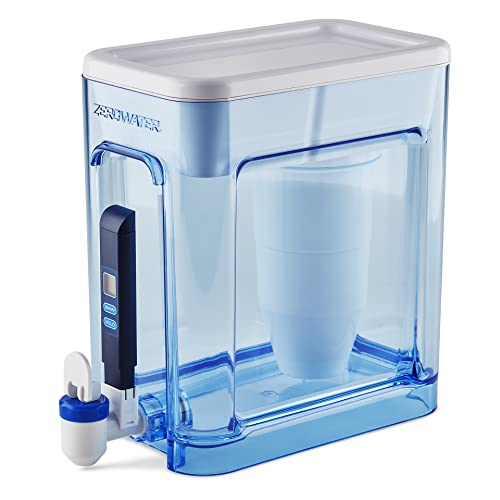
The ZeroWater Ready-Read is the smallest dispenser here at 22 cups, and it takes the opposite approach to the others: a five-stage filtration system paired with an integrated TDS meter that gives an instant reading of total dissolved solids in the dispensed water. The listing states the system is IAPMO certified to reduce lead, chromium and PFOA and PFOS, and those named reductions are the maker’s certification claims as stated in the listing.
| Specification | Detail |
|---|---|
| Capacity | 22 cups |
| Filtration | 5-stage filtration |
| Meter | Integrated TDS meter with instant read-out |
| Certification | Listing states IAPMO certification to reduce lead, chromium and PFOA/PFOS |
The built-in meter is the practical difference. Instead of changing the filter on a calendar, you can read the water and replace the filter when the reading climbs, which suits households that want evidence rather than a schedule. The trade-off is capacity: 22 cups runs dry faster in a busy fridge, and the reservoir will need refilling more often than the 30 and 35-cup models. Choose the ZeroWater if the meter and the five-stage approach matter more to you than raw volume.
Waterdrop Slim Alkaline Water Filter Dispenser, 35-Cup, Black
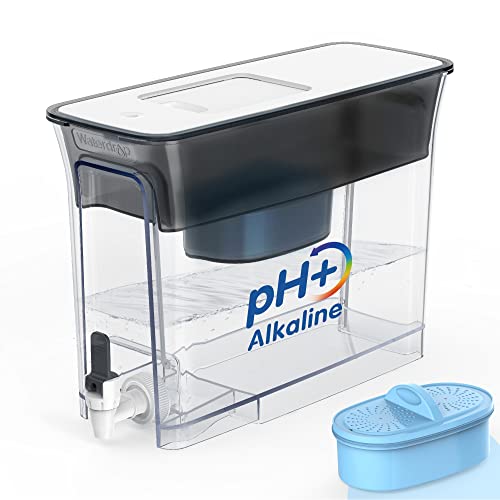
The Waterdrop has the largest headline capacity here, 35 cups in total, and the slimmest body: 14.4 by 5.5 by 10 inches, shaped to slide onto a refrigerator shelf. Note how the capacity counts: 19 cups sit in the body itself, with the 35-cup figure being the total, so compare it against rivals on both numbers. The listing describes a six-layer filtration system and states the filter lasts 100 gallons or two months, the longest stated filter life in this guide.
| Specification | Detail |
|---|---|
| Total capacity | 35 cups (19 cups in the body) |
| Dimensions | 14.4 x 5.5 x 10 in |
| Filtration | 6-layer filtration, per listing |
| Filter life | Listing states 100 gallons or 2 months |
| pH | Listing states the system raises pH up to 9.5 |
| TDS | Listing states this system does not lower TDS |
The alkaline positioning is the maker’s own framing: the listing states the system raises pH up to 9.5, and this guide reports that as a listing claim, not as a health benefit. Just as important, the listing states plainly that this system does not lower TDS, so anyone comparing it with the ZeroWater should understand they measure different things. Stock levels change, so confirm current availability on the product listing before ordering. Pick the Waterdrop for tight fridge space and long stated filter life, with eyes open about what its filtration does and does not claim.
How to choose
Measure before you shop. A dispenser only works if it fits the shelf with room to fill and to operate the spigot, so check your fridge’s shelf height and depth against the listed dimensions, and favour slim bodies like the PUR and Waterdrop models if the fridge is crowded. Capacity needs a careful read too: most figures are total capacity, but the Waterdrop also states a smaller in-body figure, so compare like with like.
Then decide what you want the filter to do, using only what each listing claims. Standard filters are framed around taste, the PUR PLUS claims lead reduction, and the ZeroWater states named certified reductions with a meter to track dissolved solids. Filter life drives running effort: the Brita and PUR listings state two months or 40 gallons, while the Waterdrop states 100 gallons or two months. Finally, remember the category limit: these are gravity filters for treated tap water, not purifiers.
Who should skip
Skip a fridge dispenser if you want filtration for the whole kitchen, since an under-sink or plumbed system covers more than drinking water. Skip it if your water source is untreated or unsafe, because gravity dispensers are not purifiers and are not a safety device. Very small refrigerators may not spare the shelf space even for a slim model, and households that will not keep up with filter changes will end up drinking unfiltered water from an expired cartridge. If countertop pitchers already meet your needs, the larger format adds little.
FAQ
Do these dispensers purify water?
No. All five are gravity filter dispensers for treated tap water. Their listings describe reductions of specific substances or improvements to taste, and those are the claims as the makers state them. None is a purifier, and none should be used to make unsafe water safe.
How often do the filters need changing?
It varies by model, per the listings. The Brita and PUR filters are stated at two months or 40 gallons, the Waterdrop filter at 100 gallons or two months, and the ZeroWater uses its built-in TDS meter to signal replacement. Treat every figure as the maker’s stated interval.
Will a 30-cup dispenser fit in my refrigerator?
Measure the shelf first. The PUR models are slim designs made for fridge shelves, and the Waterdrop lists its body at 14.4 by 5.5 by 10 inches. Leave clearance above the unit for filling and in front for the spigot, or the dispenser will be awkward to use daily.
Does the Waterdrop lower TDS like the ZeroWater does?
No. The Waterdrop listing states plainly that its system does not lower TDS, and its alkaline pH figure is a maker claim about the water’s pH, not a dissolved-solids reduction. The ZeroWater is the model here built around a TDS meter and five-stage filtration.
Final verdict
The Brita UltraMax is the easy default: mid-size capacity, the familiar two-month filter rhythm and the widest replacement availability. The two PUR models share the best slim 30-cup body, with the PLUS earning its premium only if the listing’s lead-reduction claim matches your concern. The ZeroWater trades capacity for its five-stage system and TDS meter, and the Waterdrop wins on stated capacity and filter life for tight fridges, provided you accept that it does not lower TDS.
More from Amazon
Programs that pair well with the guide above. Offers and eligibility are set by Amazon and may change.
Free shipping on eligible items, Prime Video and more. Eligible new members can start with a free trial.
Start a Prime free trialAudiobooks and podcasts to listen to on the go. Eligible new members can start with a free trial.
Try Audible freeAd-free music streaming. Eligible new subscribers can start with a free trial.
Try Music Unlimited freeA free business account with business pricing and bulk-buying tools for work, shop or home office.
Create a business accountAs an Amazon Associate we earn from qualifying purchases.