Key takeaways
- Best for a compact balcony: A fixed 1,200–1,500W infrared heater aimed at the seating area. It avoids taking up floor space and warms people and nearby surfaces directly.
- Best for a covered patio: A wall- or ceiling-mounted 1,500–2,000W unit, if the structure, electrical supply, and required clearances support it.
- Best when you need flexibility: A portable infrared heater with a stable base, tip-over protection, and a cord that can reach a suitable outdoor outlet without crossing a walkway.
- Best for a tight budget: A basic 1,200–1,500W infrared heater with a weather rating suitable for its precise location. Expect a focused warm zone rather than whole-patio heat.
Best Electric Patio Heaters for Small Spaces
The best electric patio heater for a small balcony is usually a wall- or ceiling-mounted infrared model in the 1,500-watt range, chosen to match your usable seating area and installed with the manufacturer’s required clearances. For a narrow, exposed balcony, prioritize directional radiant heat and secure mounting; for a sheltered patio where you want to move the heater around, consider a freestanding model with a tip-over shutoff.
Quick picks by situation
- Best for a compact balcony: A fixed 1,200–1,500W infrared heater aimed at the seating area. It avoids taking up floor space and warms people and nearby surfaces directly.
- Best for a covered patio: A wall- or ceiling-mounted 1,500–2,000W unit, if the structure, electrical supply, and required clearances support it.
- Best when you need flexibility: A portable infrared heater with a stable base, tip-over protection, and a cord that can reach a suitable outdoor outlet without crossing a walkway.
- Best for a tight budget: A basic 1,200–1,500W infrared heater with a weather rating suitable for its precise location. Expect a focused warm zone rather than whole-patio heat.
Compare heater types before choosing
Electric patio heaters mainly use infrared radiation, which warms people and objects in its path, rather than heating all the air outdoors. That makes placement important: a heater facing an empty wall or blocked by a table may deliver less useful warmth than the same wattage aimed at seated people. “Coverage” figures are estimates, not guarantees; wind, mounting height, and whether the space is enclosed all affect comfort.
Our top picks
 MEPTY Outdoor Heaters for Patio
- 【Fast, Efficient Infrared Heating】Powered by 1500W infrared technology,…
- 【Customizable Heat & Timer Settings】Switch between low and…
- 【Multi-Layer Safety Protection】A built-in tip-over switch automatically cuts…
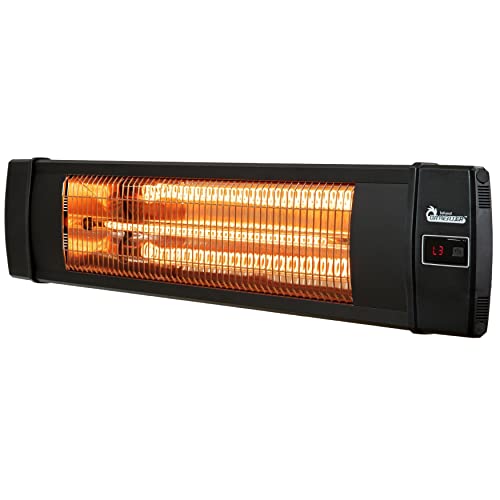 DR. INFRARED HEATER Portable Infrared Indoor and
- INDOOR and OUTDOOR HEATER - Heater is IP55…
- CLEAN and INSTANT HEAT - Clean, instant and…
- PLUG and GO - uses standard 120V, remote…
 hykolity Electric Patio Heater 38.5in
- 1500W Infrared Heating: Features dual carbon heating tubes…
- 0–24H Timer and Remote Control: Use the included…
- IP44 Waterproof Electric Patio Heater: Designed for indoor…
| Product | Key specs | |
|---|---|---|
| MEPTY Outdoor Heaters for Patio | 【Fast, Efficient Infrared Heating】Powered by 1500W infrared technology,… 【Customizable Heat & Timer Settings】Switch between low and… 【Multi-Layer Safety Protection】A built-in tip-over switch automatically cuts… | Check price |
| DR. INFRARED HEATER Portable Infrared Indoor and | INDOOR and OUTDOOR HEATER - Heater is IP55… CLEAN and INSTANT HEAT - Clean, instant and… PLUG and GO - uses standard 120V, remote… | Check price |
| hykolity Electric Patio Heater 38.5in | 1500W Infrared Heating: Features dual carbon heating tubes… 0–24H Timer and Remote Control: Use the included… IP44 Waterproof Electric Patio Heater: Designed for indoor… | Check price |
 Landeagle Outdoor Patio Heater for Garage | Instant 37" Infrared Warmth Triple-Panel Reflector Safety Built-In | Check price |
As an Amazon Associate we earn from qualifying purchases at no extra cost to you.
| Heater type | Typical power | Useful warm zone* | Space and installation | Best fit |
|---|---|---|---|---|
| Compact wall-mounted infrared | 1,200–1,500W | About 15–30 sq ft | Fixed bracket; keep specified clearances | Narrow balconies and one small seating group |
| Long-bar wall or ceiling infrared | 1,500–2,000W | About 25–50 sq ft | Needs a suitable overhead or wall structure | Covered patios with a defined seating area |
| Portable infrared tower or stand | 1,200–1,500W | About 15–30 sq ft | Uses floor area; place on a level, stable surface | Renters or people who want to reposition the heater |
| Outdoor electric radiant panel | Typically 1,000–1,500W | About 15–30 sq ft | Usually fixed; confirm the panel’s outdoor rating | Low-profile installations and directed warmth |
*Approximate planning ranges, not manufacturer-certified coverage. They assume a relatively sheltered space and a heater directed at the occupied area. Open, windy balconies may feel comfortable over a smaller zone.
Choose by balcony size, exposure, and routine
Measure the area where people actually sit, rather than the full deck. A 60-square-foot balcony with one two-seat table may only need to warm a 20- to 30-square-foot zone. If the space is open to wind, a heater with a concentrated beam and a shorter distance to the occupants will usually be more useful than trying to heat the entire balcony.
- One or two seats in a sheltered nook: Start with 1,200–1,500W and mount or position it so the beam reaches the seating area.
- A dining table under a cover: Consider a longer 1,500–2,000W model, subject to the structure’s suitability and the heater’s installation instructions.
- Very exposed or windy balcony: Favor a fixed, directional heater placed close enough to warm people directly. Avoid relying on a large advertised coverage number.
- Frequent repositioning or rental restrictions: Choose a portable unit only if it can sit securely without blocking exits or creating a cord hazard. Check building rules before mounting anything.
Wattage, electrical load, and running cost
Most small electric patio heaters draw close to their rated wattage on the highest setting. On a 120-volt circuit, a 1,500W heater draws about 12.5 amps (1,500 ÷ 120). That leaves limited room for other appliances on a typical 15-amp circuit. Check the heater manual and the circuit’s capacity; do not assume an outdoor outlet is on a dedicated circuit.
Estimate energy use by multiplying kilowatts by hours. A 1,500W heater running for two hours uses 1.5 × 2 = 3 kWh. At an illustrative electricity rate of $0.20 per kWh, that session costs about $0.60. Your local rate, selected heat setting, and thermostat controls will change the total. A timer or lower setting can reduce consumption when full output is not needed.
Safety and weather resistance matter as much as output
Look for a heater explicitly rated for outdoor use, and check its IP (Ingress Protection) rating and manual for the exposure it allows. An IP rating describes protection against dust and water under specified test conditions; it does not mean every heater can be left uncovered in every storm. A covered balcony may have different exposure from a fully open patio. Protect the plug and connection as directed, and unplug or cover the unit only as its manufacturer permits.
- Overheat protection: Helps shut the heater down if its temperature rises beyond the designed limit.
- Tip-over shutoff: Especially useful for freestanding models, but it is not a substitute for a stable, level placement.
- Clearance instructions: Maintain the specified distances from ceilings, walls, furniture, curtains, plants, and other combustible materials. Requirements vary by model.
- Outdoor-rated electrical connection: Use a properly protected outdoor outlet and follow local electrical rules. Avoid indoor extension cords or daisy-chained adapters.
- Secure mounting: Attach fixed heaters to a structure that can support them, using the correct fasteners for the material. Do not mount to a railing unless the manufacturer allows it and the railing is suitable.
Installation steps for a small patio
- Mark the occupied zone. Note chair positions and the direction people face. Infrared warmth is strongest where the heater’s radiant surface has a clear line of sight.
- Check mounting height and clearances. Compare your available wall or ceiling space with the exact manual requirements before drilling. A heater mounted too high may feel less effective; one mounted too low can create a clearance or contact hazard.
- Plan the power route. Confirm that the outlet and circuit can handle the load. Route the cord away from doors, walking paths, wet areas, and pinch points. Never conceal a cord beneath a rug.
- Mount or position the heater securely. Use the specified bracket and hardware, or place a portable model on a stable surface. Aim it at people rather than an obstruction.
- Test from the seats. Run the heater as instructed and check warmth at the usual seating positions. If the beam misses people, adjust the aim or position within the permitted installation range rather than removing safety guards or changing the mounting height beyond the manual’s limits.
Ownership: what wears and how to maintain it
Heating elements and protective covers take the most wear from repeated heat cycles, dust, moisture, and accidental knocks. Before each season, unplug the unit and inspect the cord, plug, bracket, and housing for damage or corrosion. Clean dust and debris according to the manual, using only permitted methods; abrasive cleaners and spraying water into the housing can damage components. Replace a damaged cord or heater through an authorized service provider rather than attempting an improvised repair.
For longer life, avoid leaving a portable heater exposed to rain when its instructions call for covered storage. Do not wrap or cover a hot heater, and let it cool fully before storing it. Keeping the emitter clean and the mounting hardware tight helps preserve performance and reduce preventable wear.
More from Amazon
Programs that pair well with the guide above. Offers and eligibility are set by Amazon and may change.
Free shipping on eligible items, Prime Video and more. Eligible new members can start with a free trial.
Start a Prime free trialAudiobooks and podcasts to listen to on the go. Eligible new members can start with a free trial.
Try Audible freeAd-free music streaming. Eligible new subscribers can start with a free trial.
Try Music Unlimited freeA free business account with business pricing and bulk-buying tools for work, shop or home office.
Create a business accountAs an Amazon Associate we earn from qualifying purchases.