The best rock tumbler for most hobbyists is a rubber-barrel rotary tumbler such as the Lortone 3A or Thumler’s A-R1, because the rubber barrel is quiet, durable, and holds up to years of four-stage polishing. Beginners and kids do well with a National Geographic kit that includes grit and rough stones, while serious rockhounds who tumble in bulk should look at a dual-barrel Lortone 33B or the 15-lb Thumler’s Model B. A tumbler is a slow machine: expect about four weeks from rough rock to shine, so patience matters more than speed.
Our top picks



As an Amazon Associate we earn from qualifying purchases at no extra cost to you.
Quick comparison of the best rock tumblers
| Pick | Best for | Barrel | Capacity class | Price range |
|---|---|---|---|---|
| Lortone 3A | Best overall, quiet running | Single rubber barrel | 3-lb class | Mid-range |
| Thumler’s A-R1 | Best alternative all-rounder | Single rubber barrel | 3-lb class | Mid-range |
| Thumler’s MP-1 | Best budget | Single barrel | Small | Budget |
| National Geographic Hobby Kit | Beginners and kids | Single barrel kit | Small, kit includes rocks and grit | Budget |
| Lortone 33B | Dual batches at once | Two rubber barrels | Two 3-lb class barrels | Upper-mid |
| Thumler’s Model B | Heavy-duty, high volume | Steel hex barrel with rubber liner | 15-lb class | Premium |
Capacity classes reflect the barrel sizes the makers state. Actual rock weight per load is lower than the barrel volume, because you only fill the barrel about two thirds to three quarters full.
Best overall: Lortone 3A
The Lortone 3A is a classic hobbyist tumbler with a durable rubber barrel and a quiet motor. Long-running guides for 2026 keep returning to it because the design has barely changed in decades and replacement parts remain easy to find. It handles a normal 3-lb-class batch with consistent results.
Who it suits: hobbyists who want one reliable tumbler for years. Main trade-off: a single barrel means you wait for the whole four-stage cycle to finish before you start another batch.
Best alternative all-rounder: Thumler’s A-R1
The Thumler’s A-R1 is a close rival with a rotating rubber barrel and a strong reputation for durability. Reviewers often rank it neck and neck with the Lortone 3A, and the choice often comes down to availability and price.
Who it suits: buyers who want a trusted brand with a long track record. Main trade-off: like the Lortone, it handles one batch at a time and is not as quiet as a vibratory unit during the grit stage.
Best budget: Thumler’s MP-1
If you want to try the hobby without a big commitment, the MP-1 is a frequent value pick in roundups. It uses the same four-stage method and offers a taste of real polishing at a modest price.
Who it suits: curious beginners who may not stick with the hobby. Main trade-off: a smaller capacity and a lighter build mean you may outgrow it.
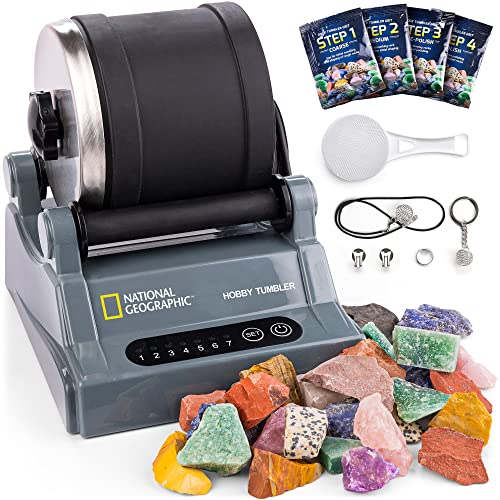
Best for beginners and kids: National Geographic Hobby Rock Tumbler Kit
National Geographic kits bundle the tumbler, grit stages, and rough rocks, so the first batch is ready without extra shopping. The instructions are designed for families and the kits come with guidance for each stage. A larger National Geographic Professional kit adds more rock and jewelry fittings.
Who it suits: kids, gifts, and anyone who wants everything in one box. Main trade-off: the included stones and grit are smaller quantities, so you will buy refills sooner than with a standalone tumbler.
Best dual-barrel: Lortone 33B
The Lortone 33B has two barrels, so you can run a coarse grind in one and a polish stage in the other. That lets you stagger batches and keep the tumbler working all month. Buyers who compare it with the Thumler’s A-R2 should choose on barrel size and the availability of spare belts and liners.
Who it suits: hobbyists who sell or gift polished stones and want steady output. Main trade-off: a higher price and a larger footprint on the workbench.
Best heavy-duty: Thumler’s Model B
The Model B has a steel hex barrel with a removable rubber liner and a 15-lb class capacity. Owners report decades of service, and many call it a buy-it-for-life machine. It is the choice for people who fill a barrel with agate or jasper every month.
Who it suits: rock clubs, lapidary hobbyists, and small sellers. Main trade-off: it is heavy, loud, and priced well above beginner models.
How rock tumbling works: the four stages
- Coarse grind (silicon carbide, around 60/90 grit): shapes the stones and removes sharp edges, typically 7 to 10 days.
- Medium grind (around 120/220 grit): smooths scratches, usually about 7 days.
- Fine grind (around 500 grit): prepares the surface for shine, about 7 days.
- Polish (aluminum oxide or cerium oxide): gives the gloss, about 7 days.
Clean the barrel and rocks thoroughly between stages. Grit from a previous stage left behind will scratch the surface, so wash every stone and the barrel completely before you start the next one.
How to choose a tumbler
- Match barrel size to your supply of rough. If you collect only a few pounds a season, a small barrel is enough.
- Pick rubber barrels for quieter operation. Steel barrels with liners suit bigger machines.
- Choose a dual barrel if you want to keep a batch running at all times.
- Check replacement part availability for belts, bearings, and liners.
- Plan for placement: tumblers run around the clock and can be heard in a quiet home, so a garage or basement is better.
| Your situation | Choose |
|---|---|
| First-time buyer or gift | National Geographic kit |
| A few pounds of rough per season | Lortone 3A or Thumler’s A-R1 |
| Rocks arriving all year | Lortone 33B |
| Bulk tumbling or club use | Thumler’s Model B |
| Testing the hobby cheaply | Thumler’s MP-1 |
Worked example: how long a batch takes
A standard four-stage cycle runs about 7 to 10 days for coarse grind plus roughly 7 days for each of the next three stages. That adds up to about 28 to 31 days per batch. With a 3-lb-class barrel filled two thirds to three quarters, you might finish around 2 lb of rock per month, so a single barrel yields roughly 24 lb a year. A dual barrel can almost double that by running two batches in parallel.
Which rocks tumble well?
Choose stones with similar hardness, as softer ones wear faster and contaminate the mix. Agate, jasper, and quartz sit around 7 on the Mohs scale and are classic choices. Mixing a soft stone like calcite with quartz tends to ruin the batch. Include a mix of sizes in each barrel so stones cushion each other, and add ceramic media if you have too few rocks to fill the barrel.
Common mistakes and what wears first
- Overfilling or underfilling the barrel: aim for about two thirds to three quarters full.
- Skipping the cleanup between stages, which leaves scratches.
- Not venting the barrel: a gas buildup can occur, so release pressure as the maker advises.
- Belts and bearings are the first parts to wear. Keep spares on hand.
- Rubber barrels eventually crack, so inspect them every few batches.
Frequently Asked Questions
What is the best rock tumbler for beginners?
A National Geographic kit is the simplest start because it includes the tumbler, grit, and rocks. If you want a machine you will keep, a Lortone 3A or Thumler’s A-R1 is easier to grow with. Both use the same four-stage process.
How long does it take to tumble rocks?
Plan on about four weeks for a full four-stage cycle. Coarse grind takes the longest at 7 to 10 days. Hard stones like agate and jasper may need extra time in the coarse stage.
Are rubber barrels better than plastic?
Rubber barrels run quieter and last longer, which is why most hobbyist guides recommend them. Plastic barrels are lighter and often come with cheaper kits. If you expect to keep tumbling for years, rubber is a better investment.
How much grit should I use?
Follow the grit maker’s label, which usually calls for a measured amount per pound of rock. Using too little slows grinding, and too much can clog the barrel. Fill the barrel to two thirds or three quarters, then add the specified grit and water.
Can I tumble different rock types together?
It works best with rocks of similar hardness. Soft stones break down faster and add slurry that dulls harder ones. Sort stones by hardness before loading.
Why are my tumbled rocks not shiny?
The most common cause is skipping a thorough cleaning between stages, so coarse grit scratches the polish. Another cause is a worn polish stage or too little time in the fine grind. Clean everything and repeat the fine and polish stages.