Key takeaways
- Compare the best personal water filter straws for hiking: 6 picks by pore size, rated capacity and certifications, plus what straws cannot remove.
The LifeStraw Personal Water Filter is the best overall pick for most hikers: a roughly 2 oz, 9-inch hollow-fiber straw with a 0.2 micron membrane that the brand says removes bacteria and protozoa such as Giardia and Cryptosporidium, with no batteries, pumping or chemicals. A personal water filter straw is a drink-from-the-source filter you sip through directly or screw onto a bottle. Note that a 0.2 micron membrane does not remove viruses or dissolved chemicals, so it fits backcountry streams and lakes in many regions better than questionable water in places with sewage contamination. Multi-pack options from Practical Survival and Membrane Solutions suit groups and emergency kits.
Quick List
- Practical Survival 5-Pack – best for groups and stocking multiple kits with a high-capacity rating
- LifeStraw Personal, 1 pack – best for a single, widely known, simple hiking filter
- Membrane Solutions S1, 4-pack – best for certification-minded buyers who want a bottle-compatible straw
- Practical Survival 2-Pack – best for a pair of filters for two hikers or a spare
- LifeStraw Personal, 5-pack – best for families, scout groups and shared gear
- Unbranded 4-pack with a 0.01 micron claim – best for shoppers who want the finest stated pore size, with claims to verify
Which One Is Right for You?
| If you… | Choose |
|---|---|
| want one reliable straw for solo trips | LifeStraw Personal, 1 pack |
| outfit a group or a set of emergency kits | Practical Survival 5-Pack |
| care about listed NSF/ANSI certifications | Membrane Solutions S1, 4-pack |
| hike as a pair and want a spare | Practical Survival 2-Pack |
| need many straws for a family or troop | LifeStraw Personal, 5-pack |
| are interested in a very fine stated pore size | Unbranded 4-pack (0.01 micron claim) |
Decide first whether you need protection from bacteria and protozoa only, which most straw filters address, or also from viruses and chemicals, which they usually do not. Then choose a pack size that matches the number of people. Treat the capacity numbers on any listing as ceilings rather than promises, because clarity of the water and how carefully you store the straw matter more than the printed gallons. A straw is cheap insurance, but only if you use it correctly and keep it from freezing.
All 6 Picks in Detail
1. Practical Survival Reusable Emergency Water Filter Straws, 5-Pack – Best for groups and emergency kits
As an Amazon Associate we earn from qualifying purchases at no extra cost to you.

This is a five-pack of hollow-fiber straws rated by the maker for up to 1,800 gallons per filter, with no expiration date. The manufacturer says each filter removes at least 99.99 percent of waterborne bacteria and parasites down to 0.1 micron and weighs about 2 oz at roughly 8 inches long. Each filter reportedly comes sealed with a backflushing plunger that helps keep flow steady, which is useful if the straw slows down over time.
The appeal of the five-pack is redundancy and value spread across several kits. Hikers often keep one straw in the pack, one in the car and one in a home emergency kit, and still have two left for friends. Because these filters are marketed as reusable and with no expiration date, the real limit is how well you care for them. Store them dry, backflush them if the plunger is included and discard any that you suspect froze.
- Pack size: 5 filters
- Lifespan rating: up to 1,800 gallons per filter, per the listing
- Pore size: 0.1 micron, per the manufacturer
- Size and weight: about 8 inches and 2 oz, per the manufacturer
- Third-party certification: not stated, confirm on listing
Pros:
- Enough straws for a group or multiple go-bags
- Backflush plunger helps maintain flow
Cons:
- No independent certification is named in the listing
- The lifespan rating is a maximum that depends on water clarity and care
It is nearly the same filter as the Practical Survival 2-Pack, so choose by quantity rather than performance.
2. LifeStraw Personal Water Filter, 1 Pack – Best for a simple solo hiking filter
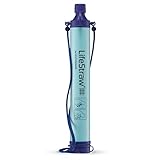
LifeStraw is the best-known name in straw filters. The Personal model is a straw with a 0.2 micron hollow-fiber membrane that the brand says removes 99.9999 percent of bacteria and 99.999 percent of parasites, with no batteries or chemicals. The brand states that it does not remove viruses, salt or chemicals. Brand materials give a lifespan around 1,000 gallons (4,000 liters), while older listings cited 1,000 liters, so confirm the figure for the pack you receive.
Many hikers like this straw because it is simple: no pumping, no tablets and no waiting. You kneel at the water, drink and go. Its limits are also clear. Because it is not designed for viruses or chemicals, it is best matched to routes where bacteria and protozoa are the main concern, and it should be paired with another treatment method if you travel somewhere with higher risk.
- Pack size: 1 filter
- Pore size: 0.2 micron hollow-fiber membrane
- Targets: bacteria and protozoa, per the brand
- Not for viruses, chemicals or salt water
- Weight and size: about 2 oz and 9 inches, per the brand
Pros:
- Simple, light and easy to use at a stream
- Clear manufacturer information about what it does not remove
Cons:
- Only one filter in the pack, so no spare
- You must drink directly from the source or add a bottle-compatible adapter if available
Compared with the Practical Survival filters, it is the better-known name with clearer published limits, while they state a finer 0.1 micron pore size and a higher capacity rating.
3. Membrane Solutions Personal Water Filter Straw S1, 4-Pack – Best for certification-minded buyers
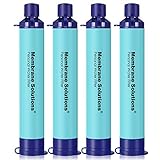
The listing for this four-pack names NSF/ANSI 42, 372 and 401 certification, a 1,320-gallon capacity, a 0.1 micron rating and a fit for 28 mm bottle necks. Those standards cover chlorine and taste (42), lead-free materials (372) and certain particulates and emerging contaminants (401), which is not the same as the protocols for removing bacteria and protozoa. The brand describes a multi-stage design that includes carbon and hollow-fiber membranes, so you get some taste improvement beyond the membrane alone.
The bottle-neck fit is a useful extra. If the straw screws or fits into a standard 28 mm opening, you can fill a bottle, sit down and drink, rather than lying at the edge of a stream. Keep in mind that the certifications named in the listing relate to specific standards, so look at what each number actually covers instead of assuming it means full microbiological purification.
- Pack size: 4 filters
- Capacity: 1,320 gallons, per the listing
- Pore size: 0.1 micron, per the listing
- Certifications named in the listing: NSF/ANSI 42, 372, 401
- Bottle fit: 28 mm necks, per the listing
Pros:
- Certifications are named in the listing title
- Can be used with a compatible bottle, not just as a straw
Cons:
- Capacity rating is lower than the Practical Survival filters
- The named certifications do not mean it is certified as a microbiological purifier, so read the claims carefully
It beats the Practical Survival packs on documentation, though they lead on stated capacity.
4. Practical Survival Reusable Emergency Water Filter Straws, 2-Pack – Best for two hikers

This is the two-pack version of the Practical Survival straw, with the same 1,800-gallon rating and no-expiration positioning on the listing. It suits a pair of hikers, a couple’s emergency kit or a person who wants a spare in the glove box. The brand specifies the same hollow-fiber construction and 0.1 micron pore size as the larger pack.
A two-pack is a sensible purchase for couples and for hikers who want a backup. If one straw clogs or gets damaged, the second keeps the trip safe. Because the listing carries the same rating as the larger pack, the main question is simply how many filters you will actually use. Store the spare in its sealed packaging until you need it.
- Pack size: 2 filters
- Lifespan rating: up to 1,800 gallons per filter, per the listing
- Pore size: 0.1 micron, per the manufacturer
- Weight and size: about 2 oz and 8 inches, per the manufacturer
- Independent certification: not stated, confirm on listing
Pros:
- Right size for a hiking pair
- Spare filter is easy to stash in a pack
Cons:
- No named third-party certification
- Same limits as other 0.1 micron straws: no virus or chemical protection is stated
Choose it over the 5-pack only if you do not need extra straws.
5. LifeStraw Personal Water Filter, 5 Pack – Best for families and troops
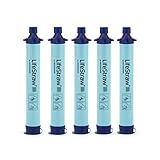
The five-pack gives you the same LifeStraw Personal design in a shareable quantity. It makes sense for scout troops, family camping trips and school emergency kits, where each person gets a labeled straw. The listing names hiking, camping, travel and emergency preparedness as uses. As with the single, the straw has a 0.2 micron membrane and the brand states that it addresses bacteria and parasites but not viruses or chemicals.
Handing every person in a group their own straw avoids sharing mouthpieces and speeds up water stops. Troop leaders and school programs often buy packs like this one for that reason. Write each name on a straw with a permanent marker and remind younger hikers to keep the mouthpiece out of the mud and to blow the water out after drinking.
- Pack size: 5 filters
- Pore size: 0.2 micron hollow-fiber membrane
- Targets: bacteria and protozoa, per the brand
- Not for viruses, chemicals or salt water
- Weight and size: about 2 oz and 9 inches, per the brand
Pros:
- One filter per person in a group
- Same simple design as the best-known single
Cons:
- You must label straws to avoid sharing mouthpieces
- Same limits on viruses and chemicals as the single
It is the group-sized equivalent of the 1 pack, while the Practical Survival 5-pack is its nearest competitor.
6. Personal Water Filter Straw, 4-Pack, 0.01 Micron – Best for shoppers who want the finest stated pore size

This unbranded four-pack is described as a portable water purifier with a 0.01 micron rating for survival gear, emergency preparedness, hiking, camping and travel. A 0.01 micron figure is finer than the 0.1 and 0.2 micron ratings above and, if accurate, would be small enough to address many viruses. However, the listing does not give a brand with a published track record, so confirm what the claim is based on, how the capacity is rated and whether any independent certification exists before relying on it.
Treat the finer pore size as a claim that needs support. A pore rating alone does not tell you how well the filter is built, whether the seals are secure or how it behaves with silty water. If you are considering this pack for areas where viruses are a worry, look for explicit statements and independent verification, or use a product that is clearly rated as a purifier.
- Pack size: 4 filters
- Stated pore size: 0.01 micron, per the listing
- Marketed as a purifier, per the listing; confirm how that term is supported
- Capacity rating: confirm on listing
- Certification: confirm on listing
Pros:
- Finest stated pore size in the group
- Four-pack for sharing
Cons:
- Limited published information about brand and verification standards
- “Purifier” language can overstate what a simple straw does
Its nearest rival is the Membrane Solutions four-pack, which names specific certifications while this one leans on a pore-size claim.
Specs Compared
| Filter | Pack | Pore size | Stated capacity | Certification named | Notes |
|---|---|---|---|---|---|
| Practical Survival 5-Pack | 5 | 0.1 micron | Up to 1,800 gallons each | Confirm on listing | Backflush plunger, per manufacturer |
| LifeStraw Personal 1 pack | 1 | 0.2 micron | Confirm on listing | Confirm on listing | Bacteria and protozoa, per brand |
| Membrane Solutions S1 4-pack | 4 | 0.1 micron | 1,320 gallons | NSF/ANSI 42, 372, 401 | Fits 28 mm bottle necks |
| Practical Survival 2-Pack | 2 | 0.1 micron | Up to 1,800 gallons each | Confirm on listing | Same filter as the 5-pack |
| LifeStraw Personal 5 pack | 5 | 0.2 micron | Confirm on listing | Confirm on listing | Bacteria and protozoa, per brand |
| Unbranded 4-pack | 4 | 0.01 micron (claimed) | Confirm on listing | Confirm on listing | Marketed as a purifier |
How We Chose These
This list comes from published information. We read each listing name and specification field, then compared stated pore size, rated capacity, pack size and any named certifications. We also consulted manufacturer descriptions for LifeStraw, Membrane Solutions and Practical Survival to see what each brand says its filter removes and does not remove. Where a value was missing, we marked it “confirm on listing.” We preferred filters with clear pore-size and capacity statements, honest limits on viruses and chemicals, and packs that match common use cases. Because water safety matters, we flagged claims that could not be verified from the listing alone, such as the 0.01 micron “purifier” description.
What to Look For
What a straw filter does and does not remove
Most straw filters use a hollow-fiber membrane with pores around 0.1 to 0.2 microns. That is small enough to physically block bacteria (typically 0.5 to 5 microns) and protozoan cysts like Giardia and Cryptosporidium (several microns). Viruses are far smaller, often 0.02 to 0.3 microns, so a 0.2 micron membrane does not remove them. Straws also generally do not remove dissolved chemicals, heavy metals, pesticides or salt. If you hike where the main concern is wildlife and livestock contamination in streams, a bacteria-and-protozoa filter is a common choice. If there is a risk of sewage contamination, such as in some travel destinations, use a purifier rated for viruses or add chemical treatment or boiling.
Pore size, capacity and certifications
Smaller pore sizes do not automatically mean a better filter, because flow and clogging also matter. Capacity ratings such as 1,000 or 1,800 gallons are maximums that depend on water clarity; silty water clogs a filter far sooner than clear streams. Third-party standards help you compare claims: NSF/ANSI 42 deals with aesthetic effects such as chlorine taste, NSF/ANSI 372 with lead-free materials and NSF/ANSI 401 with certain emerging contaminants. None of these by itself is the same as the protocol for microbiological removal, so read what the listing says it covers. When a listing offers no certification, rely on the maker’s description and your own judgment about the water source.
Using a straw correctly
Choose the clearest water you can find, ideally flowing rather than stagnant. Do not drink from the straw while standing in the water, and keep the mouthpiece from touching the source. Before first use, follow the maker’s instructions for priming. After use, blow the water out of the straw, let it dry and store it away from contamination. If flow slows, backflush it if the model includes a plunger or syringe, or shake out debris as advised. If you can, prefilter cloudy water through a bandana or coffee filter to extend the filter’s life.
Matching the filter to the trip. For a day hike on a well-used trail with water sources that you can inspect, a straw filter is lightweight insurance that weighs about as much as a granola bar. For a long trek, carry a backup method such as chemical tablets in case the straw clogs or freezes. For international travel, first find out what the water risks are and choose a method that covers them. Remember that a filter is only one layer: choose the clearest source, keep your mouthpiece clean and have a plan if the filter fails.
Choosing your water source. Look for moving water that is clear and cool, upstream of campsites, trails crossing the stream and any sign of livestock. Avoid scummy, foamy or oil-slicked water, since a straw cannot fix chemical or fuel contamination. If the only source is cloudy, let it settle in a bottle first or pre-filter it through a clean cloth. Scoop water from just below the surface rather than the muddy bottom, and never push the mouthpiece into the mud. Rinsing the mouthpiece with treated water before packing it also keeps the next drink cleaner.
Freezing, storage and replacement
Hollow-fiber membranes can crack if water inside them freezes. Manufacturers generally advise discarding a filter that may have frozen, because tiny cracks cannot be seen. In cold weather, keep the straw in an inside pocket or your sleeping bag overnight. Store dry, away from sunlight and chemicals. Replace the filter if flow becomes very slow after backflushing, if it has been dropped hard or if it leaks.
Rule of thumb for pack size
Count the people, then add one spare per trip. A solo hiker needs one straw plus a bottle; a pair of hikers is covered by a 2-pack; a family of four does well with a 5-pack with one spare. Remember that sharing a mouthpiece is a hygiene issue, so label straws for each person.
Questions
Do water filter straws remove viruses?
Most do not. Straws with a 0.1 or 0.2 micron membrane block bacteria and protozoa but are too coarse for most viruses. If virus protection is important, choose a product explicitly rated for viruses or use boiling, chemical treatment or UV in addition.
Can I use a filter straw in a lake or stream?
Yes, in clear water, it is the typical use. Avoid water that looks polluted, smells of chemicals or is downstream of obvious contamination, because straw filters do not remove chemicals.
How long does a filter straw last?
Makers state ratings from about 1,000 to 1,800 gallons, but real life depends on water clarity and care. Clean, flowing streams extend the lifespan; silty water shortens it. Replace the straw when flow stays slow after cleaning.
Can I filter water into a bottle?
Some straws, such as the Membrane Solutions S1, say they fit certain bottle necks. Check the product page for neck size and adapters. Otherwise, you drink straight from the source.
Will a filter straw remove salt or make seawater drinkable?
No. Straw filters do not remove salt, dissolved minerals or chemicals. Do not use them with seawater.
What if the filter freezes?
Treat it as damaged. Ice can crack the hollow fibers, and cracks are not always visible. Replace the filter to be safe.
Update History
- October 20, 2026 – Initial publication; product set drawn from current catalog listings.
- Check the product page for current specifications and availability before buying.
Sources
- Manufacturer product and specification pages for LifeStraw, Membrane Solutions and Practical Survival
- Retailer listing titles and specification fields for all six filters
- NSF/ANSI standard designations (42, 372 and 401) as named in the listings