Key takeaways
- Best use: variable-length trips, business travel, and return journeys with purchases.
- Less useful for: travelers who always pack the same amount and fly strict-size airlines.
- Most important warning: expansion increases exterior dimensions, not the airline’s weight allowance.
Best Briggs & Riley Luggage for Every Trip Type
The best Briggs & Riley luggage depends on one decision first: choose a CX expandable carry-on for frequent short trips, a larger checked Baseline case for maximum packing flexibility, or a lighter Sympatico case when weight and maneuverability matter more than expansion.
Quick picks by trip type
| Trip situation | Best starting point | Why it fits | Main compromise |
|---|---|---|---|
| Two to four days, domestic flights | Baseline Essential 22-inch Carry-On | CX expansion adds packing space while the standard profile is designed for a typical U.S. carry-on limit | Heavy compared with many soft-sided carry-ons |
| International trips with stricter cabin limits | Baseline Global 21-inch Carry-On | Shorter profile is more suitable for airlines with tighter height restrictions | Less room than the larger domestic carry-on |
| One to two weeks, checked luggage | Baseline Essential Large 28-inch Spinner | Large interior, garment organization, and CX expansion for souvenirs or bulky clothing | Expansion can make the case overweight or oversized when full |
| Frequent travel where every pound matters | Sympatico International Carry-On | Lighter construction and a more restrained profile than many Baseline models | Less expandable capacity and less elaborate internal organization |
| Business travel with a garment bag | Baseline Essential 22-inch Carry-On or a matching checked case | Built-in garment panel helps reduce creasing and keeps a suit separate from casual clothing | Garment features take up usable space if you do not carry tailored clothing |
Carry-on versus checked Briggs & Riley luggage
Carry-on dimensions: capacity versus airline fit
The Baseline Essential 22-inch Carry-On is commonly listed at approximately 22 x 14 x 9 inches in its unexpanded configuration. That size is aimed at the widely used U.S. domestic carry-on benchmark, but airline rules differ, and some carriers measure wheels and handles. CX expansion increases the depth by roughly 2 inches, depending on the model and how the measurement is taken.
Our top picks

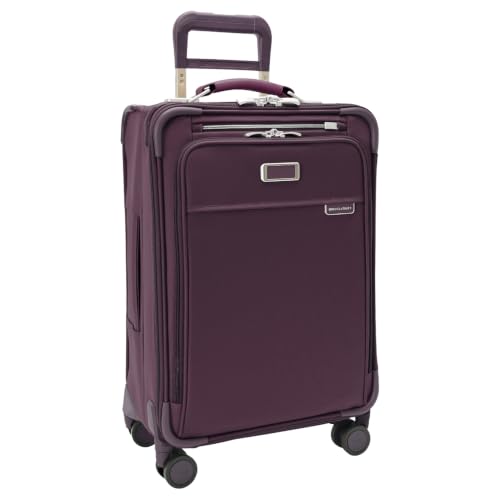


As an Amazon Associate we earn from qualifying purchases at no extra cost to you. Ratings are shown as listed on Amazon.
That extra depth is useful after the case is in the cabin, but it can make the bag unsuitable for the sizer before boarding. Treat the expanded position as a packing feature, not as the everyday airport profile. Pack it closed to the standard depth when you intend to carry it onto the aircraft.
The Baseline Global 21-inch Carry-On is the safer choice for travelers who regularly fly internationally or use airlines with smaller cabin allowances. Its shorter exterior gives you more margin on height, although no suitcase is universally compliant. Check the airline’s published dimensions before each trip, especially when the ticket includes a low-cost carrier.
Checked dimensions: the 62-inch rule matters
A large Briggs & Riley spinner can provide substantially more usable space than a carry-on, but exterior dimensions deserve as much attention as interior volume. Many airlines calculate checked size by adding height, width, and depth. A common standard is 62 linear inches, excluding or including certain parts according to the airline’s policy.
For example, a case measuring 30 x 20 x 12 inches equals 62 linear inches:
30 + 20 + 12 = 62 linear inches.
If CX expansion adds about 2 inches of depth, the same case becomes approximately 64 linear inches. That can trigger an oversize fee even before weight is considered. A large expandable case is therefore most useful when you leave a little empty space or use expansion only on routes whose baggage rules allow it.
How CX expansion changes the buying decision
Briggs & Riley’s CX system lets the case expand outward and then compress back to its original size. The practical advantage is not simply “more room.” It is the ability to travel compactly on the outbound journey and make space for a jacket, gifts, or a second pair of shoes on the return.
- Best use: variable-length trips, business travel, and return journeys with purchases.
- Less useful for: travelers who always pack the same amount and fly strict-size airlines.
- Most important warning: expansion increases exterior dimensions, not the airline’s weight allowance.
Consider the weight limit as well as the volume. If an airline allows 50 pounds and the empty suitcase weighs about 10 pounds, your practical packing allowance is approximately 40 pounds. Filling the expanded compartment with dense items such as shoes, books, or toiletries may use the extra space without leaving enough weight margin.
Baseline versus Sympatico: which range is better?
Choose Baseline for organization and long-term flexibility
Baseline is Briggs & Riley’s more traditional soft-sided premium range. Depending on the model, it combines ballistic nylon, a built-in garment system, compression features, external pockets, and CX expansion. It is particularly well suited to professionals who want one case to handle work clothing, casual clothing, and irregular packing loads.
The trade-off is weight. A feature-rich Baseline carry-on can weigh around 9 to 10 pounds empty, leaving less of a typical 50-pound checked allowance for clothing. Its fabric exterior also needs sensible handling: do not drag it through standing water, and avoid overloading exterior pockets until the bag becomes difficult to maneuver.
Choose Sympatico for a lighter, cleaner packing system
Sympatico uses a more streamlined design and is often the better match for travelers who prioritize a lighter case, a structured interior, and easy rolling. It generally offers less of the Baseline range’s expandable, garment-focused organization. That makes it a good choice for short trips, simple wardrobes, and travelers who prefer packing cubes over built-in compartments.
The decision is not about which line is universally superior. It is about whether your extra capacity comes from the suitcase’s hardware and organization or from a lighter shell with fewer built-in features.
What the lifetime warranty actually covers
Briggs & Riley’s lifetime guarantee is valuable because it is intended to cover repair of functional damage for the life of the bag, subject to the company’s current warranty terms. It is not an unconditional promise that every mark or failure will be replaced with a new suitcase.
Covered problems commonly include functional failures such as:
- broken wheels or wheel housings;
- damaged handles and telescoping handle assemblies;
- failed zippers or zipper pulls;
- separated seams that affect use;
- other defects or damage that prevent the luggage from working as intended.
Airline damage is an important part of the ownership proposition. Functional damage caused during airline or transportation handling may be eligible for repair under the guarantee, so a cracked frame, damaged wheel, or unusable handle is not automatically the traveler’s loss. Photograph the suitcase before leaving the baggage area, keep the baggage report and flight details, and contact Briggs & Riley promptly. The company may request documentation and will determine whether the issue qualifies under the current policy.
The guarantee generally does not mean that cosmetic wear is covered. Scratches, scuffs, stains, fabric abrasion, dents that do not affect operation, and ordinary fading are normal consequences of travel and may not qualify. Damage from misuse, unauthorized alterations, or improper care can also fall outside coverage. Policies and procedures can change, so verify the current terms before relying on warranty service for a particular incident.
Ownership realities: what wears first
On frequently used luggage, wheels, handles, zipper pulls, and the lower corners usually show problems before the main fabric or case structure. Wheel bearings collect grit; telescoping handles can become stiff when dirt enters the tracks; and overfilled compartments strain zippers and seams.
A simple maintenance routine
- Empty every pocket after a trip, including the small compartments where grit and receipts accumulate.
- Wipe fabric with a lightly damp cloth and mild soap; test an inconspicuous area first and avoid saturating the lining.
- Remove hair and debris from wheel housings with a soft brush.
- Operate the handle and zippers gently rather than forcing them around an overpacked corner.
- Store the case expanded only if the storage space is dry and the fabric is fully clean.
- Report functional damage before attempting a third-party repair, since unauthorized work may complicate a warranty claim.
A common mistake is using CX expansion to solve an overpacking problem. Expansion gives more volume, but it does not make a heavy bag lighter or guarantee that the expanded dimensions remain airline-compliant.
Final recommendation
For most domestic travelers, the Baseline Essential 22-inch Carry-On is the strongest all-purpose choice because it combines a conventional carry-on profile with useful CX expansion. Choose the Baseline Global 21-inch when international cabin limits are the priority, and choose a large Baseline checked spinner when organization and return-trip flexibility matter more than empty-case weight. If you pack simply and want to conserve every possible pound, compare the Sympatico International Carry-On before paying for Baseline’s additional features.
The best Briggs & Riley luggage is ultimately the case whose unexpanded dimensions fit your airlines, whose empty weight leaves enough allowance for your packing habits, and whose warranty benefits match how often you travel. CX expansion and lifetime repair coverage are meaningful advantages, but they work best when you stay within airline size and weight rules and distinguish functional damage from normal cosmetic wear.