Key takeaways
- Jump starting: Check the stated peak current, supported engine size, battery type, and whether cables and clamps are included. Portable lithium jump starters are different from traditional jumper cables; they do not need another vehicle, but must be charged and used as instructed.
- Tire inflation: Look for a 12-volt compressor with a stated maximum pressure and a readable gauge. A 100–150 PSI rating is common, but that figure is a ceiling—not a promise of fast inflation at that pressure. A useful inflator also needs a hose long enough to reach all tires and a connector compatible with your valve stems.
- Visibility and first aid: Prefer a reflective warning triangle or LED beacon, a vest, and a first-aid pouch with identifiable basics such as adhesive bandages, gauze pads, and antiseptic wipes. Item counts alone do not tell you whether supplies are sufficient or still in date.
- Vehicle fit: Small cars need less storage space than SUVs, but engine size, cold-weather conditions, and whether you travel alone can change what is sensible to carry. Check your owner’s manual before using electrical equipment or lifting a vehicle.
Best Car Emergency Roadside Kits for Every Driver
The best car emergency roadside kit for most drivers is a compact kit with a 12-volt tire inflator, a 1,000-amp-or-higher jump starter, basic first aid, and a separate reflective warning device; buying those essentials individually usually costs about $100–$190, so a bundled kit is worthwhile only when its components meet useful specifications.
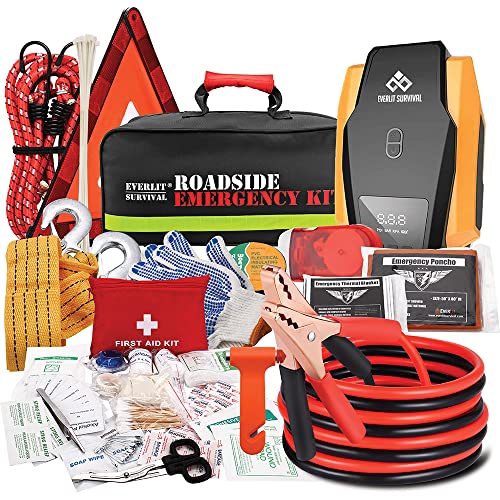
One catch: “roadside kit” can mean a bag of hand tools and safety gear, a jump starter and inflator, or both. Compare the inventory, not the number of pieces. A kit that counts zip ties and tiny bandages as separate items may have less practical value than a smaller, better-specified set.
Our top picks


As an Amazon Associate we earn from qualifying purchases at no extra cost to you. Ratings are shown as listed on Amazon.
What to look for before choosing
- Jump starting: Check the stated peak current, supported engine size, battery type, and whether cables and clamps are included. Portable lithium jump starters are different from traditional jumper cables; they do not need another vehicle, but must be charged and used as instructed.
- Tire inflation: Look for a 12-volt compressor with a stated maximum pressure and a readable gauge. A 100–150 PSI rating is common, but that figure is a ceiling—not a promise of fast inflation at that pressure. A useful inflator also needs a hose long enough to reach all tires and a connector compatible with your valve stems.
- Visibility and first aid: Prefer a reflective warning triangle or LED beacon, a vest, and a first-aid pouch with identifiable basics such as adhesive bandages, gauze pads, and antiseptic wipes. Item counts alone do not tell you whether supplies are sufficient or still in date.
- Vehicle fit: Small cars need less storage space than SUVs, but engine size, cold-weather conditions, and whether you travel alone can change what is sensible to carry. Check your owner’s manual before using electrical equipment or lifting a vehicle.
Compare the kit types—and the cost of assembling them
Specifications and prices vary by brand and model. The figures below are practical shopping targets and broad U.S. market ranges, not claims about one particular package. Check the exact product listing and manual: many conventional kits include cables but no jump starter or air compressor.
| Option | What it should include | Typical price range | Best fit |
|---|---|---|---|
| Basic safety kit | Reflective triangle, vest, gloves, flashlight, basic first aid, simple tools | $25–$60 | Drivers who already own a jump solution and inflator |
| Jump-start bundle | Portable lithium starter, clamps, charging cable; some include a light or inflator | $60–$150 | Drivers who want to restart a vehicle without waiting for another car |
| All-in-one roadside kit | Safety supplies and tools; contents may include cables, an inflator, or a battery starter | $40–$180 | Buyers who want one organized bag and have verified its key specifications |
| Build-your-own essentials | 12-gauge, 16-foot jumper cables; 12-volt, 100–150 PSI inflator; triangle, vest, gloves, and first aid | $100–$190 | Drivers who want to select each component separately |
The build-your-own estimate assumes roughly $25–$45 for suitable cables, $25–$50 for an inflator, $20–$45 for visibility and basic safety gear, and $15–$50 for first aid and small tools. Add a portable jump starter and the total commonly rises by another $40–$120. These are broad component-price ranges; premium equipment and unusually small or large kits can fall outside them.
Choose by your driving situation
| Your situation | A sensible choice | Why |
|---|---|---|
| Tight budget; mostly short urban trips | Safety kit plus properly rated jumper cables | Lower upfront cost if another vehicle can help. Cables are useful only when a safe, compatible jump source is available. |
| New driver or limited roadside experience | Jump starter with clear instructions, inflator with an automatic shutoff, and triangle | Self-contained equipment can reduce dependence on another driver. Practice using it while parked at home. |
| Long rural drives or winter travel | Higher-capacity, vehicle-compatible jump starter; inflator; warm layers; light; water | Help may take longer to arrive, and cold can reduce battery performance. Keep the starter charged and follow its temperature guidance. |
| Minimal trunk space | Compact starter and a small safety pouch | Prioritize a flashlight, reflective warning gear, gloves, and first aid; avoid paying for bulky tools you cannot store securely. |
| Several vehicles or frequent road trips | Separate, vehicle-appropriate kits or one kit with verified compatibility | A single starter or cable set may not suit every engine or battery arrangement. Check each vehicle’s manual and the equipment rating. |
Which configuration is worth buying?
For most drivers: a compact, specified bundle
Choose a bundle only if its listing names the important parts: starter capacity and compatible engine size, inflator pressure and power source, cable length and gauge if cables are included, and the contents of the first-aid pouch. For a common sedan, a 1,000-amp-or-higher peak-current starter is a reasonable starting point for comparison, but peak amps alone do not guarantee compatibility. Follow the manufacturer’s vehicle guidance.
If the kit substitutes a small USB-powered pump for a 12-volt compressor, or has no visible warning device, price those items separately. A bundle is not a bargain when its most important component has no meaningful specification.
For a low-cost setup: cables and a separate safety kit
Look for copper or copper-clad-aluminum cables around 12 gauge and 16 feet long for general passenger-car use. Thicker conductors have lower gauge numbers. Cable gauge, length, clamp quality, and the vehicle’s requirements all matter; an inexpensive, thin, short set may be awkward or unsuitable. This setup is cheaper than buying a jump starter but depends on finding another compatible vehicle and a safe place to work.
For remote travel: buy for independence, then add supplies
A jump starter and inflator help with two common problems but do not replace roadside assistance, a spare tire, or safe judgment. Add a warm blanket or layer, drinking water, a phone charging cable, and any necessary personal supplies. Keep emergency items accessible rather than buried under luggage.
Check the details that piece counts hide
First-aid inventories vary widely. Count usable categories—bandages, gauze, tape, antiseptic wipes, and gloves—rather than relying on a headline such as “100 pieces.” Small travel pouches are for minor first aid, not a substitute for medical care. Check expiration dates and replace used or damaged items.
For an inflator, compare its power connection and operating instructions as well as its maximum PSI. Some connect to a 12-volt outlet; others use a vehicle battery or rechargeable battery. Do not assume every outlet can handle every compressor. Never exceed the tire pressure shown on the vehicle’s tire placard, and check pressure when tires are cold if the vehicle manual recommends it.
Warning triangles, lights, and reflective vests are useful only if accessible and safe to deploy. On a highway shoulder, prioritize getting occupants away from traffic and follow local rules; do not attempt a repair in an unsafe location.
Ownership: the maintenance that protects your purchase
- Recharge jump starters: Check the charge indicator on a regular schedule and after use. Storage recommendations differ by model; follow the manual rather than leaving a lithium battery forgotten for years.
- Inspect cables and clamps: Replace cables with cracked insulation, loose clamps, or corrosion. Keep clamps from touching each other or metal surfaces during use.
- Run the inflator briefly: Periodic checks can reveal a dead battery, damaged hose, or missing adapter before an emergency. Let the unit cool as instructed; compressors can become hot during operation.
- Refresh consumables: Replace expired first-aid items, used batteries, and damaged reflective gear. Secure the bag so equipment does not become a projectile in a collision.
For a quick value check, compare the bundle price with the cost of its usable parts—not its advertised piece count. If a $90 kit contains a $50 starter, a $25 inflator, and $15 of useful safety supplies, it roughly matches the separate-purchase estimate. If its “starter” is only cables and its inflator is absent, compare it instead with a $25–$60 basic safety kit plus the cost of the missing components.