Key takeaways
- Paper records, passports, and small valuables: Give priority to a recognized fire rating and interior dimensions that let papers lie flat. A 1-hour rating is a useful comparison point, but does not mean contents remain safe in every house fire.
- Documents at risk from leaks or sprinklers: Look for a water rating with stated depth and duration, not just “waterproof” in a headline. A floor location can be exposed to pooled water, so a tested seal and installation above likely standing-water level matter.
- Frequent access: An electronic lock is convenient if you can replace its batteries and follow the manufacturer’s instructions. A mechanical combination lock avoids batteries but takes longer to operate.
- Rental or finished home: A heavy safe may be difficult to move, but anchoring it may require permission and suitable structure. Confirm installation rules before ordering.
- Large binders, camera equipment, or heirlooms: Measure the items and compare the clear opening as well as interior volume. A safe can have adequate cubic feet yet still have a door opening too narrow for what you plan to store.
Best High-End Fireproof Waterproof Floor Safes
The best high-end fireproof and waterproof floor safes for home are models whose independently verified fire and water ratings match what you need to protect, with enough interior space, a practical lock, and an installation plan that keeps the safe anchored and accessible. For most homeowners, compare fire duration and temperature, water-protection conditions, certification details, and floor construction before comparing convenience features.
High-end floor safes compared
The models below are established safe lines, but ratings vary by model and size. Treat the numbers as representative specifications, not guarantees for every configuration: confirm the exact model’s current label and documentation before purchase. Capacity is approximate and can differ by interior layout.
Our top picks
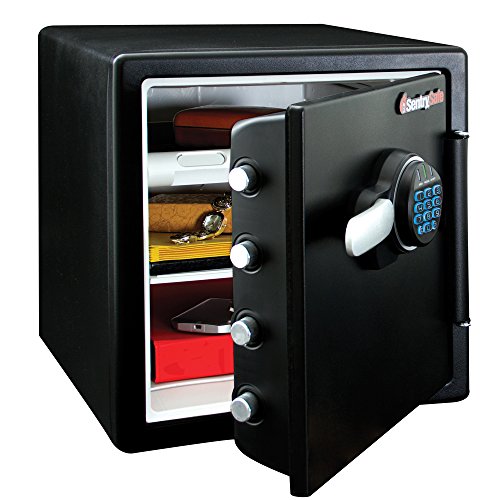


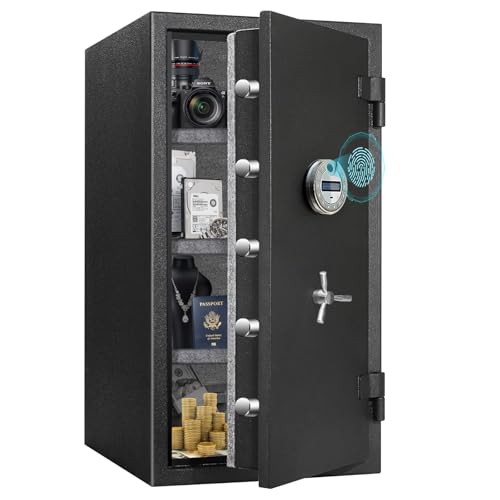
As an Amazon Associate we earn from qualifying purchases at no extra cost to you. Ratings are shown as listed on Amazon.
| Safe line | Fire protection | Water protection | Construction and lock options | Approximate capacity | Best fit |
|---|---|---|---|---|---|
| AMSEC BF series | Many models are UL-listed for 1 hour at 1,850°F | Water resistance varies by model; verify the specific rating | Heavy steel body and door with composite fire insulation; mechanical or electronic lock options depend on model | About 1.4–2.5 cu. ft. across common sizes | Buyers prioritizing a recognized fire rating and substantial construction |
| Gardall FB series | Selected models carry a 1-hour fire rating; confirm the exact certification | Some models offer water resistance; check the model’s test conditions | Steel construction with fire-resistant insulation; key, mechanical combination, or electronic options vary | Roughly 1.1–2.4 cu. ft. | Households seeking several size and lock configurations |
| Hollon RH series | Selected models are rated for 1 hour at 1,700°F; verify model documentation | Water protection is model-specific | Steel shell and door with fire-resistant fill; lock type depends on the configuration | About 1.3–2.8 cu. ft. | Buyers comparing rated protection across multiple capacities |
| Stealth EGS series | Selected models advertise a 1-hour fire rating; check whether the claim is independently certified | Selected models advertise water protection; confirm the test and duration | Steel construction, with electronic lock configurations on some models | Approximately 1.5–2.5 cu. ft. | People who want electronic access and a larger safe footprint |
These capacity ranges are for comparison, not a substitute for checking internal dimensions. Insulation reduces usable space, and shelves or door organizers can make the interior less suitable for bulky items.
Choose by the risk and the room
- Paper records, passports, and small valuables: Give priority to a recognized fire rating and interior dimensions that let papers lie flat. A 1-hour rating is a useful comparison point, but does not mean contents remain safe in every house fire.
- Documents at risk from leaks or sprinklers: Look for a water rating with stated depth and duration, not just “waterproof” in a headline. A floor location can be exposed to pooled water, so a tested seal and installation above likely standing-water level matter.
- Frequent access: An electronic lock is convenient if you can replace its batteries and follow the manufacturer’s instructions. A mechanical combination lock avoids batteries but takes longer to operate.
- Rental or finished home: A heavy safe may be difficult to move, but anchoring it may require permission and suitable structure. Confirm installation rules before ordering.
- Large binders, camera equipment, or heirlooms: Measure the items and compare the clear opening as well as interior volume. A safe can have adequate cubic feet yet still have a door opening too narrow for what you plan to store.
What the ratings do—and do not—tell you
Fire rating and certification
UL fire-resistance classifications specify a test exposure and temperature limit for maintaining the interior below a threshold. For example, a UL Class 350 rating is intended to keep the interior below 350°F during the specified test. That threshold is relevant to paper, but not necessarily to delicate digital media, which may need a much lower temperature and humidity exposure. Check whether the safe itself is UL-listed or whether the seller is describing a manufacturer test; these are not interchangeable claims.
Fire ratings are time-limited lab results, not a promise that the safe will survive any fire. A longer or hotter fire, an impact from a collapsing floor, or a location near fuel can exceed tested conditions. If protecting data drives or photographic media, look for a dedicated media-rated container or use a separate fire-resistant media insert, and verify its rating.
Water claims and installation
Water protection may be tested for a particular depth and duration, and some claims apply only when the safe is closed and properly latched. Ask for the test standard, depth, duration, and whether the safe was tested after a fire exposure. “Water-resistant” and “waterproof” alone do not provide enough information to compare products.
Floor safes are not automatically safer from water because they sit low. Basements and ground-floor rooms can flood, and a floor drain may fail. Avoid placing a safe where water routinely collects; if flooding is plausible, position it on a stable raised platform that does not interfere with anchoring or the manufacturer’s installation requirements.
Steel, locks, and usable capacity
Thicker steel can improve resistance to prying, but steel thickness alone does not establish burglary resistance. Door design, boltwork, hinge protection, weld quality, and anchoring all matter. A fire safe is primarily designed to protect contents from heat; do not assume its fire certification means it offers a high burglary rating. For jewelry or substantial cash, look for a separately stated burglary classification and consider a safe designed for that threat.
A mechanical combination lock has no battery to maintain, though its dial and mechanism still need careful handling. Electronic locks offer quicker entry and may support user codes, but batteries are consumables. Use the battery type specified by the manufacturer, replace batteries on schedule, and keep the override key or recovery instructions secure—not inside the safe. A key lock is simple, but losing or misplacing the key becomes the main access risk.
Compare internal width, depth, and height, not capacity alone. As a practical check, measure the largest item in each direction, add room to remove it without scraping, then compare those measurements with the safe’s listed usable interior. Leave space for the door swing and shelves, too.
Installation checklist for a floor safe
- Check the floor structure. Confirm the safe’s loaded weight is appropriate for the slab or floor. A heavy unit on an upper story may need a structural professional’s advice.
- Plan the route. Measure doorways, stairs, turns, and the final opening. Safe weight can make delivery and placement a specialist job.
- Choose the anchor point. Concrete slabs generally allow direct anchoring; wood floors require a suitable connection to structural framing. Follow the safe maker’s instructions and use compatible anchors.
- Check building services. Before drilling or cutting, identify plumbing, electrical lines, heating, and any floor heating. For an in-floor installation, have a qualified installer assess the location and waterproofing details.
- Test access and sealing. Confirm the door opens fully, the safe is level, and the gasket is not obstructed. Keep the combination or recovery information in a secure location separate from the safe.
Do not bury or encase a safe unless its manufacturer explicitly permits that installation. An installation that blocks ventilation, damages a seal, or prevents service can undermine the protection or complicate future access.
Ownership realities worth planning for
Door seals, batteries, and lock components are the parts most likely to need attention over time. Keep the gasket clean and free of dust, avoid solvents unless the manufacturer approves them, and inspect for cracks or compression that could compromise a water seal. Do not oil a lock unless its instructions call for it: the wrong lubricant can collect dirt or interfere with the mechanism.
After a fire or flood, do not assume the safe is undamaged because it opens. Have the manufacturer or a qualified safe technician inspect the lock, seal, and body before relying on it again. Keep an inventory of contents and take photos stored separately; a safe protects objects, but it cannot document what was inside.
Bottom line
For a home safe, start with the exact fire and water test documentation, then size the interior around your largest items. Choose a mechanical lock for battery-free operation or an electronic lock for quicker everyday access, and treat anchoring and floor suitability as part of the purchase—not an afterthought. A certified rating, correctly installed safe, and realistic fit are more valuable than a broad “fireproof and waterproof” claim.