Our Top Picks
 Donner Bluetooth 5.0 Stereo Audio Amplifier Receiver440W13.78 x 3.54 x 8.27 inches9.1 poundsCheck on Amazon
 Zoom AMS-44 USB Audio Interface for Musicians &2.306.1 x 5.63 x 2.28 inches0.7 PoundsCheck on Amazon

If you want the short answer: the Zoom AMS-44 is the best multi channel audio interface for most people buying in 2026. It gives you four analog inputs and four outputs that record as discrete channels over USB, conversion up to the 96 kHz class, loopback routing for streaming, and — unusually for this category — the option to run on two AA batteries when there is no powered USB port within reach. It suits podcasters running two or three mics plus a phone call, singer-songwriters tracking a stereo instrument and a vocal at the same time, and anyone who moves between a desk and a live room. If your ceiling is much higher, the MOTU 16A is the premium answer at 16 analog in and 16 analog out in a single rack space. If your budget is the constraint, the CIXUN 2×2 USB-C covers a clean two-channel recording path for the least money. Everything below is organized around the six things that actually decide a multi-channel purchase: simultaneous input count, preamp quality, converter specifications, driver stability, monitoring options, and whether the box belongs on a desktop or in a rack.
Top 3 Picks
Best overall: Zoom AMS-44
The AMS-44 hits the sweet spot that most buyers are actually shopping for — four real channels, not a stereo mix pretending to be four. Its four-in/four-out layout covers a two-mic podcast plus a stereo music bed, or a vocal plus a stereo keyboard plus a DI, and it does so in a body small enough to live in a laptop bag. The battery option is the feature nobody else in this list offers at this channel count, and loopback makes it a genuinely practical streaming interface rather than a recording-only box.
Best budget: CIXUN 2×2 USB-C Audio Interface
If you need one microphone and one instrument recorded cleanly to a computer and nothing more, the CIXUN 2×2 does the job at the lowest entry point here. USB-C connectivity means it works with current laptops and tablets without a dongle chain, and a 2-in/2-out layout is the honest starting point for a first recording setup. The trade-off is channel count: two inputs is a hard ceiling, and you will outgrow it the first time you want to record a second microphone.
Best premium: MOTU 16A
The 16A is a different category of tool — 16 balanced analog inputs and 16 balanced analog outputs in a single rack space, with ADAT optical expansion, AVB networking, and an on-board mixing and effects engine. It suits a permanent studio, a synth-heavy room, or a multichannel monitoring rig where you want every source live at once and patchable without repatching. It costs more than everything else in this list combined, and it is worth it only if you have already outgrown four channels and need the routing to prove it.
Quick Comparison
| Product | Best for | Analog in / out | Conversion class | Power | Fit | Price tier |
|---|---|---|---|---|---|---|
| Roland GO:MIXER STUDIO | Phone-first creators filming and livestreaming | Multiple sources (mic, instrument, stereo line, 3.5 mm) summed to stereo out | 24-bit class, 44.1/48 kHz family | Bus power from phone or laptop | Palm-size desktop | Premium |
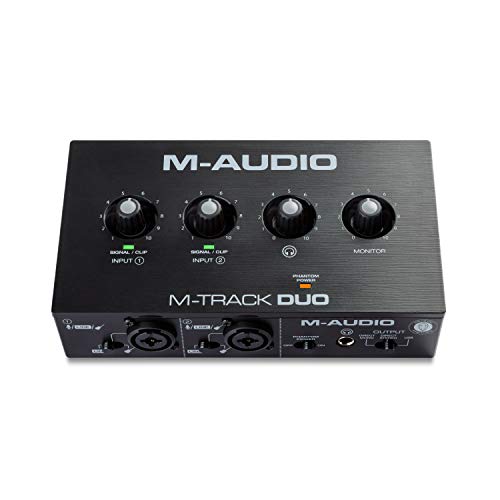
| M-AUDIO M-Track Duo | First two-channel home studio | 2 in (combo XLR/TRS) / 2 out + headphone | 24-bit / 48 kHz | USB bus power | Desktop | Mid-range |
| Donner Bluetooth 5.0 Stereo Amplifier Receiver | Playback zones and passive speaker switching | 4 channels of amplification, 440 W peak, no recording path | Analog amplifier — no conversion stage | Mains AC | Shelf or cabinet | Mid-range |
| Zoom AMS-44 | Portable four-channel recording and streaming | 4 in / 4 out, combo mic/line plus line-level channels | Up to 24-bit / 96 kHz | USB bus or 2× AA batteries | Desktop, bag-friendly | Mid-range |
| CIXUN 2×2 USB-C Audio Interface | Cheapest credible stereo recording path | 2 in / 2 out | 24-bit class, 48–96 kHz class | USB-C bus power | Desktop | Budget |
| Movo UMX-2 | Four-mic podcast and production desks | 4-channel in / USB and USB-C out | 24-bit class | USB bus power | Desktop | Mid-range |
| MOTU 16A | Rack-scale routing and high channel counts | 16 analog in / 16 analog out, plus ADAT and AVB | Up to 192 kHz class, premium converter chips | Mains AC, 1U rack | Rack (1U, 19 in) | Premium |
| Riworal 6 Channel Sound Board Mixing Console | Budget live mixing with on-board effects | 6 channels with +48 V phantom, stereo USB path | 16-bit DSP effects engine | Mains AC | Desktop console | Budget |
| STABCL Mini 6-Channel Audio Mixer | Sub-mixing keyboards and line-level gear | 6 line-level inputs on 6.35 mm and 3.5 mm jacks, stereo out | Analog summing — no converter | Mains or USB | Mini desktop | Budget |
How We Chose
Selection started with published specifications rather than brand familiarity. For each candidate we compared the number of inputs that can be recorded simultaneously — the number that actually matters, not the total jack count — against the class of preamp it uses, the phantom power provision, the converter specifications the maker publishes, and the sample rates supported. We then looked at driver history and platform support: whether the device is class compliant on macOS and iOS, whether a vendor ASIO driver exists for Windows, and whether the connection is USB, USB-C, Thunderbolt, or network audio. Monitoring came next, because a multi-channel interface with one headphone output and no direct monitoring is a different tool from one with hardware cue mixing and loopback.
Finally we weighed form factor and upgrade path. A desktop box with top-mounted controls and a rack unit with rear-panel connectors solve different problems, and the ability to add channels later through ADAT optical, AVB, or word-clock expansion changes how long a purchase stays useful. Where a listing name does not state an exact figure, we describe the specification class rather than guessing at a number, and we flag anything a buyer should confirm on the listing before ordering. Nothing here is based on physical evaluation of the units — the analysis is built from manufacturer documentation, category norms, and the ownership patterns reported by long-term users.
1. Roland GO:MIXER STUDIO – Best for Smartphone-First Content Creators
As an Amazon Associate we earn from qualifying purchases at no extra cost to you.

The GO:MIXER STUDIO is built for a specific person: someone whose camera is a phone and whose recorder is that same phone. It is a palm-sized mixer and interface that mounts in-line with a mobile device, letting you bring a microphone, an instrument, a stereo line source, and a consumer 3.5 mm feed together and send the result into the phone as a stereo stream. If your workflow is filming performance videos, livestreaming, or recording a podcast where the phone is the host, this is the most direct path from source to finished file. It suits solo creators, music teachers recording lessons, and players who want hardware faders instead of a screen.
- Form factor: palm-sized desktop mixer/interface designed around a phone mount
- Inputs: combo microphone input (XLR/TRS class), instrument input, stereo line input, consumer 3.5 mm input
- Outputs: stereo USB stream to phone or computer, plus headphone monitoring
- Conversion: 24-bit class at the 44.1/48 kHz family of rates
- Power: bus-powered from the connected phone or laptop
- Control: hardware level controls and a monitoring blend, no software required
The critical thing to understand about this device — and the thing that decides whether it is right for you — is what the phone actually receives. It receives a stereo mix. The mixer sums your microphone, instrument, and line sources into a two-channel stream, which means you get the convenience of a hardware mixing surface and the portability of a pocket-sized box, but you do not get four discrete tracks you can rebalance later. If a vocal is too loud in the take, it is too loud. That is not a flaw, it is the design: the GO:MIXER family exists to make live-to-stereo capture effortless, and it does that extremely well.
Where it earns its premium tier is in the workflow compression. There is no computer in the signal path, no driver to install, no DAW session to set up before the moment passes. You plug in, set levels on physical controls, and hit record on the phone. For creators who publish performance content, that reduction in friction is worth more than extra channels they would never route. Monitoring is handled through the headphone output with a blend control, so you can hear your sources without a separate headphone amp.
Pros
- Phone-first design removes the computer from the recording chain entirely
- Multiple source types — mic, instrument, stereo line, 3.5 mm — in one pocketable box
- Physical controls make live level changes possible while filming
- Bus powered, so no wall supply and no cable spaghetti on location
Cons
- The USB output is a stereo mix, not discrete multitrack channels
- Premium tier pricing for a device with fewer recorded channels than cheaper interfaces
- Fixed 44.1/48 kHz family of rates limits high-sample-rate work
- Not the right tool if you need to edit individual sources after the fact
Compared with the nearest alternative in this list, the choice comes down to whether you want a stereo mix or discrete channels. The Zoom AMS-44 records four separate channels that arrive in your software as four tracks, and it can run on AA batteries — but it assumes you are working into a computer or a mobile device with a recording app rather than a camera app. If you edit in a DAW, take the AMS-44. If you publish what you capture, the GO:MIXER STUDIO is the shorter road.
2. M-AUDIO M-Track Duo – Best for Singer-Songwriters on a Starter Setup

The M-Track Duo is the classic first interface, and it remains the right recommendation for a solo performer who needs one microphone and one instrument recorded at the same time. Two combo inputs accept either an XLR microphone or a 1/4-inch line or instrument cable, so a vocal mic and a guitar can be live simultaneously without swapping anything. M-Audio has been building budget interfaces for a long time, and the M-Track line is the reference point against which every other entry-level box gets compared. It suits beginners, home demo makers, and anyone who wants a two-channel setup that simply works.
- Inputs: 2 combo XLR/TRS inputs, switchable +48 V phantom power for condenser microphones
- Outputs: balanced TRS main outputs plus a headphone output
- Conversion: 24-bit / 48 kHz
- Monitoring: direct monitoring with a blend control between input and playback
- Power: USB bus powered — no external supply required
- Platform: class compliant on macOS and iOS; a vendor ASIO driver is typically used on Windows
Two channels is a real limitation and also a real strength. Limitation, because the moment you want a second microphone — a co-host, a second guitar amp, a stereo keyboard — you are out of inputs. Strength, because a two-input interface forces decisions about arrangement rather than chasing channel counts, and 24-bit/48 kHz capture is genuinely sufficient for release-quality material in most genres. The 48 kHz ceiling is worth understanding rather than dismissing: 24-bit depth is what determines dynamic range and noise floor, while sample rate mainly determines the highest frequency that can be represented. Going from 48 kHz to 96 kHz doubles file size and processing load for a difference most listeners cannot identify.
The Duo’s practical appeal is its monitoring path. Direct monitoring lets you hear your input without a round trip through the computer, which removes the latency that makes performers hesitate. Combined with a blend control, you can sit between “all input” and “all playback” depending on whether you are tracking or overdubbing. Both inputs carry phantom power, which matters if you are running a condenser microphone — and it is the feature budget interfaces most often omit or restrict to a single channel.
Pros
- Two combo inputs with phantom power cover the standard vocal-plus-instrument session
- Direct monitoring with a blend control removes performance-killing latency
- Bus powered and compact, with a straightforward control layout
- Well-documented driver and platform support across macOS, Windows, and iOS
Cons
- Only two simultaneous inputs — no path to a multi-mic session
- 48 kHz maximum sample rate
- No digital expansion port, so there is no way to add channels later
- No loopback routing for streaming a computer’s audio alongside a microphone
The nearest alternative here is the CIXUN 2×2, which occupies the same two-in/two-out territory at a lower price tier. The M-Track Duo’s advantage is brand track record, driver maturity, and a phantom power implementation you can rely on for a condenser mic. The CIXUN’s advantage is cost and USB-C connectivity out of the box. If your budget genuinely ends at the bottom tier, the CIXUN will record a clean two-channel take; if you want the more predictable long-term experience, the Duo is the safer mid-range pick. Either way, both are two-channel boxes — if you need four, look at the Zoom AMS-44 or Movo UMX-2 instead.
3. Donner Bluetooth 5.0 Stereo Audio Amplifier Receiver – Best for Playback Zones and Speaker Switching

This one needs an honest framing, because the listing sits in “multi-channel” searches and is not a recording interface at all. The Donner unit is a stereo power amplifier and receiver: it takes line-level and Bluetooth sources and drives passive loudspeakers. Its “4 channel” description refers to four channels of amplification — typically two stereo zones, or an A/B speaker arrangement — rated at 440 W peak. It suits someone powering speakers in two rooms, switching between a pair of bookshelf speakers and a pair of outdoor speakers, or driving a set of passive monitors that no powered speaker can replace.
- Function: stereo power amplifier and source receiver for passive speakers
- Channels: 4 channels of amplification, 440 W peak total
- Wireless: Bluetooth 5.0 input for streaming from phones and tablets
- Recording path: none — there are no microphone preamps, no phantom power, and no USB audio interface
- Power: mains AC
The number worth doing arithmetic on is that 440 W peak figure. Peak ratings describe brief transients, not sustained output, and amplifier marketing in this class leans on them heavily. If 440 W peak is spread across four channels, that is roughly 110 W of peak per channel. Continuous RMS ratings for amplifiers of this type usually land somewhere between a third and a half of the peak number, so a realistic planning figure is in the neighborhood of 35 to 55 W per channel of continuous power. That is plenty for efficient bookshelf speakers in a normal room, and marginal for inefficient low-impedance floorstanders driven at high volume. Match the amplifier to your speakers’ sensitivity and nominal impedance — 4 ohm loads demand more current than 8 ohm loads, and a cheap amplifier asked to drive 4 ohm speakers hard is where distortion and heat show up first.
What this device cannot do is record. There is no XLR input, no instrument input, no phantom power, and no USB audio path into a computer. If you arrived here searching for a way to capture multiple microphones, this is the wrong box and the right category is the interfaces above it. If you arrived here because you need to amplify a stereo pair, or switch between two speaker pairs from one chassis with Bluetooth convenience, then it does exactly what the listing claims.
Pros
- Four channels of amplification allow two speaker zones from one unit
- Bluetooth 5.0 input removes the need for a separate streamer
- Straightforward speaker-level wiring for passive cabinets
- Useful for workshop, garage, and multi-room playback setups
Cons
- Records nothing — no preamps, no phantom power, no USB audio interface
- Peak wattage ratings overstate real continuous output
- Bluetooth introduces its own compression and latency versus a wired source
- Not a substitute for a studio monitor controller or a mixing console
Its nearest relative in this list is the STABCL Mini 6-Channel Audio Mixer, and the contrast is instructive. The STABCL sums line-level sources into a stereo pair but provides no amplification — it feeds an amplifier or a powered speaker. The Donner provides amplification but no summing. If your problem is “I have five keyboards and one input pair,” you want the STABCL. If your problem is “I have a stereo source and passive speakers,” you want the Donner. Buying both is a legitimate budget stack; buying the wrong one is a dead end.
4. Zoom AMS-44 – Best for Portable Four-Channel Recording and Streaming

The AMS-44 is the best overall pick in this roundup because it solves the most common multi-channel problem at a mid-range tier without asking the buyer to choose between portability and channel count. It is a four-in/four-out USB interface aimed at musicians and podcasters: the first pair of inputs are mic/line channels with phantom power for condenser microphones, and the remaining channels handle line-level sources. Everything records as discrete channels, which means four separate tracks in your software rather than a stereo mix. It suits podcasters running two or three microphones, songwriters tracking a stereo instrument and a vocal at once, and streamers who need to blend computer audio with live sources.
- Inputs / outputs: 4 in / 4 out over USB, mic/line channels with phantom power plus line-level channels
- Conversion: up to 24-bit / 96 kHz
- Power: USB bus power, or two AA batteries for untethered operation
- Routing: loopback function for sending computer audio into a stream alongside live sources
- Monitoring: headphone output with direct monitoring
- Platform: macOS, Windows, iOS, and Android connectivity
The battery operation is the standout feature, and it is genuinely rare in this class. Almost every bus-powered interface assumes a computer or a powered USB port on the other end of the cable. The AMS-44 can run from two AA cells, which means you can capture four channels on a tablet in a rehearsal room, on a phone at a session, or anywhere