Key takeaways
- Light commercial: up to about 20 blended cycles per day, with substantial idle time.
- Moderate commercial: approximately 20 to 60 cycles per day during defined service periods.
- High volume: more than 60 cycles per day, often with several consecutive cycles during rushes.
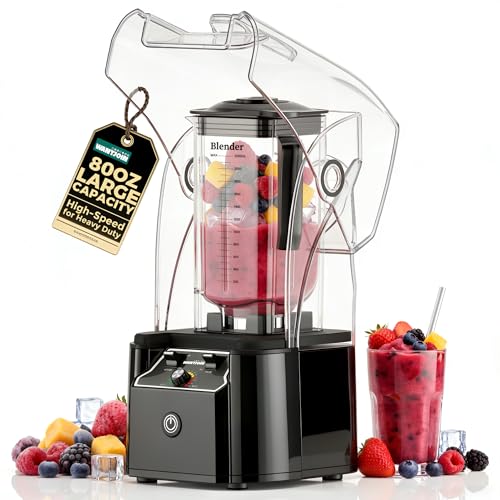
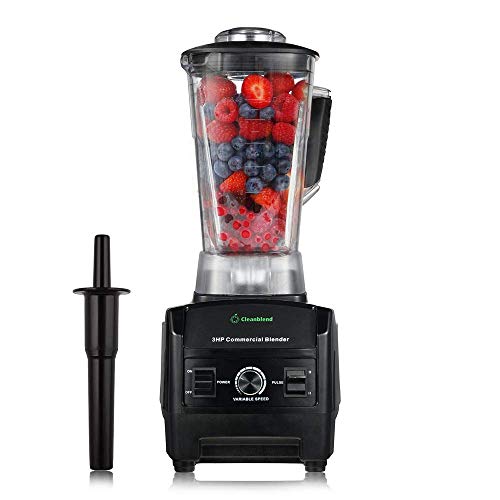
The best commercial blenders for most high-volume operations are the Vitamix The Quiet One for front-of-house noise control, the Blendtec Stealth 885 for programmable café production, and the Waring MX1050XTX for maximum batch power at a comparatively lower equipment cost.
Our top picks


As an Amazon Associate we earn from qualifying purchases at no extra cost to you. Ratings are shown as listed on Amazon.
Best commercial blenders at a glance
These machines are designed for repeated service rather than occasional household use, but they are not interchangeable. Motor horsepower affects how quickly a blender recovers under load; jar capacity determines practical batch size; an acoustic enclosure matters in customer-facing spaces; and NSF certification helps verify that food-contact and cleanability requirements are suitable for commercial food service.
| Blender | Motor rating | Jar capacity | Sound enclosure | Best fit |
|---|---|---|---|---|
| Vitamix The Quiet One | 3 peak horsepower | 48 oz | Integrated enclosure; approximately 64 dB during operation, depending on recipe and environment | Quiet cafés, bars, hotels, and open kitchens |
| Blendtec Stealth 885 | 3.8 peak horsepower | 90 oz WildSide+ jar | Integrated enclosure; manufacturer describes a reduction of roughly 10 dB compared with unenclosed blending | High-throughput cafés and automated drink programs |
| Waring MX1050XTX | 3.5 peak horsepower | 64 oz | No integrated sound enclosure on the standard model | Back-of-house production and heavy-duty prep |
| Hamilton Beach Commercial HBB908 | 1.2 peak horsepower | 48 oz | No integrated sound enclosure | Lower-cost, moderate-volume service |
Horsepower figures are peak or maximum ratings, not a direct measurement of blending output. Blade design, controller programming, ingredient temperature, ice size, and the recipe’s liquid-to-solid ratio can matter just as much.
Best for a customer-facing bar: Vitamix The Quiet One
The Quiet One is the strongest choice when noise is part of the customer experience. Its 48-ounce container is large enough for most individual smoothies, frozen cocktails, frappés, and shakes, while the built-in enclosure substantially reduces the sharp mechanical sound associated with high-speed blending.
Its 3 peak horsepower motor is ample for repeated frozen-drink service, and its programmable controls can standardize recipes across shifts. The smaller jar, compared with the Blendtec Stealth 885, is an advantage when the bar needs single-drink consistency rather than large production batches.
Choose it when the blender will sit near guests, a checkout counter, a hotel lobby, or a coffee bar where conversation matters. The trade-off is cost: enclosed commercial blenders typically occupy the premium end of the market, with general new-equipment prices often ranging from about $1,500 to $2,500 depending on configuration and supplier.
Best for high-volume programmed service: Blendtec Stealth 885
The Stealth 885 combines a 3.8 peak horsepower motor, a 90-ounce WildSide+ jar, an enclosure, and programmable controls. Its larger container gives a production team more room for multiple servings, although the usable batch still depends on the recipe and the manufacturer’s fill guidance.
This is a strong head-to-head alternative to The Quiet One when speed, automation, and batch capacity matter more than compact single-drink workflow. A bar or café can assign preset cycles to common recipes, reducing variation between operators. The enclosure is particularly useful in a busy café, where several blending cycles may occur each hour.
Its larger footprint and jar can be inconvenient under low cabinets or on a narrow bar. Measure the machine with the lid and enclosure open, not merely the countertop footprint. Typical commercial pricing is commonly in the roughly $2,000-to-$3,000 range, varying by package and contract pricing.
Best unenclosed workhorse: Waring MX1050XTX
The Waring MX1050XTX is the practical choice for a back-of-house kitchen that values power and durability over acoustic comfort. Its 3.5 peak horsepower motor and 64-ounce container suit sauces, purées, frozen drinks, soups, and other demanding preparations.
Without a sound enclosure, it is noticeably louder at the operator’s position than the two enclosed models above. That is usually acceptable in a prep kitchen, but less suitable beside guests. It also requires more attention to splash control and hearing comfort when several machines run at once.
The advantage is a simpler, more open workflow: the operator can see the container easily, add ingredients when the recipe permits, and clean the components without working around an enclosure. General market pricing often falls around $700 to $1,300, making it one of the better value choices for a kitchen that does not need quiet operation.
Best for moderate volume and tighter budgets: Hamilton Beach Commercial HBB908
The HBB908 uses a 1.2 peak horsepower motor and a 48-ounce container. It is suitable for a café, diner, juice counter, or bar producing blended drinks steadily but not continuously throughout every service period.
It is not the right substitute for a 3-horsepower machine when recipes contain heavy ice loads, frozen fruit, nut pastes, or repeated dense batches. Under those conditions, a lower-powered blender may take longer per cycle and experience greater wear if operators force the motor by overfilling the jar.
Its lower purchase price, often roughly $400 to $700 in the commercial market, makes sense when the blender has a moderate duty pattern and the operation can tolerate longer cycle times. Confirm the exact model’s current NSF listing and container configuration before buying, since commercial product packages can vary by region.
How to compare duty cycles and NSF certification
NSF certification is not the same thing as a published duty-cycle rating. NSF evaluation addresses sanitation, materials, construction, and cleanability; it does not automatically mean that a machine is approved for unlimited nonstop blending. Manufacturers also use different terms, such as commercial duty, heavy duty, or continuous-use design.
For purchasing, translate your expected service into a workload:
- Light commercial: up to about 20 blended cycles per day, with substantial idle time.
- Moderate commercial: approximately 20 to 60 cycles per day during defined service periods.
- High volume: more than 60 cycles per day, often with several consecutive cycles during rushes.
These are planning categories, not manufacturer warranties. If your operation falls into the high-volume category, ask the supplier for the exact model’s permitted operating pattern, cooling requirements, warranty exclusions, and service parts availability. A machine can have an NSF mark and still be a poor choice if its motor, coupling, or container is not intended for your recipe load.
Decision matrix: choose by location and workload
| Your situation | Recommended direction | Why |
|---|---|---|
| Blender is within several feet of guests | Vitamix The Quiet One or Blendtec Stealth 885 | Enclosure reduces disruptive noise during repeated service |
| More than 60 cycles per day and multiple servings per batch | Blendtec Stealth 885 | Large 90 oz jar, high peak power, and programmable cycles |
| Back-of-house sauces, purées, and frozen prep | Waring MX1050XTX | High power and accessible unenclosed workflow |
| Fewer than 20 cycles per day and a limited equipment budget | Hamilton Beach Commercial HBB908 | Lower acquisition cost without buying premium acoustic hardware |
| Narrow counter or under-counter installation | 48 oz enclosed or unenclosed model after measuring clearance | Smaller containers and housings are easier to place and service |
Capacity is not the same as usable batch size
A 64-ounce jar does not necessarily produce a 64-ounce finished batch. Foam, expansion, vortex formation, and splash risk reduce the practical fill level. For example, if a recipe should occupy no more than 75 percent of the container during blending, a 64-ounce jar provides about 48 ounces of working volume:
64 oz × 0.75 = 48 oz
That could represent three 16-ounce drinks before accounting for ice melt, toppings, or waste. A 90-ounce jar at the same planning level provides about 67.5 ounces, or roughly four 16-ounce portions. Use the actual recipe volume—not the advertised jar capacity—to determine whether batch blending will save labor.
Ownership realities: what wears first
The blade assembly is not always the first component to fail. In busy service, the drive socket or coupling, container bearings, lid, and programmable control interface can also become wear points. Running a thick mixture with too little liquid, repeatedly blending oversized ice, or allowing ingredients to dry around the blade can shorten component life.
- Rinse the container immediately after each recipe so sugars, dairy, and syrups do not harden around the blade.
- Use the manufacturer’s cleaning cycle or approved detergent concentration; excessive detergent can damage seals or leave residue.
- Inspect the drive coupling for rounding, cracking, or slipping rather than continuing to run a noisy machine.
- Do not immerse a motor base or spray liquid into vents, switches, or control panels.
- Keep a spare approved container or blade assembly if a single blender is critical to service.
- Leave the enclosure hinge and ventilation areas clear so heat can escape and the door can close fully.
Final recommendation
Buy the Vitamix The Quiet One when the blender is part of the guest-facing environment and noise reduction justifies the premium. Choose the Blendtec Stealth 885 for larger programmed batches and high-throughput drink production. Choose the Waring MX1050XTX for powerful back-of-house work, and the Hamilton Beach Commercial HBB908 when volume is moderate and budget matters most. Before ordering, verify the current NSF listing, electrical requirements, warranty terms, container capacity, and the manufacturer’s guidance for your expected daily cycle count.