Key takeaways
- Measure the available floor area, including working clearance and the route through doors.
- Compare your height and leg length with the manufacturer’s stated user range or adjustment dimensions.
- Check the capacity definition and include any weight you plan to hold during exercise.
- Confirm the footplate locks at a position that lets you enter and exit without forcing your ankles or knees.
- Identify how you will move the unit for cleaning or rearranging; do not assume wheels are included.
Best Glute Ham Developers for Home Gyms: The Short Answer
The best glute ham developer (GHD) for most home gyms is a compact, non-folding unit with a wide, braced steel frame, adjustable footplate and hip pad, and a clearly stated capacity of at least 300 lb. Choose a lighter, shorter model only if floor space is the main constraint and you have confirmed it fits your height and training needs. A GHD’s footprint and fit matter more than extra adjustment points you will rarely use.
Unlike a bench, a GHD takes up substantial floor area and must resist leverage as you lower and raise your torso. Before buying, check the assembled dimensions, total equipment weight, user-height guidance, capacity, and whether the frame needs to be anchored. Some listings use “GHD” loosely for smaller back-extension benches; those may not offer the footplate adjustment and geometry needed for full glute-ham raises.
Our top picks


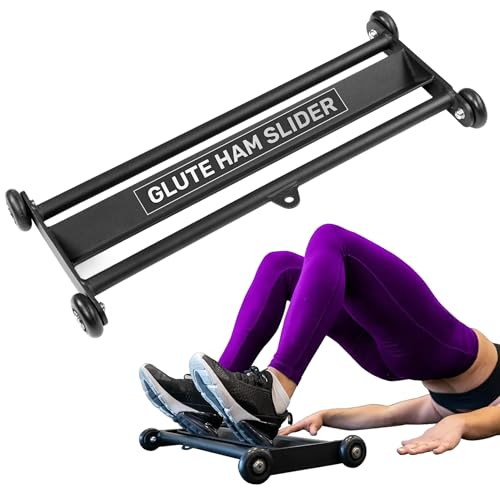
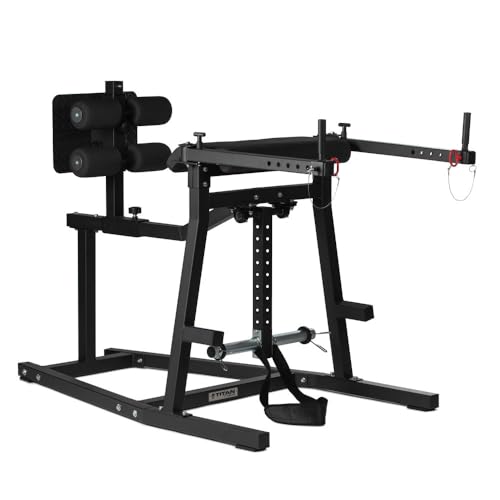
As an Amazon Associate we earn from qualifying purchases at no extra cost to you. Ratings are shown as listed on Amazon.
Compare the Main Home-Gym Options
Specifications vary by model and production run. The figures below are representative examples, not guarantees for every version. Verify the current manufacturer’s listing and manual before purchase, especially where room clearance or load capacity is tight.
| Model or type | Approx. footprint (L × W) | Equipment weight | Published capacity | Storage and fit notes |
|---|---|---|---|---|
| Rogue Abram GHD 2.0 | About 71 × 34 in | About 250 lb | Not stated as a simple user-weight limit; confirm intended loading with Rogue | Heavy, fixed-frame design; multiple adjustment positions |
| REP Fitness GHD | About 70 × 34 in | About 215 lb | Listed around 500 lb | Fixed, braced frame; adjustable footplate and pad |
| Titan Fitness GHD | About 64 × 36 in | About 200 lb | Listed around 400 lb | Fixed-frame option; check the specific version’s adjustment range |
| Compact back-extension bench (not a full GHD) | Often about 40–55 × 20–30 in | Varies widely | Often 250–300 lb; model-specific | May be easier to move, but typically offers less GHD-specific adjustment |
Dimensions and capacities are rounded because manufacturers may revise specifications, and capacity can refer to user weight, total load, or a particular test condition. Do not assume two capacity figures mean the same thing. For weighted movements, ask the manufacturer what the rating includes.
Choose by Your Room, Training, and Experience
| Your situation | What to prioritize | Best fit |
|---|---|---|
| Dedicated training area; frequent GHD use | Wide stance, welded or well-braced frame, secure footplate locks, replaceable upholstery | Full-size fixed GHD such as the REP Fitness or Rogue option |
| Limited room but enough space to use the machine | Shortest footprint that still fits your stride and torso; transport wheels or a practical way to move it | Measure first; consider a compact GHD only if its adjustment range suits you |
| New to glute-ham raises | Fine footplate adjustment, stable frame, easy entry and exit, clear setup instructions | A full GHD with straightforward adjustments; begin with assisted or partial-range reps |
| Occasional back extensions, not full GHD raises | Smaller footprint and simple setup | A back-extension bench may be more sensible than a full GHD |
| Several users with different heights | Broad footplate travel and multiple pad positions; published user-height guidance | A model with documented adjustment dimensions, not just “adjustable” in the listing |
For a shared machine, adjustment range is more useful than the number of adjustment holes. Check the distance from the footplate to the hip pad at the shortest and longest settings. A user should be able to secure the ankles without being forced into an awkward hip position. If the seller does not publish this range, request a measurement or consult the manual.
What Matters Most in a Home-Gym GHD
Stability and capacity
Look for a broad base, cross-bracing, solid welds, and adjustment pins that lock without play. A heavy machine is harder to shift during reps, but weight alone does not prove stability: a narrow base or loose footplate can still feel insecure. Check whether the manufacturer recommends floor anchoring, particularly if you plan to use added weight. Keep the machine on a level surface and retighten fasteners after the initial sessions.
Footprint and usable clearance
Do not measure only the frame. Allow room to step in, set your feet, lower your torso, and get off safely. A practical starting point is to reserve the machine’s full length plus about 24–36 inches at the working end, then confirm clearance for your own body and movement. That extra space is a planning allowance, not a manufacturer specification. Also account for nearby racks, walls, and other equipment.
Pad and footplate adjustment
The footplate should lock firmly and move far enough to fit your leg length. The hip pad should support the upper thighs without pressing uncomfortably into the abdomen or preventing a controlled range of motion. Compare the actual adjustment positions in the manual; “adjustable” can mean only a few coarse settings. Dense upholstery and replaceable pads are practical advantages because the covering and foam are common wear points.
Storage and assembly
Most full-size GHDs are fixed frames, not folding machines. Some include wheels or handles for tilting and rolling, but moving a 200-plus-pound unit is not the same as storing it vertically. Treat a compact or foldable product as a separate category and verify that it is rated for the movements you intend to perform. Assembly commonly involves joining the base, uprights, pad support, and footplate; two people make handling large parts safer. Check package dimensions, required tools, and whether the machine can pass through doorways before ordering.
Measure Before You Buy
Use this quick fit check rather than relying on a product photo:
- Measure the available floor area, including working clearance and the route through doors.
- Compare your height and leg length with the manufacturer’s stated user range or adjustment dimensions.
- Check the capacity definition and include any weight you plan to hold during exercise.
- Confirm the footplate locks at a position that lets you enter and exit without forcing your ankles or knees.
- Identify how you will move the unit for cleaning or rearranging; do not assume wheels are included.
For example, a 70-inch-long GHD in a 72-inch-deep space may technically fit but leave almost no room to approach or dismount. A smaller footprint or a different room layout may be the safer purchase, even if the larger model has more adjustments.
Ownership: What Wears and What to Maintain
Upholstery, foam, adjustment knobs, and locking pins typically need attention before a steel frame does. Wipe sweat from the pads after use, keep the unit dry, and inspect stitching and covering for splits. If a pin no longer seats fully or an adjustment point develops noticeable play, stop using that setting until it is repaired. Check bolts after assembly and periodically thereafter, following the maker’s maintenance guidance.
Avoid dragging the machine across flooring, which can loosen hardware or damage the floor. Use suitable floor protection, but make sure it does not make the base rock. When moving a wheeled unit, tilt it only as instructed and keep hands clear of pinch points.
Bottom Line
For regular full-range glute-ham raises, a full-size, braced GHD with a stable base and useful footplate travel is usually the better long-term choice; the REP Fitness and Rogue Abram are recognizable examples to compare. For a tight room or occasional back extensions, a smaller back-extension bench may be the more practical buy, but it is not automatically a substitute for a true GHD. Prioritize fit, usable clearance, and secure adjustment over a low price or a long feature list. If you have an injury, pain, or uncertainty about whether a movement is appropriate, consult a qualified fitness or healthcare professional.