Our Top Picks
 ARCCAPTAIN 200A MIG Welder 110V 220V 6 in20.9" x 8.5" x 16.1"3.5 x 2.4 x 2.8 inches0.9 PoundsCheck on Amazon



Best overall: the ARCCAPTAIN 200A MIG Welder (MIG200). It is the single most useful machine on this list for most buyers because it runs on ordinary 120 V household power for sheet metal and auto body work, then switches to 240 V when you need to weld 1/4-inch steel with real authority. Its six-process platform adds a spool-gun path to aluminum, lift TIG, and stick, so it can follow a hobby into genuine fabrication without forcing a second purchase. It suits home welders, car restorers, and small shop owners who want one box covering MIG, flux core, and occasional TIG or stick work.
If your budget is tight or your garage only has 120 V, the YESWELDER 135A is the best budget pick — a genuinely capable gasless flux-core machine that costs a fraction of a dual-voltage unit and still welds trailer frames, gates, and body panels. If you weld several days a week and want the shortest path from unboxing to a good bead, the Millermatic 211 PRO is the best premium pick, thanks to dual-voltage input and Auto-Set controls that choose voltage and wire speed for you. This guide compares all twelve machines by amperage range, duty cycle class, wire compatibility, portability, and ease of use, then maps each one to the buyer it actually fits.
Top 3 Picks
Best overall: ARCCAPTAIN 200A MIG200
Dual-voltage input, a 200 A ceiling, and a six-process platform including a spool-gun route to aluminum make this the broadest machine in the mid-range tier. It covers 22-gauge body panels on 120 V and 1/4-inch plate on 240 V, which is more range than most home shops ever need. If you want one welder to do everything short of daily production work, start here.
Best budget: YESWELDER 135A
A 120 V, three-process flux-core machine that requires no gas cylinder, no regulator, and no electrician. It handles sheet metal, light brackets, and repairs up to roughly 1/8-inch steel in a single pass. It is the right first welder for anyone who is not yet sure how deep the hobby will go.
Best premium: Millermatic 211 PRO
Dual-voltage input plus Auto-Set controls that let you dial in wire diameter and material thickness and let the machine handle voltage and wire speed. It is the easiest machine here to get a good bead from on the first try, and it has the deepest long-term parts and service ecosystem of anything on this list. It suits the buyer who welds often and values predictability over feature count.
Quick Comparison
Price tiers below are relative bands — budget, mid-range, and premium — rather than fixed figures, because listings move with promotions and bundles. Amperage and voltage figures come from each machine’s listed specifications.
| Product | Best for | Key specs | Price tier |
|---|---|---|---|
| YESWELDER 135A | First welder on 120 V, light repair | 135 A, 120 V, gasless flux-core MIG + lift TIG + stick | Budget |
| ARCCAPTAIN 200A MIG200 | Best overall for home and auto | 200 A, 120/240 V, 6-in-1 incl. aluminum spool-gun path | Mid-range |
| YESWELDER 160A | Budget dual-voltage, gas or flux core | 160 A, 120/240 V, MIG + flux core + lift TIG + stick | Budget |
| ARCCAPTAIN 165A | Mid-range gas MIG with dual voltage | 165 A, 120/240 V, 4-in-1 gasless and gas MIG + stick + lift TIG | Mid-range |
| YESWELDER 205A | Spool-gun aluminum on a mid-range budget | 205 A, 120/240 V, 5-in-1 incl. spool-gun MIG | Mid-range |
| Lincoln Electric 90i | Portability and brand-name 120 V simplicity | 90 A class, 120 V, MIG and flux-core wire feed, shoulder strap | Mid-range |
| YESWELDER 250A | High-amperage fabrication, dual voltage | 250 A, 120/240 V, 6-in-1 | Premium |
| ARCCAPTAIN 250A MIG250 | Aluminum-heavy and thicker steel | 250 A, 120/240 V, 6-in-1 incl. aluminum | Premium |
| ARCCAPTAIN 135A | Tightest budget, 120 V only | 135 A, 120 V, gasless MIG + stick + lift TIG | Budget |
| Millermatic 211 PRO | Ease of use and long-term ownership | Dual voltage, Auto-Set, MIG/flux core, spool-gun option | Premium |
| ARCCAPTAIN MIG250DP | Aluminum and pulse work | 250 A, 120/240 V, 8-in-1 with double pulse | Premium |
| Futelo 145A | Light hobby work on 120 V | 145 A, 120 V, flux core + stick + lift TIG | Budget |
How We Chose
This roundup is built from published manufacturer specifications, category knowledge, and a consistent set of selection criteria — not from physical evaluation of the units. Every machine included had to clear four filters. First, specification clarity: amperage ceiling, input voltage, process count, and wire and spool compatibility had to be stated well enough that a buyer could match the machine to a real job. Second, category fit: each pick had to be the strongest representative of its tier, whether that is a sub-150 A 120 V starter machine or a 250 A dual-voltage unit with pulse capability.
Third, use-case coverage: the list is deliberately weighted so that home repair, automotive sheet metal, and light fabrication are each served at more than one price tier, rather than stacking the list with near-identical machines. Fourth, upgrade path: we favored platforms that accept a spool gun, support both solid wire with shielding gas and self-shielded flux core, or offer a TIG and stick route, because a machine that can grow with the operator delays the next purchase. Where an exact figure was not published, the machine is described by spec class instead of an invented number.
1. YESWELDER 135A – Best for Beginners on 120V
As an Amazon Associate we earn from qualifying purchases at no extra cost to you.
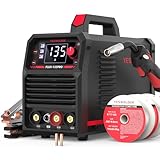
The YESWELDER 135A is the classic first welder: a 120 V, three-process machine that runs gasless flux-core MIG, lift TIG, and stick from an ordinary household outlet. It suits the beginner patching a trailer, repairing a mower deck, or learning to run beads on scrap plate in a garage, and who is not yet sure whether welding will become a serious hobby. It is also the right call if you rent, move often, or simply have no 240 V circuit available.
At 135 A on 120 V input, this is a sheet-metal and light-fabrication machine. It handles 22-gauge auto body panels through roughly 1/8-inch mild steel in a single pass with the right wire and travel speed, and it can manage 3/16-inch with a bevel and multiple passes if you give it time and let the duty cycle cool. The native consumable is self-shielded flux-core wire in 0.030 and 0.035 inch, which means no gas cylinder, no regulator, and no solenoid — one less variable for a new operator to get wrong.
Key specs
- Output class: 135 A maximum on 120 V single-phase input
- Processes: gasless flux-core MIG, lift TIG, stick (3-in-1)
- Wire: self-shielded flux-core in 0.030 in and 0.035 in
- Materials: mild steel; stainless with the appropriate flux-core wire
- Power: standard household circuit; a dedicated 20 A outlet is the safe target
- Portability: compact, luggable class — easy for one person to move
Where it earns its place is simplicity. The controls are a voltage dial and a wire-speed dial, the polarity is already set for flux core, and the chassis is light enough to lift onto a bench or into a truck bed without help. For brackets, gates, exhaust patches, and lawn equipment, that is enough machine to do real work for years.
Pros
- Lowest barrier to entry — real welding capability at the budget tier
- No gas cylinder, regulator, or hose to buy or refill
- Runs on a standard 120 V outlet, so no electrician visit
- Three processes from one box, including stick for thicker or dirtier material
- Light enough to carry to the job instead of dragging the job to the machine
Cons
- 120 V only — 1/4-inch steel is out of reach no matter the technique
- Duty cycle is short at maximum output, so long beads mean waiting
- No spool-gun path, which effectively rules out aluminum
- A lift TIG torch is usually a separate purchase, and lift TIG is less forgiving than high-frequency TIG
Compared with the ARCCAPTAIN 135A, the two are near-identical in class and capability; the decision comes down to which bundle includes the accessories you want. Compared with the Futelo 145A, the Futelo claims slightly more amperage headroom but sits in the same 120 V, flux-core-only world. The real upgrade from here is the YESWELDER 160A, which adds 240 V input and a gas-capable MIG path for a modest step up in price tier.
2. ARCCAPTAIN 200A MIG200 – Best Overall for Home and Auto

The ARCCAPTAIN 200A MIG200 is the machine most people should buy if they can stretch to the mid-range tier. Dual-voltage input means it plugs into a 120 V household circuit for body panels and light brackets, then moves to 240 V when you need to weld 1/4-inch plate or run longer beads without tripping a breaker. It suits the home welder, the car restorer, and the small shop owner who wants one platform rather than three.
The six-in-one process count is the headline. The listing names aluminum welding among its capabilities, which in this class means a spool-gun MIG path — aluminum wire is too soft to feed reliably through a standard torch liner, so a spool gun mounted directly on the gun is the standard solution. Note that the spool gun itself is frequently sold separately, and aluminum MIG also requires 100% argon shielding gas rather than the argon-CO2 mix used on steel.
Key specs
- Output class: 200 A maximum, 120 V and 240 V dual-voltage input
- Processes: 6-in-1, including MIG with gas, flux-core MIG, spool-gun MIG, lift TIG, and stick
- Wire: solid MIG wire with shielding gas and self-shielded flux-core; spool gun for aluminum
- Materials: mild steel, stainless, and aluminum via spool gun
- Power: 120 V for light work, 240 V for the full amperage range
- Portability: inverter-class chassis, movable by one person but heavier than a 120 V-only unit
What separates this from the 135 A machines is headroom. A 200 A ceiling on 240 V gives you the ability to weld 1/4-inch steel with 0.035-inch wire, run longer duty cycles before the thermal protection trips, and get into aluminum without buying a second welder. The dual-voltage design also future-proofs the purchase: if you move to a shop with 240 V, the machine grows with you.
Pros
- Dual voltage covers both household outlets and full-power 240 V work
- Spool-gun capability opens up aluminum without a second machine
- 200 A ceiling handles 1/4-inch steel and longer beads
- Multi-process platform includes stick and lift TIG for repair work
- Strong value position in the mid-range tier
Cons
- Spool gun and TIG torch are commonly sold separately
- Heavier and bulkier than a dedicated 120 V machine
- Aluminum welding requires 100% argon gas, which is a separate cylinder
- More settings to learn than a two-dial starter machine
The nearest alternative here is the YESWELDER 205A, which matches the dual-voltage, 200 A-class formula and also includes a spool-gun MIG process. The two are close enough that bundle contents — regulator, hose, spool gun, torch — should decide it. Against the ARCCAPTAIN 165A, the MIG200 buys 35 A of headroom and a broader process count for a similar tier position, which matters if you plan to weld anything thicker than 3/16 inch.
3. YESWELDER 160A – Best Budget Dual-Voltage Machine

The YESWELDER 160A is the sweet spot for a buyer who wants dual-voltage flexibility without paying mid-range prices. It runs MIG with shielding gas, gasless flux-core MIG, lift TIG, and stick, and it accepts both 120 V and 240 V input. It suits the hobbyist who has a 240 V dryer or range outlet available but does not want to spend mid-range money on a 200 A machine.
The 160 A ceiling on 240 V is a meaningful step above any 120 V-only machine. It will weld 1/8-inch steel comfortably and 3/16-inch with proper joint prep, and the 120 V mode still covers body panels and thin-wall tubing. Because the listing names both MIG and flux core, the wire-feed path is gas-capable, which means you can run solid wire with an argon-CO2 mix for cleaner welds or switch to flux core for outdoor work where wind would blow shielding gas away.
Key specs
- Output class: 160 A maximum, 120 V and 240 V dual-voltage input
- Processes: MIG with gas, flux-core MIG, lift TIG, stick (4-in-1)
- Wire: solid MIG wire in common diameters, plus self-shielded flux core
- Materials: mild steel and stainless; no spool-gun path for aluminum
- Power: 120 V for sheet metal, 240 V for the full range
- Portability: compact inverter chassis, single-person movable
The practical case for this machine is the 240 V mode. It lets you run hotter on thicker material without tripping a household breaker, and the duty cycle at moderate amperage is longer than a 120 V-only unit can manage. If your projects are trailers, gates, and light structural brackets rather than thin body panels, the extra voltage is worth more than extra processes.
Pros
- Dual-voltage input at a budget-tier price
- Gas-capable MIG path for clean welds on steel
- 160 A on 240 V handles 1/8-inch steel and most 3/16-inch work
- Four processes including stick for repair and dirty material
- Compact and easy to store in a small shop
Cons
- No spool gun, so aluminum is effectively off the menu
- Requires a 240 V outlet to use its full capability
- Lower amperage ceiling than the 200 A mid-range machines
- Gas regulator, hose, and cylinder are usually additional purchases
Against the YESWELDER 135A, this is the natural upgrade: same brand family, same basic operating logic, but with 240 V capability and a gas MIG path that the 135 A does not offer. Against the ARCCAPTAIN 165A, the two are extremely close — 160 A versus 165 A, both dual voltage, both gas and flux-core capable. If aluminum matters to you at all, neither of these is the right answer; step up to the YESWELDER 205A or the ARCCAPTAIN MIG200.
4. ARCCAPTAIN 165A – Best Mid-Range Gas MIG for Sheet Metal

The ARCCAPTAIN 165A is aimed squarely at the welder who wants gas-shielded MIG as the primary process. The listing names both gasless and gas MIG alongside stick and lift TIG, and it accepts 120 V and 240 V input. It suits the auto body hobbyist, the fabricator building brackets and benches, and anyone who wants cleaner welds than flux core produces without jumping to a 200 A machine.
The difference between gas MIG and flux core is not marketing. Solid wire with an argon-CO2 shielding gas mix produces far less spatter and no slag to chip, which matters enormously on visible welds and thin sheet metal where cleanup risks distorting the panel. Flux core, by contrast, tolerates wind and outdoor conditions and needs no cylinder. A machine that does both, like this one, gives you the option to pick per job.
Key specs
- Output class: 165 A maximum, 120 V and 240 V dual-voltage input
- Processes: 4-in-1 — gasless flux-core MIG, gas MIG, stick, lift TIG
- Wire: solid MIG wire with shielding gas, plus self-shielded flux core
- Materials: mild steel and stainless steel
- Power: 120 V for thin sheet, 240 V for the top of its range
- Portability: inverter-class, compact enough for a rolling cart
The 165 A ceiling puts it in the same practical band as the 160 A YESWELDER: comfortable on 1/8-inch steel, workable on 3/16-inch with joint prep and multiple passes, and ideal on 16- to 22-gauge sheet. On 120 V it will handle body panels and light tubing all day; on 240 V