Our Top Picks
 Cuisinart Chef's Classic Roasting Pan w/Rack16-Inch6.25 x 20.75 x 13.25 inches7 PoundsCheck on Amazon
 HexClad Hybrid 17 x 14 Inch Rectangular Nonstick17 inches x 14 inches16 x 14 x 3 inches11 PoundsCheck on Amazon
 Tifanso Heavy Duty Stainless Steel Roasting Pan with15.5"x11.6"x2.8"15.5 x 15.5 x 15.5 inchesCheck on Amazon

If you want one pan that can handle a 20-pound turkey and a weeknight chicken with equal ease, the Cuisinart Chef’s Classic 16-Inch Roasting Pan with Rack (7117-16UR) is the best overall pick. Its wide stainless body leaves enough clearance around a large bird for air to circulate, the uncoated surface lets drippings brown into gravy instead of scorching under a coating, and the included rack lifts the meat clear of the fat so the bottom browns instead of steaming. It suits anyone who roasts a whole bird several times a year and wants a pan that will outlast the oven it sits in. If cleanup is the deciding factor, the HexClad Hybrid 17 x 14 is the premium nonstick alternative. If you want to spend as little as possible and still get a rack, the Glad 11 x 15 nonstick is the budget pick — just check the bird size, because it is a small-turkey pan, not a large one. Everything below breaks down size, material, rack design, and handle ergonomics so you can match a pan to your oven and your holiday.
Top 3 Picks
Best Overall: Cuisinart Chef’s Classic 16-Inch Roasting Pan with Rack
A 16-inch rectangular stainless roaster with a fitted rack is the shape that solves the most problems at once: it fits a large turkey with clearance, it takes high oven heat without a coating to degrade, and it can go on the stovetop afterward to reduce drippings into gravy. It is the pick for anyone who wants one pan to do the holiday bird and the Sunday roast.
Best Budget: Glad Roasting Pan Nonstick 11 x 15 with Rack
The Glad pan delivers the two things a first roasting pan needs — a rack and a nonstick surface — at the lowest price band in this roundup. It is best understood as a chicken, small-turkey, and vegetable pan rather than a 20-pound-bird pan, and the coating is the part that will wear out first, but for occasional roasting it is the cheapest sensible entry point.
Best Premium Nonstick: HexClad Hybrid 17 x 14 with Rack
HexClad’s hybrid surface pairs a laser-etched stainless steel pattern with a nonstick layer, so you get nonstick release without giving up metal utensils. At 17 x 14 inches it is the largest pan here, which makes it the pick for big-batch roasting, sheet-pan-style dinners, and anyone who refuses to scrub a stainless roaster after a holiday meal.
Quick Comparison
| Product | Best For | Key Specs | Price Tier |
|---|---|---|---|
| Granite Ware 13″ Oval Roaster with Lid | High-heat roasting and covered braises | Porcelain-enameled steel, oval, 13 in, domed lid, oven safe to 932°F | Mid-range |
| Cuisinart Chef’s Classic 16″ Roasting Pan w/Rack (7117-16UR) | Turkey and pan gravies | Stainless steel, 16 in rectangular, fitted rack, riveted handles | Premium |
| Glad Nonstick Roasting Pan 11 x 15 | Budget entry and small birds | Nonstick-coated metal, 11 x 15 in, rack included | Budget |
| HexClad Hybrid 17 x 14 with Rack | Large-batch nonstick roasting | Hybrid laser-etched stainless over nonstick, 17 x 14 in, rack included | Premium |
| Tifanso Heavy Duty Stainless Roasting Pan with Rack & Handle | Cheapest stainless option | Stainless steel, rack and handle included, size per listing | Budget |
| Kendane 13″ Granite Enameled Oval Roaster with Domed Lid | Budget covered roasting | Enameled steel, oval, 13 in, domed lid | Budget |
| JY COOKMENT Granite Roaster Pan, Small 13″ with Domed Lid | Small households and countertop ovens | Enameled granite finish, oval, 13 in, domed lid | Mid-range |
| VANKUTL 16″ Covered Oval Roaster | Traditional covered roasting | Enameled carbon steel, 16 in oval, lid included | Premium |
| EsOfficce 12.7″ x 15.5″ Stainless Roasting Pan with 2 Flat Racks | Two-rack batch roasting | Stainless steel, 12.7 x 15.5 in, two flat racks, handles | Mid-range |
How We Chose
This roundup is built from published product specifications, manufacturer materials and care guidance, and the well-established behavior of each material class in a home oven — not from any first-hand use. The first filter was category fit: every pan here is sold as a roasting pan with the depth and shape to hold a bird and its drippings, so none of the flat baking sheets or broiler pans that get miscategorized as roasters made the cut. The second filter was specification transparency. Where a listing states a size, a material, a lid, or a heat rating, that is reported as stated; where it does not, the pan is described by spec class rather than assigned a number it never claimed.
The third filter was coverage across real buying situations. A shopper who roasts a 20-pound turkey twice a year needs something different from a shopper who wants a pan for weeknight chicken and roasted vegetables, and both need something different from someone cooking in a compact oven or a countertop model. So the list deliberately spans budget, mid-range, and premium bands, and spans enameled steel, uncoated stainless, and nonstick and hybrid surfaces. The final filter was upgrade path: each entry had to answer the question “if this is not right, what is the next step up or down in the same category?” That is why the comparison notes at the end of every section point at a specific alternative in this list rather than a vague suggestion to spend more.
1. Granite Ware 13-Inch Oval Roaster with Lid – Best for High-Heat Roasting and Covered Braises
As an Amazon Associate we earn from qualifying purchases at no extra cost to you.
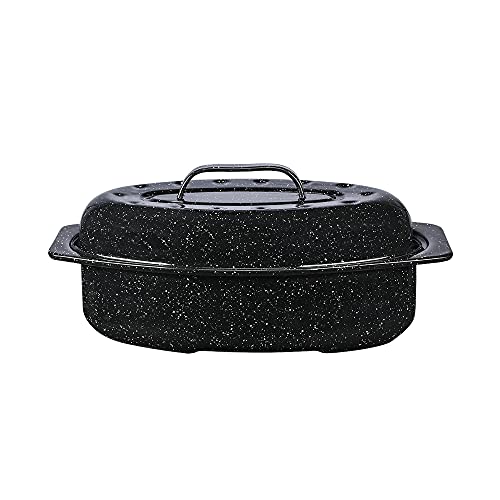
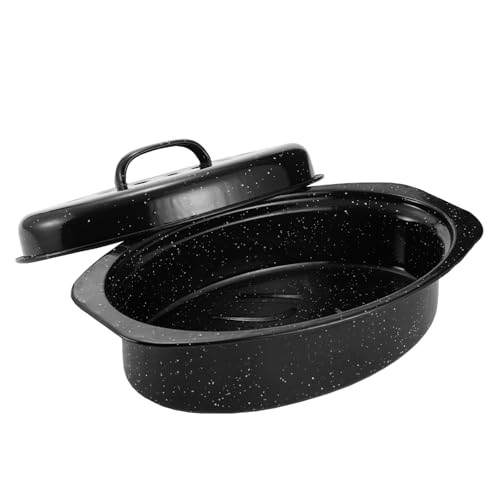
Granite Ware’s 13-inch oval roaster is the pan to reach for when a recipe calls for a very hot oven and you would rather not think about what that does to a coating. The body is porcelain-enameled steel finished in the brand’s speckled granite pattern, and the listing rates it oven safe to 932°F — a ceiling far above anything a home oven can produce, which means the pan itself is never the limiting factor in a recipe. The dark, slightly glossy enamel absorbs radiant heat instead of reflecting it, so the underside of a chicken or a small roast browns faster and more evenly than it would in a bare aluminum pan of the same size.
The oval shape is a deliberate trade. It cradles a bird or a rolled roast closely, which keeps juices pooled around the meat rather than spread thin across a rectangle, and it leaves less exposed surface area to scorch. The trade is that you lose the four corners: a rectangular pan holds more sheet-pan-style vegetables and fits more consistently into the squared-off interior of a modern range. If your roasting is mostly birds, braises, and pot roasts, the oval is the better geometry. If it is mostly tray bakes and vegetables around a joint, a rectangle earns its space.
The included domed lid is the feature that separates this from the bare enameled roasters at the same size. With the lid on, the pan becomes a covered braiser: steam stays in, collagen breaks down, and a tough cut turns tender without drying out. With the lid off, you get dry radiant heat and a browned crust. That two-mode flexibility is genuinely useful, and the lid doubles as a serving vessel or a drip tray when inverted on the counter.
Enameled steel is also the lightest option in this roundup by a wide margin. A 13-inch enamel roaster can be lifted one-handed out of a hot oven even when loaded, which matters more than most buyers expect — a loaded 16-inch stainless roaster with a turkey in it is a two-hands-and-a-good-grip operation, and the risk of a spill at that moment is real. The enamel surface wipes clean with hot water and a soft sponge, and it does not need seasoning or a protective layer of oil the way bare carbon steel does.
Key specs
- Material: porcelain-enameled steel with a speckled granite finish
- Shape and size: oval, 13 inches
- Oven safe to 932°F as stated on the listing
- Domed lid included
- No rack included — roast on the enamel or add a generic rack
- Integrated side handles formed into the body
Pros
- Highest stated heat tolerance of any pan in this roundup, which removes oven temperature as a concern
- Dark enamel browns meat and vegetables noticeably well
- Lid makes it a covered braiser as well as an open roaster
- Light enough to handle safely when full
- No coating to scratch off with a fork or a pair of tongs
Cons
- No rack in the box, so the bottom of the bird sits in the drippings unless you add one
- Enamel chips if the pan is banged against a sink or stacked carelessly, and a chip exposes steel that can rust
- Thermal shock — moving a hot enamel pan into cold water — can craze or crack the finish
- Oval shape wastes oven space for rectangular foods and tray-bake cooking
- The dark interior makes it harder to judge how brown pan drippings are getting
How it compares: the nearest alternatives in this list are the Kendane 13-inch granite oval and the JY COOKMENT 13-inch granite roaster, both of which are the same shape and the same basic construction. The Granite Ware is the one that states a 932°F rating explicitly and comes from the brand that established the speckled-enamel roaster category, which is why it sits a tier above the Kendane on price while the JY COOKMENT lands at mid-range on the strength of its finish and packaging. If the 932°F figure is irrelevant to you because your oven tops out far below it, the Kendane gives you the same cooking geometry for less.
2. Cuisinart Chef’s Classic 16-Inch Roasting Pan with Rack (7117-16UR) – Best for Turkey and Pan Gravies

This is the pan that does the holiday bird and then earns its keep the rest of the year. At 16 inches, the rectangular stainless body has enough length to lay a large turkey flat with clearance on all four sides, and that clearance is not cosmetic — a bird packed tight against the pan walls steams in its own moisture instead of roasting, and the sides stay pale while the breast dries out. The fitted rack lifts the meat so heat circulates underneath, and it gives the fat somewhere to go besides the bottom of the pan.
Uncoated stainless is the right material for anyone who wants to make gravy in the same vessel. After the bird comes out, the pan goes on the stovetop, the drippings come to a simmer, and a wooden spoon lifts the browned fond off the bottom. That step is impossible in a nonstick pan at any temperature above a gentle simmer, and it is the single biggest functional difference between stainless and coated roasters. The trade is cleanup: stainless does not release baked-on fat the way a coating does, and a long roast leaves a ring of carbonized protein that needs a soak and a scrub.
The pan is a heavier gauge than budget stainless roasters, which is what keeps it from oil-canning when it goes from a 425°F oven to a cool countertop. Thin stainless and thin steel pans warp under exactly that thermal swing, and a warped pan rocks on the stovetop and no longer sits level in the oven, so the juices pool to one side. Riveted side handles give a full-hand grip with a folded towel or mitt, and because they are stainless rather than coated, they tolerate the same heat as the body.
One detail worth knowing before you buy any stainless roaster: the rack is usually the weak link, not the pan. Chrome-plated and stainless wire racks are frequently rated lower than the pan body, and a rack left in a very hot oven can discolor or lose its plating over time. If you routinely roast above 450°F, check the rack’s rating separately rather than assuming it matches the pan.
Key specs
- Material: stainless steel body with a fitted rack
- Size: 16 inches, rectangular
- Handles: riveted side handles, stainless
- Rack: included, lifts meat clear of drippings
- Stovetop-friendly for deglazing and gravy
- Oven safe to the manufacturer’s stated maximum — confirm on the listing, and check the rack rating separately
Pros
- Large enough for a big turkey with genuine air clearance around the bird
- Uncoated surface lets you deglaze and build a proper pan gravy
- No coating to wear out, flake, or limit the pan’s useful life
- Heavier gauge resists the warping that kills cheap roasters
- Riveted handles stay cool enough to grip with a folded towel and tolerate high heat
Cons
- Nothing releases easily — expect soaking and scrubbing after a holiday roast
- Heavy when loaded, which is a genuine two-hand lift out of the oven
- No lid, so covered braising needs foil
- Premium price band for a pan that is, functionally, a shaped sheet of metal
- The included rack may have a lower heat rating than the pan itself
How it compares: the closest alternative here is the EsOfficce 12.7 x 15.5-inch stainless pan, which is slightly smaller, sits a tier lower on price, and ships with two flat racks instead of one fitted rack — a real advantage if you want to roast a bird on one rack and rest it on the second while you make gravy. The Cuisinart wins on size and on the brand’s long-standing reputation in stainless cookware. Against the HexClad Hybrid, the choice is philosophical: the Cuisinart gives you gravy and a surface that never degrades, the HexClad gives you release and a coating that eventually will.
3. Glad Nonstick Roasting Pan 11 x 15 with Rack – Best Budget Nonstick Roaster

The Glad roaster is the lowest-cost way to get both a rack and a nonstick surface, and for a lot of households that is exactly the right trade. It is a metal bakeware pan with a nonstick coating, 11 by 15 inches, with a rack included. The dimensions tell you what it is for: 15 inches of length fits a chicken, a small turkey, a pork loin, a salmon side, or a tray of roasted vegetables, and it fits comfortably in a standard oven with room to spare.
The honest limitation is bird size. A 15-inch-long pan will not hold a 20-pound turkey with the clearance that bird needs — you would be wedging it in, and the parts touching the walls would steam rather than brown. For a 10-to-14-pound turkey, a whole chicken, or two chickens spatchcocked side by side, it is fine. Buying this pan for a large holiday bird and discovering the fit problem on Thanksgiving morning is the most common version of this mistake, and it is entirely avoidable by measuring the bird’s footprint first.
Nonstick earns its place in a roaster for one reason: cleanup. Roasting generates a layer of polymerized fat and caramelized protein that bonds to bare metal and requires soaking, scrubbing, and sometimes an abrasive cleaner. A good nonstick surface releases most of it under warm water. What it does not do is last forever. Nonstick coatings degrade with high heat, with metal utensils, with abrasive sponges, and with dishwasher detergent, and a roasting pan is used at higher temperatures than almost any other coated pan in the kitchen. Treat the coating as a consumable and expect to replace the pan eventually rather than handing it down.
Two care habits extend the life of any nonstick roaster substantially. First, keep the oven at or below the coating’s rated maximum — most nonstick bakeware is rated around 450°F, and an empty coated pan left in a hot oven is the fastest way to ruin it. Second, hand wash it. Dishwasher detergent and the drying cycle are hard on coatings, and a roasting pan is large enough that hand washing it in the sink is easier than loading it anyway.
Key specs
- Material: nonstick-coated metal bakeware
- Size: 11 x 15 inches
- Rack included
- Hand wash recommended to protect the coating
- Oven safe to the coating’s rated maximum — confirm on the listing before high-heat roasting
- No lid
Pros
- Lowest price tier in this roundup while still including a rack
- Nonstick release makes post-roast cleanup genuinely quick
- Light and easy to maneuver when full
- Right size for chicken, small turkey, fish, and vegetables
- Fits a standard oven with plenty of clearance for air circulation
Cons
- Too small for a large turkey with proper clearance
- Coating is the first thing to fail and cannot be restored
- Metal utensils, abrasive pads, and dishwasher cycles shorten its life
- Thin gauge is more prone to warping at high heat than heavier pans
- Nonstick surface will not produce the same browned fond for gravy
How it compares: the direct alternative is the Tifanso heavy duty stainless roaster, which sits in the same budget tier but takes the opposite approach — no coating to wear out, but real scrubbing after every roast, and a size you need to confirm on the listing. If you want a pan that will still be usable in a decade, the Tifanso is the safer budget bet. If you want the pan that makes you more likely to actually roast on a Tuesday night, the Glad’s cleanup advantage is worth more than its shorter lifespan.
4. HexClad Hybrid 17 x 14 Nonstick Roasting Pan with Rack – Best Premium Nonstick for Large Batches

HexClad’s hybrid construction is the most interesting surface in this roundup. Instead of a plain nonstick coating, the pan has a laser-etched stainless steel pattern bonded over a nonstick layer, so the stainless peaks protect the coating from utensils while the recessed areas provide release. In practice that means you can use tongs, a carving fork, or a metal spatula without the panic that comes with a conventional coated pan — a meaningful difference when you are lifting a hot bird out of a roaster.
At 17 by 14 inches, this is the largest pan in the roundup, and size changes what a pan is for. It holds a large turkey with clearance, but it also works as a full-sheet-pan substitute for big-batch dinners: a whole spatchcocked chicken surrounded by root vegetables, two racks of ribs, a side of salmon with asparagus alongside, or a holiday vegetable roast that would otherwise need two trays. The rack included with the pan lifts meat, and because the pan is wide, the drippings spread thin and are less likely to burn and smoke.
The practical question with any coated pan is heat. Hybrid pans tolerate more oven heat than conventional nonstick, and HexClad rates its cookware for high-temperature oven use, but the coating is still a coating. Confirm the exact figure on the listing before you plan a 500°F roast, and never leave the pan empty in a hot oven to preheat — that is the classic way to destroy a coated surface, and it happens because people preheat a roasting pan the way they preheat a sheet pan for vegetables.
Weight is the other consideration. A 17-inch hybrid pan is a substantial piece of metal, and loaded with a turkey and a quart of drippings it becomes heavy enough that the lift out of the oven is a deliberate, two-handed move. Wide, riveted handles help a lot here, but plan the counter landing spot before you open the oven door, not after.
Key specs
- Material: hybrid construction — laser-etched stainless steel pattern over a nonstick layer
- Size: 17 x 14 inches, rectangular
- Rack included
- Metal utensils are compatible with the surface, unlike conventional nonstick
- Rated for high-temperature oven use; confirm the exact maximum on the listing
- Wide riveted handles
Pros
- Largest cooking surface here — handles big birds and full tray-bake dinners
- Metal-utensil safe, which removes the main frustration of coated pans
- Nonstick release without giving up browning
- Wide surface spreads drippings thin so they are less likely to scorch and smoke
- Premium build quality with a finish that resists scratching
Cons
- Premium price tier — the most expensive approach to roasting in this list
- Heavy when loaded, especially with a large bird
- The nonstick layer can still wear over years of high-heat use
- Coating requires the same care discipline as any nonstick: no empty preheating, no abrasives
- At 17 inches plus handles it needs a genuinely large oven interior
How it compares: against the Cuisinart stainless roaster, the HexClad trades the ability to build a pan gravy and a coating-free lifespan for release and metal-utensil freedom. Against the Glad, it is the same idea at four times the size and a much better surface. The decision usually comes down to one question: do you want to deglaze this pan on the stovetop? If yes, buy the Cuisinart. If you would rather soak and wipe than scrub, buy the HexClad.
5. Tifanso Heavy Duty Stainless Steel Roasting Pan with Rack & Handle – Best Budget Stainless

The Tifanso roaster is the budget route into uncoated stainless steel. It is sold as a heavy duty stainless roasting pan with a rack and a handle, and it occupies the same price tier as the Glad — but it takes the opposite approach to every design decision. There is no coating to flake, chip, or wear through, which means the pan’s useful life is limited mainly by how badly it gets warped and how well it is cleaned rather than by a surface that degrades on a schedule.
Stainless at this price does not mean thin, but it does mean you should check the gauge expectation realistically. Budget stainless roasters are typically lighter than premium ones, and light stainless is the pans that warp when it goes from a 425°F oven onto a cool countertop or into a sink. Two habits prevent it: let the pan cool on a trivet or a dry towel rather than on a cold surface, and never run a hot pan under cold water. A warped roaster rocks on the stovetop and sits unevenly in the oven, so juices pool to one side and one end of the bird browns faster.
Because the listing name does not state a size, confirm the interior dimensions before buying rather than assuming. What matters is the usable interior length and width, not the number in the title — a pan sold as a large roaster may measure differently across the rim than across the base, and the base is what the bird actually sits on. Measure the inside of your oven as well, and remember to add the handles: a pan with a 15-inch body and wide loop handles can occupy close to 19 or 20 inches of shelf width, which matters in a compact oven.
The rack included with this pan is the feature that makes it a real roaster rather than a deep baking dish. Lifting the meat off the bottom keeps the underside from stewing in fat, lets the oven’s dry heat reach the bottom of the bird, and gives you a clearer pan of drippings to work with afterward. Stainless racks are also the most durable option in this price range, since there is no plating to wear through.
Key specs
- Material: stainless steel, uncoated
- Includes rack and handle as stated on the listing
- Size: not stated in the listing name — confirm interior dimensions before purchase
- Stovetop-friendly for deglazing and pan sauces
- Hand wash; stainless tolerates scrubbing and abrasive cleansers
- No lid
Pros
- Uncoated stainless at a budget price — no coating to wear out
- Rack included, which is the feature most budget pans omit
- Stovetop-safe for making gravy directly in the pan
- Tolerates scrubbing, abrasive cleaners, and dishwasher cycles
- Durable construction for the price tier
Cons
- No stated dimensions in the listing name, so fit must be verified
- Lighter gauge than premium stainless and therefore more warp-prone
- Stainless shows every water spot and needs polishing to look new
- Requires soaking and scrubbing after a long roast
- No lid for covered braising
How it compares: this is the stainless answer to the Glad nonstick pan in the same budget tier, and the choice between them is the central budget decision in this roundup: release versus longevity. The EsOfficce stainless pan is the step up if you want two racks and stated dimensions at a mid-range price, and it is the better buy if you are not certain about fit, since you can at least check its numbers before ordering.
6. Kendane 13-Inch Granite Enameled Oval Roasting Pan with Domed Lid – Best Budget Covered Roaster

The Kendane roaster is a 13-inch oval enameled pan with a domed lid, and it delivers the classic granite-ware cooking experience at the lowest price band in the enamel category. The dark speckled enamel absorbs radiant heat, which browns meat and vegetables well, and the domed lid converts the pan into a covered braiser for pot roasts, stews, and any cut that needs a long, moist cook to become tender.
What you get for the budget price is the same geometry as the Granite Ware and JY COOKMENT pans in this list: a 13-inch oval that holds a chicken or a modest roast snugly, with the lid trapping steam. What you typically do not get is a stated high heat ceiling, which is worth thinking about if you roast at very high temperatures. Enameled steel as a material handles high heat well, but the number a manufacturer publishes is a warranty-relevant commitment, and a budget listing may simply not publish one. If a 500°F roast is part of your routine, that is a reason to look at the Granite Ware instead.
Enamel care is the same across every pan in this category, and it is the main thing that determines how long a budget enamel roaster lasts. Thermal shock is the enemy: a hot enamel pan hitting cold water can craze, crack, or chip the finish, and a chip exposes bare steel that will rust. Let the pan come down to room temperature on a trivet before it goes anywhere near the sink. Skip abrasive pads and steel wool for the same reason — a soft sponge and hot soapy water handle almost everything, and a short soak handles the rest.
Storage is the other place these pans get damaged. Stacking a heavy stainless pan on top of an enamel roaster is how lids get chipped and rims get nicked. If cabinet space is tight, keep the lid inverted on the pan with a cloth between the surfaces, and avoid sliding the pan across a hard countertop.
Key specs
- Material: enameled steel with a granite speckle finish
- Shape and size: oval, 13 inches
- Domed lid included
- No rack included
- Hand wash; avoid abrasive pads and thermal shock
- Heat rating not stated on the listing name — verify if high-heat roasting is a priority
Pros
- Lowest price band for a lidded enamel roaster
- Domed lid supports covered braising, pot roasts, and steam-roasting
- Dark enamel browns food well
- Light and easy to lift when loaded
- Lid doubles as a serving dish or drip tray
Cons
- No stated heat ceiling, which is a gap if you roast very hot
- No rack included, so the bird sits in its drippings
- Enamel chips if handled roughly and cannot be repaired
- Oval shape limits tray-bake and vegetable roasting
- Budget finish may show wear faster than a premium enamel pan
How it compares: the Granite Ware 13-inch oval is the same shape and construction with an explicit 932°F rating, and it is the upgrade if heat tolerance is what you are buying. The JY COOKMENT 13-inch granite roaster is the same size one tier up, which makes the Kendane the value pick of the three: if you want a lidded enamel oval and you roast at ordinary temperatures, this is where the money goes furthest.
7. JY COOKMENT Granite Roaster Pan, Small 13-Inch Enameled with Domed Lid – Best for Small Households

JY COOKMENT’s 13-inch granite roaster is aimed squarely at the cook who does not need a 20-pound-bird pan. The listing calls it small, and that is the honest framing: a 13-inch oval with a domed lid is the right size for a whole chicken, a 3-to-5-pound roast, a small turkey breast, a casserole, or a batch of roasted vegetables for two to four people. It is also the size that fits a compact oven, a countertop oven, or a small apartment range, which is a real constraint that most roasting pan advice ignores.
For that buyer, the pan’s proportions are an advantage rather than a compromise. A large roaster in a small oven crowds the racks, blocks the convection fan, and forces you to move the shelf to a position where the pan sits too close to the top element. A 13-inch oval leaves room around it, so hot air actually circulates and the food browns on all sides. It is also far easier to store: an oval with a domed lid can live on a shelf where a 17-inch rectangle will not fit at all.
The granite enamel finish does the same work it does on every pan in this category — dark, radiant-heat-absorbing, and forgiving of high temperatures — and the domed lid makes it a braiser as well as a roaster. Because the pan is at the mid-range price tier rather than the bottom, you are paying for finish consistency and packaging rather than for a fundamentally different cooking surface, and that is worth being clear-eyed about. The cooking results from a 13-inch enameled oval come from the material and the shape, both of which are shared across this category.
What you should check before buying is whether the lid actually clears what you plan to cook. A domed lid on a 13-inch oval typically has a couple of inches of headroom over the rim, which is plenty for a chicken or a roast but not for a tall standing rib roast or a piled-high casserole. If your cooking tends toward tall cuts, a lidless rectangular pan with an added foil tent is the more flexible tool.
Key specs
- Material: enameled steel with a granite finish
- Shape and size: oval, 13 inches, described by the listing as small
- Domed lid included
- Best for chicken, small roasts, and two-to-four-person portions
- Hand wash; avoid thermal shock and abrasives
- No rack included
Pros
- Right size for small households and compact ovens
- Fits where a large rectangular roaster cannot, both in the oven and in the cabinet
- Domed lid enables covered braising
- Enamel finish browns food well and cleans easily
- Mid-range build quality with a more consistent finish than the cheapest enamel pans
Cons
- Cannot hold a large turkey — this is a chicken and small-roast pan
- Lid headroom limits tall cuts
- No rack included
- Paying a mid-range price for the same basic material as cheaper enamel pans
- Enamel remains vulnerable to chipping and thermal shock
How it compares: this is the same size and shape as the Granite Ware and Kendane ovals, so the three are genuinely interchangeable in cooking terms. The JY COOKMENT sits above the Kendane on finish and below the Granite Ware on stated heat rating. If you want the same small-pan footprint in a pan you can deglaze, the EsOfficce stainless pan is a different shape at a different size, and the Tifanso is the budget stainless alternative — but neither gives you the covered-braise capability that the domed lid does.
8. VANKUTL 16-Inch Covered Oval Roaster, Enamel Carbon Steel – Best for Traditional Covered Roasting

The VANKUTL roaster is a 16-inch covered oval in enameled carbon steel, and it is the pan in this list that most closely follows the old-fashioned covered roaster template. The larger oval is a meaningful step up from the 13-inch pans: 16 inches of length gives you room for a full-size turkey, a large chicken plus vegetables, or a big pot roast with the lid on. If your mental image of roasting is a covered pan going into the oven for three hours and coming out with a tender roast and a pan of juices, this is that pan at full scale.
Carbon steel is the substrate underneath the enamel, and it is worth understanding what that means. Carbon steel heats evenly, responds quickly to temperature changes, and is lighter than stainless at the same size — which matters at 16 inches, where a stainless roaster becomes genuinely heavy. The enamel coating protects the steel from rust and provides the easy-release, easy-wipe surface. The vulnerability is at the edges: any chip or crack in the enamel exposes carbon steel directly to moisture, and carbon steel rusts. Inspect the rim and the lid edge periodically and dry the pan thoroughly after washing rather than letting it air-dry in a rack.
A covered oval also changes how you cook, not just what you cook. With the lid on, the pan traps steam, which means the meat will not develop a crisp skin — the trade for a moist, evenly cooked roast. The usual approach is to roast covered for most of the time and then remove the lid for the last 20 to 30 minutes to let the skin crisp and the surface brown. That two-stage method is why covered roasters remain popular despite the extra storage burden of a lid: you get both results from one pan.
Two practical notes for anyone considering a 16-inch oval. First, measure your oven shelf — a 16-inch oval with side handles can occupy close to 19 inches of width, and it needs vertical clearance above it for the domed lid. Second, a lid that large needs somewhere to go when it comes off. A lid rest or a folded towel on the counter prevents the classic mistake of setting a hot, greasy lid down on a surface that will stain.
Key specs
- Material: enameled carbon steel
- Shape and size: oval, 16 inches
- Covered roaster with lid included
- Lighter than stainless at the same size thanks to the carbon steel substrate
- Hand wash and dry thoroughly; enamel chips expose rust-prone steel
- Best for whole birds, large pot roasts, and covered braising
Pros
- Large enough for a full-size turkey while staying lighter than stainless
- Lid supports traditional covered roasting and long braises
- Carbon steel heats evenly and responds quickly to oven changes
- Enamel surface wipes clean and does not require seasoning
- Premium build in the traditional covered-roaster format
Cons
- Premium price tier for a single-purpose covered pan
- Chips in the enamel expose carbon steel, which will rust if not dried thoroughly
- Lid takes up significant storage space and needs a landing spot during cooking
- Covered roasting prevents crisp skin unless you finish uncovered
- Oval shape limits tray-bake and sheet-pan style cooking
How it compares: against the Cuisinart 16-inch stainless roaster, this is the covered-versus-open decision. The Cuisinart is rectangular, lidless, and made for high-heat roasting and stovetop gravy; the VANKUTL is oval, lidded, and made for long covered cooks. Against the 13-inch JY COOKMENT oval, it is the same concept at full holiday-bird scale — and the reason to pay the premium tier is precisely that a 16-inch oval is the smallest shape that handles a large turkey under a lid.
9. EsOfficce 12.7″ x 15.5″ Stainless Steel Roasting Pan with 2 Flat Racks – Best for Two-Rack Batch Roasting

The EsOfficce pan is the only one in this roundup that ships with two racks, and that single detail makes it more versatile than its mid-range price suggests. Two flat racks mean you can roast a bird on one rack while the second holds vegetables in the same pan, or roast on one and use the second as a resting rack on the counter so the bird drains while you make gravy in the pan. For anyone who cooks a protein and a side together, that is a genuine workflow advantage rather than a marketing extra.
At 12.7 by 15.5 inches, the pan is slightly shorter and slightly narrower than a full 16-inch roaster, which puts it in a useful middle zone: it fits a chicken, a small-to-medium turkey, a large roast, or a full tray of vegetables, and it fits comfortably in a standard oven with clearance around it for air circulation. It is also small enough to sit in a compact oven that a 17-inch pan would crowd. If your oven interior is on the tighter side, this is the size that stops being a compromise and starts being the right answer.
Stainless is the right call for the two-rack approach. A coated pan with two racks would give you easier cleanup, but the racks themselves — wire, repeatedly exposed to high heat and drippings — are the part that benefits most from being uncoated and scrubbable. Stainless racks do not flake or lose plating, and they can go straight into the sink with everything else.
Handles are worth a specific mention here because they are listed as a feature. On a 15.5-inch pan, wide handles that a folded towel can wrap around make the difference between a controlled lift and an awkward one. Handles that are too narrow or too close to the pan body force a pinch grip, which is exactly the wrong way to move several pounds of hot metal and drippings. Check that the handles clear the oven door and that they leave enough room to get a mitt in.
Key specs
- Material: stainless steel, uncoated
- Size: 12.7 x 15.5 inches
- Two flat racks included
- Handles sized for a full-hand grip with a mitt or towel
- Stovetop-friendly for deglazing and gravy
- Hand wash or dishwasher; tolerates scrubbing and abrasive cleansers
Pros
- Two racks for roasting and resting, or protein and vegetables at once
- Mid-range price for a genuinely versatile stainless pan
- Fits compact ovens that a 17-inch roaster would crowd
- Uncoated surface allows stovetop deglazing and pan sauces