Our Top Picks
 Oklahoma Joe’s Laredo Series 1100 Offset Charcoal Smoker32.58 x 64.43 x 47.7 inches94.97 poundsCheck on Amazon
 Oklahoma Joe's Longhorn Offset Charcoal Smoker and Grill1060 sq. in.36.5 x 64.3 x 55.5 inches253 PoundsCheck on Amazon
 Oklahoma Joe's Highland Offset Charcoal Smoker and GrillLarge33.5 x 59 x 52.8 inches168 poundsCheck on Amazon
 Oklahoma Joe's Bronco 18 in. Heavy Duty CharcoalLarge26.6 x 44.4 x 43.4 inches136.5 PoundsCheck on Amazon
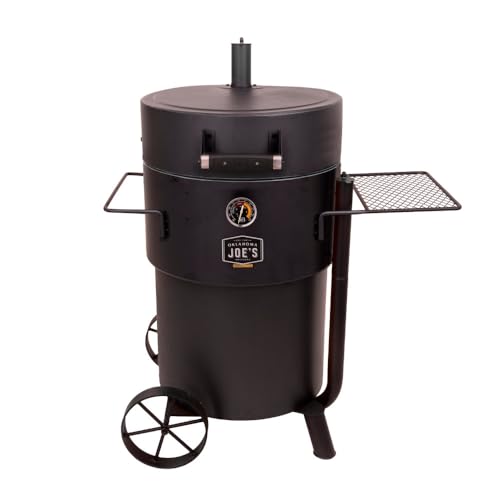
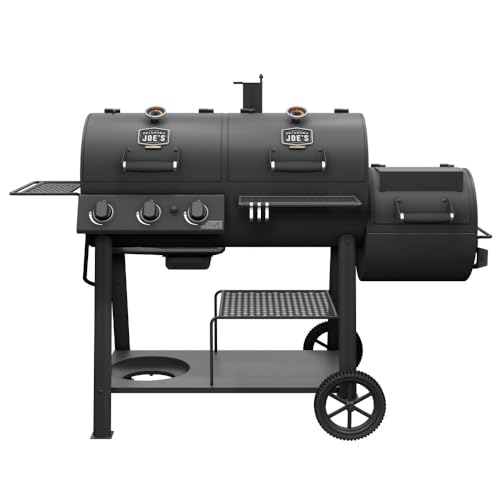
The best Oklahoma Joe’s smoker for most backyard cooks is the Highland Offset Charcoal Smoker and Grill. Its 900 sq. in. of cooking area, heavy-gauge steel body and true offset firebox deliver real stick-burning barbecue at a mid-range price, and its smaller chamber is meaningfully easier to hold at 225–275°F than the brand’s 1,000-plus-sq.-in. models. If you routinely feed 15 or more people, step up to the Laredo Series 1100 or the Longhorn; if you want the shortest possible path to consistent results with almost no fire-tending, the Bronco Pro drum smoker is the smarter tool. Budget buyers, balcony cooks and tailgaters should look at the Rambler tabletop, and anyone who wants gas convenience on weeknights plus charcoal smoke on weekends should look at the Canyon Combo dual-fuel unit. Everything below compares cooking capacity, fuel flexibility, temperature control, steel construction, cleanup effort and patio footprint across the current Oklahoma Joe’s lineup so you can match a cooker to your space and the way you actually cook.
Top 3 Picks
Best overall: Oklahoma Joe’s Highland Offset Charcoal Smoker and Grill
The Highland is the model most people should buy first. At 900 sq. in. it holds a full packer brisket plus sides, the offset firebox lets you burn charcoal and wood splits for genuine smoke flavor, and the chamber is small enough that a beginner can learn fire management without fighting a 6-foot cook chamber. It also has the deepest accessory ecosystem of any Oklahoma Joe’s model, which matters more than most buyers expect.
Best budget: Oklahoma Joe’s Rambler Portable Tabletop Charcoal Grill
With 218 sq. in. of cooking space and heavy-duty steel construction, the Rambler is the cheapest way into real charcoal cooking in this lineup. It is not a smoker in the low-and-slow sense — it is a compact direct-heat grill — but it covers burgers, sausages, chicken and small reverse-seared cooks, and it stores on a shelf.
Best premium: Oklahoma Joe’s Longhorn Offset Charcoal Smoker and Grill
The Longhorn is the flagship horizontal offset at 1,060 sq. in., and it is the pick for cooks who already understand fire management and want maximum capacity with the classic offset profile. It costs more than the Laredo for essentially the same grate area, so you are paying for the established platform, the longer track record and the broader aftermarket support.
Quick Comparison
| Product | Best for | Key specs | Price tier |
|---|---|---|---|
| Oklahoma Joe’s Laredo Series 1100 Offset Charcoal Smoker and Grill | Large-batch offset cooking on a mid-range budget | 1,100 sq. in. total cooking area; charcoal + wood offset firebox; horizontal chamber; black finish; cart with wheels | Mid-range |
| Oklahoma Joe’s Longhorn Offset Charcoal Smoker and Grill | Experienced pitmasters who want the flagship horizontal offset | 1,060 sq. in. total cooking area; charcoal + wood offset firebox; main chamber plus upper warming rack; black finish | Premium |
| Oklahoma Joe’s Bronco Pro 21.5 in. Heavy Duty Charcoal Drum Smoker and Grill | Low-effort, long unattended charcoal cooks | 366 sq. in. grate; 21.5 in. vertical drum; charcoal basket and diffuser; adjustable air intake; hinged lid | Premium |
| Oklahoma Joe’s Highland Offset Charcoal Smoker and Grill | First-time offset owners and everyday backyard smoking | 900 sq. in. total cooking area; charcoal + wood offset firebox; main chamber plus upper rack; black finish | Mid-range |
| Oklahoma Joe’s Canyon Combo Dual Fuel 3-Burner Propane Gas and Charcoal Smoker and Grill | Households that want gas speed and charcoal smoke in one footprint | 1,031 sq. in. total cooking area; 3 propane burners plus charcoal/smoker side; combo cart configuration | Premium |
| Oklahoma Joe’s Bronco 18 in. Heavy Duty Charcoal Drum Smoker and Grill | Small patios and shorter cooks in a drum format | 284 sq. in. grate; 18 in. vertical drum; charcoal basket; adjustable air intake; hinged lid | Mid-range |
| Oklahoma Joe’s Bandera Smoker and Grill | Maximum food volume from a small ground footprint | Vertical cabinet smoker configuration; multiple stacked cooking grates; offset charcoal/wood firebox | Premium |
| Oklahoma Joe’s Rambler Portable Tabletop Charcoal Grill | Tailgating, camping, balconies and small households | 218 sq. in. cooking space; heavy-duty steel construction; tabletop format; portable | Budget |
| Oklahoma Joe’s Highland Offset Smoker Cover | Protecting any Highland-size horizontal offset from weather | Fitted black cover; sized to Highland-class offsets and comparable chamber dimensions | Budget |
| Char-Broil Oklahoma Joe’s Bronco Barrel Drum Smoker | Entry-level drum smoking with porcelain-coated steel | 630 sq. in. cooking area; porcelain-coated steel body; air intake channel; barrel drum format | Mid-range |
| Oklahoma Joe’s Stainless Steel Offset Smoker Charcoal Firebox Basket | Fixing uneven burns and awkward ash cleanup in an offset firebox | Stainless steel basket; sized for offset smoker fireboxes; lifts charcoal off the firebox floor | Budget |
| Oklahoma Joe’s Smoker Gasket 15-ft Roll | Sealing smoke and heat leaks on Highland, Longhorn and combo units | 15 ft of high-temperature gasket material; fits lid and firebox seams on listed models | Budget |
Price tiers above are relative bands, not fixed numbers — promotional pricing on smokers moves constantly, and the accessories in this list cost a small fraction of what the cookers do. Use the tiers to compare within the lineup, then check current pricing at your preferred retailer.
How We Chose
This guide is built from manufacturer specification sheets and brand documentation for the current Oklahoma Joe’s range, combined with well-documented ownership patterns for offset, drum and combo cookers as a category. No product here was tested, benchmarked or owned by us, and nothing in this article comes from hands-on use. Instead, we compared the specs that actually determine whether a smoker works for a given household: total cooking area in square inches, fuel type and whether the unit accepts wood splits, the presence and design of airflow controls, the cooking configuration (horizontal offset, vertical drum, cabinet, combo or tabletop), and the physical footprint the unit demands once you account for lid swing, fire-tending clearance and storage.
We also weighted the ownership side of the decision — what wears first, which consumables you will re-buy, how much ash and grease you will handle per cook, and whether the model sits on a platform with enough aftermarket support to be worth upgrading rather than replacing. Category fit mattered as much as raw size: a 1,100 sq. in. offset is the wrong answer for a 30 sq. ft. balcony, and a tabletop grill is the wrong answer for a family of eight. Finally, we looked at upgrade paths. The best first smoker is one you can grow with through inexpensive accessories rather than one you outgrow in a season.
1. Oklahoma Joe’s Laredo Series 1100 Offset Charcoal Smoker and Grill – Best for Large-Batch Offset Cooking
As an Amazon Associate we earn from qualifying purchases at no extra cost to you.

Who it suits: The Laredo Series 1100 is for the cook who regularly feeds a crowd — 15 to 25 people, or a family that wants leftovers — and who wants a traditional horizontal offset with a real firebox rather than a cabinet or a pellet unit. It is the largest chamber in the mid-range tier of this lineup, and it is the natural pick for someone who has decided that offset barbecue is the goal but does not want to pay flagship money to get there.
At 1,100 sq. in. of total cooking area, the Laredo gives you a main chamber and an upper rack in a black-finished cart configuration with wheels. Fuel is charcoal and wood in an offset firebox, which is the whole point: you build a coal bed, then feed splits or chunks for the smoke and flavor that a gas or electric unit cannot replicate. Airflow is managed through the firebox damper and the smokestack damper, which together are your temperature controls.
Key specs
- Total cooking area: 1,100 sq. in. (main chamber plus upper rack)
- Fuel: charcoal and wood splits/chunks in an offset firebox
- Configuration: horizontal offset cook chamber with side firebox, cart with wheels
- Air control: adjustable firebox intake damper plus smokestack exhaust damper
- Finish: black; assembly requires two people given the size of the chamber
The capacity math is the strongest argument for this unit. A 12–14 lb packer brisket needs roughly 200–225 sq. in. of grate, so 1,100 sq. in. looks like it holds five. Realistically, with airflow gaps and the ability to reach in and move things, plan on three to four packers, or two packers plus four to five racks of spare ribs, or a dozen-plus chicken halves. That is a genuine party cooker, and it is the cheapest way in this lineup to get a four-brisket chamber.
The offset format also gives you a second cooking surface most people forget about: the firebox itself works as a direct-heat grill over the coals, which means you can sear steaks or finish chicken while the main chamber runs low and slow. That dual-purpose behavior is a real advantage over a dedicated drum or cabinet smoker, and it is why offsets remain the default for cooks who want one machine to do everything.
Pros
- Largest cooking area in the mid-range tier — roughly four briskets at realistic packing density
- True offset firebox accepts charcoal and wood splits for genuine stick-burning flavor
- Firebox doubles as a direct grilling surface over live coals
- Upper rack adds usable secondary capacity without increasing the footprint much
- Wheeled cart makes it movable for cleaning and storage
Cons
- A chamber this size is harder to hold steady than a 900 sq. in. offset; expect more fire-tending
- Consumes noticeably more fuel per cook than a drum or cabinet of similar capacity
- Large footprint plus lid swing and fire-tending clearance demands a serious patio
- Assembly and moving it around take two people
How it compares: The closest alternative is the Longhorn, at 1,060 sq. in. The two are within 4% of each other on capacity, so the decision is not about size. The Longhorn is the more established platform with a longer track record and broader aftermarket support; the Laredo gives you comparable grate area in the mid-range tier, which frees budget for a cover, a firebox basket and a gasket roll. If you want the cheapest route to a four-brisket offset, the Laredo wins. If you want the flagship name and the deeper accessory ecosystem, the Longhorn is the step up. Against the Highland’s 900 sq. in., the Laredo adds roughly 200 sq. in. and one more brisket of practical capacity — but it also adds fire-management difficulty, so it is the wrong first offset for a beginner.
2. Oklahoma Joe’s Longhorn Offset Charcoal Smoker and Grill – Best for Serious Backyard Pitmasters

Who it suits: The Longhorn is for the cook who already knows how to run a fire — someone who understands coal beds, intake dampers and the difference between clean blue smoke and the white stuff — and who wants the largest classic horizontal offset in the Oklahoma Joe’s range. It is also the right answer for anyone who has owned a smaller offset, liked it, and wants more room without moving to a cabinet or a drum.
The Longhorn is the flagship horizontal offset here at 1,060 sq. in. of total cooking area in a black finish. The layout is the traditional one: a long cook chamber with a main grate and an upper warming rack, a side firebox for charcoal and wood, and damper-controlled airflow at both the intake and the exhaust. The size of the chamber is what defines the experience — a long, heavy cook chamber is both the reason the Longhorn can hold a lot of food and the reason it responds slowly to adjustments.
Key specs
- Total cooking area: 1,060 sq. in. (main chamber plus upper warming rack)
- Fuel: charcoal and wood splits/chunks in an offset firebox
- Configuration: full-size horizontal offset with side firebox
- Air control: adjustable firebox damper and smokestack damper
- Finish: black; large-offset weight class, two-person assembly recommended
The practical difference between the Longhorn and a smaller offset shows up in two places. First, capacity: at realistic packing density you are looking at three to four packer briskets, or two packers plus four to five racks of ribs, or a dozen chicken halves with room to rotate. Second, heat stability: a large steel chamber with a thick coal bed and a steady split fire tends to hold temperature longer between adjustments than a small one, which is why experienced cooks often describe big offsets as easier to run well than small ones — the caveat being that they are harder to run well when the fire is wrong.
That is the honest trade-off with the Longhorn. The chamber responds slowly. If you overshoot to 325°F because you added three splits at once, you will spend the next 40 minutes bringing it back down by closing the intake and cracking the stack. Learning to feed one split at a time, and to preheat splits on top of the firebox before they go in, is the single biggest skill upgrade you can make on this cooker. Do that and the Longhorn becomes a genuinely predictable machine.
Pros
- Largest classic horizontal offset in the Oklahoma Joe’s range at 1,060 sq. in.
- Long chamber holds temperature longer between fire adjustments once a good coal bed is built
- Firebox grilling over live coals for searing and finishing
- Deepest aftermarket support of any model in this lineup — gaskets, covers, baskets, tuning plates
- Well-established platform with a long ownership track record
Cons
- Premium tier pricing for capacity that is nearly identical to the mid-range Laredo 1100
- Fuel-hungry on long cooks; splits add up across a season
- Heavy and long — plan on a dedicated patio zone, not a rolling storage spot
- Slow to correct when you overshoot temperature
How it compares: Against the Laredo Series 1100, the Longhorn is essentially a capacity tie — 1,060 vs. 1,100 sq. in. — which means the Laredo undercuts it on price while matching it on grate area. The Longhorn’s case rests on platform maturity and accessory availability rather than raw size. Against the Highland, the Longhorn adds about 160 sq. in. and a longer chamber, which translates to one extra brisket and better heat retention, at the cost of a premium-tier price and a much bigger footprint. If you are choosing between the Longhorn and a drum smoker like the Bronco Pro, the split is about effort versus authenticity: the drum is dramatically easier to run, the Longhorn gives you stick-burning flavor and a direct-grill firebox.
3. Oklahoma Joe’s Bronco Pro 21.5 in. Heavy Duty Charcoal Drum Smoker and Grill – Best for Set-and-Forget Charcoal Smoking
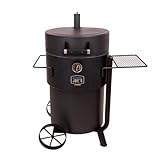
Who it suits: The Bronco Pro is for the cook who wants real charcoal barbecue without spending an afternoon babysitting a fire. It is the right pick for a busy household, for someone whose first offset experience was frustrating, or for anyone who wants to load a basket, set the intake and walk away for six to ten hours. It is also the best choice for a small patio, because a vertical drum delivers a lot of cooking capacity in a very small ground footprint.
The Bronco Pro is a 21.5 in. heavy-duty charcoal drum smoker with 366 sq. in. of grate area. The vertical format is the key design decision: heat and smoke rise from a charcoal basket at the bottom, pass a diffuser that evens out hot spots, and exit through the lid. Air enters through an adjustable intake at the bottom and leaves through the exhaust, and those two controls are the entire temperature-management system. There is no firebox to feed, no long chamber to equalize, and no lid that swings up and back over three feet of patio.
Key specs
- Cooking area: 366 sq. in. grate
- Body: 21.5 in. heavy-duty vertical drum
- Fuel: charcoal in a bottom basket, with wood chunks for smoke
- Air control: adjustable bottom intake plus lid exhaust
- Features: charcoal basket and diffuser plate, hinged lid, built-in thermometer
What the drum format buys you is efficiency. On a 12-hour brisket cook, a drum running the minion method — a small chimney of lit coals poured over a full basket of unlit briquettes — typically burns in the range of 8 to 10 lb of fuel total, because the fire creeps downward through the basket at a controlled rate. An offset of comparable output on the same cook burns an 8 to 10 lb charcoal bed for the coal base plus a steady stream of splits to maintain the fire, landing closer to 18 to 25 lb of combined fuel. At roughly $1.00–$1.50 per pound for lump charcoal and $0.60–$1.00 per pound for bulk splits, that is the difference between roughly $8–$14 and roughly $18–$28 per long cook. Over 30 long cooks a season, the drum saves several hundred dollars.
Capacity is the trade-off. A 366 sq. in. grate holds one packer brisket with room for two racks of ribs alongside, or four to five pork butts if you arrange them vertically, or six chicken halves. That is a family-and-friends cooker, not a party cooker. The workaround is a second grate — drum smokers stack vertically, so adding a rack is the cheapest capacity upgrade in barbecue. The Bronco Pro’s heavy-duty construction supports that, which is the main reason to choose it over the smaller 18 in. Bronco.
Pros
- Holds 225–275°F for many hours with minimal intervention once the intake is dialed in
- Roughly half the fuel cost per long cook compared with a same-output offset
- Very small ground footprint for the capacity it delivers
- Heavy-duty 21.5 in. drum construction supports adding a second stacked grate
- Doubles as a high-heat grill when the diffuser is removed and the intake is opened up
Cons
- 366 sq. in. is roughly one brisket plus two rib racks — less than half a large offset
- Vertical layout means dripping fat can hit the fire; a water pan or drip shield helps
- No offset firebox, so no true stick-burning flavor profile
- Ash management requires lifting out the basket between cooks
How it compares: Against the 18 in. Bronco, the Pro adds 82 sq. in. of grate and a larger drum diameter, which matters mostly because it lets you run two stacked grates without crowding. Against the Char-Broil Bronco Barrel, the Pro is the heavier-duty build with a larger grate; the Barrel offers 630 sq. in. of porcelain-coated cooking area in the mid-range tier, which is more total surface but a different construction story. Against the Longhorn, this is the effort-versus-authenticity decision in its purest form: the drum is easier and cheaper to run, the offset tastes like an offset.
4. Oklahoma Joe’s Highland Offset Charcoal Smoker and Grill – Best for First-Time Offset Owners

Who it suits: The Highland is the right first offset for almost everyone. It is the mid-range 900 sq. in. model that has become the default recommendation for backyard cooks who want to learn fire management without being punished by a six-foot chamber. It suits families of four to twelve, people who cook two to six times a month, and anyone who wants a cooker they can grow into rather than replace.
The configuration is the classic horizontal offset: a main cook chamber with a grate and an upper rack, a side firebox for charcoal and wood, and dampers at the intake and the smokestack. At 900 sq. in. total, the chamber is large enough for a full packer brisket plus sides but small enough that a single chimney of lit charcoal and one or two splits can move the temperature meaningfully. That responsiveness is the whole reason to start here.
Key specs
- Total cooking area: 900 sq. in. (main chamber plus upper rack)
- Fuel: charcoal and wood splits/chunks in an offset firebox
- Configuration: horizontal offset with side firebox, black finish
- Air control: adjustable firebox intake and smokestack exhaust dampers
- Platform: the most widely supported Oklahoma Joe’s model for covers, gaskets, baskets and tuning plates
Capacity math for the Highland: a 12–14 lb packer brisket occupies roughly 200–225 sq. in., so 900 sq. in. is theoretically four briskets and realistically three. Swap in pork butts at roughly 60–70 sq. in. each and you are looking at eight to ten at realistic packing density. Spare rib racks at roughly 120–150 sq. in. each means five racks, or four with a brisket sharing the chamber. That covers essentially every backyard scenario short of a full-blown catered event.
The Highland’s real advantage is that its flaws are fixable and cheap to fix. Factory offsets in this price class commonly leak smoke around the cook chamber lid and the firebox seam, which makes temperature control fussier than it needs to be. A 15-ft roll of high-temperature gasket tape, applied along the lid and firebox mating surfaces, closes most of that gap for a budget-tier outlay and is the single highest-value upgrade you can make. The second is a stainless firebox basket, which lifts the coal bed off the firebox floor so ash falls clear and air reaches the coals evenly. Together those two accessories change how the smoker behaves more than any other purchase in this list.
Pros
- 900 sq. in. holds three briskets or eight to ten pork butts at realistic density
- Small enough chamber to respond quickly while you learn fire management
- Best aftermarket support of any model in the lineup
- Firebox works as a direct grill for searing and finishing
- Mid-range tier pricing leaves budget for the accessories that actually improve results
Cons
- Factory lid and firebox seams often leak; expect to add a gasket
- Requires active fire-tending — this is not a set-and-forget cooker
- Consumes more fuel per pound of food than a drum or cabinet
- Needs a cover if stored outdoors, especially around the firebox seam
How it compares: Against the Laredo Series 1100, the Highland gives up about 200 sq. in. — roughly one brisket — and gains easier temperature control, lower fuel burn and a lighter, more manageable unit. For a first offset, that is the right trade. Against the Longhorn, the Highland is smaller and cheaper but shares the same basic architecture, so moving from one to the other is a capacity decision rather than a change in cooking style. Against the Bronco Pro drum, the Highland is harder to run and thirstier on fuel, but it delivers stick-burning flavor and a firebox grill that a drum cannot match.
5. Oklahoma Joe’s Canyon Combo Dual Fuel 3-Burner Propane Gas and Charcoal Smoker and Grill – Best for Dual-Fuel Flexibility
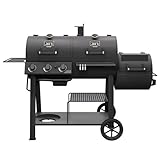
Who it suits: The Canyon Combo is for the household that cannot choose between gas and charcoal — the family that wants burgers on a Tuesday in 12 minutes and a brisket on Saturday in 12 hours, from one machine that occupies one spot on the patio. It suits people with limited patio space who would otherwise buy two cookers, and people who host often enough that cooking speed on weeknights matters as much as smoke flavor on weekends.
This is a premium-tier dual-fuel unit with 1,031 sq. in. of total cooking area, combining a three-burner propane gas grill with a charcoal smoker and grill side. In practice that means two distinct cooking zones on one cart: the gas side for direct grilling with instant, precise heat control, and the charcoal side with its smoker configuration for low-and-slow work. The gas side is what you will use most often; the charcoal side is what you bought it for.
Key specs
- Total cooking area: 1,031 sq. in. across gas and charcoal sections
- Fuel: propane (3 burners) plus charcoal and wood on the smoker side
- Configuration: combo cart with separate gas and charcoal cooking zones
- Temperature control: burner knobs with independent zones on the gas side; damper control on the charcoal side
- Footprint: a single cart footprint replacing two separate cookers
The strongest argument for the Canyon Combo is footprint consolidation. A mid-range offset plus a three-burner gas grill, set up side by side with the clearances both need, occupies a working zone in the neighborhood of 90–120 sq. ft. of patio. The Canyon Combo does both jobs from one cart, and while it still needs lid-swing clearance on both sides, it collapses that working zone considerably. If your patio is the limiting factor rather than your budget, this is the unit that solves your actual problem.
The honest limitation is that a combo rarely matches a dedicated machine at either job. The gas side will not sear like a high-output dedicated grill, and the charcoal side will not hold a 14-hour brisket like a well-tuned offset or a drum. What it does extremely well is cover 90% of backyard cooking without a second appliance. For most households that is a better real-world outcome than owning one excellent smoker they use six times a year and one excellent grill they use weekly — because the combo gets used, and used cookers beat unused ones.
Pros
- Two cooking methods, one cart — the biggest patio-space saving in this lineup
- 1,031 sq. in. of total capacity split across gas and charcoal zones
- Gas side delivers fast, precise weeknight cooking without lighting charcoal
- Charcoal side provides genuine smoke flavor for weekend cooks
- Reduces the total equipment count and therefore the total maintenance burden
Cons
- Premium tier pricing for a unit that is a compromise at both jobs
- Two fuel systems means two sets of consumables and two cleaning routines
- Propane adds a recurring cost and a tank you have to monitor
- Gas and charcoal sections have separate grease and ash cleanup needs
How it compares: Against the Highland offset, the Canyon Combo gives up low-and-slow authenticity on the charcoal side but adds a full three-burner gas grill and consolidates two appliances into one. Against the Longhorn, it is a fundamentally different proposition: the Longhorn is a specialist that does one thing very well, while the Canyon Combo is a generalist that does two things adequately. Choose the combo if your constraint is patio space or weeknight time; choose a dedicated offset or drum if your constraint is the quality of your long cooks.
6. Oklahoma Joe’s Bronco 18 in. Heavy Duty Charcoal Drum Smoker and Grill – Best for Small-Space Drum Smoking

Who it suits: The 18 in. Bronco is for the cook with a small patio, a narrow side yard, or a balcony where a full-size offset would never fit. It is also the right pick for couples and small families who smoke two to six times a month and do not need to feed a crowd — one brisket, a couple of racks of ribs, or a pork butt and some chicken. It suits anyone who wants drum-smoker convenience in the smallest possible package.
This is the mid-range 18 in. version of the Bronco drum line, with 284 sq. in. of grate area in a vertical barrel format. Charcoal goes in a bottom basket, air enters through an adjustable intake, smoke and heat rise past a diffuser and out the lid exhaust, and the hinged lid lets you check and rotate food without lifting the whole top off. It is a simpler, smaller version of the Bronco Pro, and for a lot of households that is exactly the right size.
Key specs
- Cooking area: 284 sq. in. grate
- Body: 18 in. heavy-duty vertical drum
- Fuel: charcoal in a bottom basket, with wood chunks for smoke
- Air control: adjustable bottom intake plus lid exhaust
- Features: charcoal basket, hinged lid, built-in thermometer, compact ground footprint
Capacity math for 284 sq. in.: one 12–14 lb packer brisket fills most of the grate with a little room for a rack of ribs beside it. Or two to three pork butts at roughly 60–70 sq. in. each. Or four chicken halves, or a dozen burgers if you are grilling rather than smoking. That is a real cooker, not a toy — it just is not a party cooker. If you routinely cook for more than eight people, the 21.5 in. Bronco Pro is the better buy, and the 82 extra square inches matter more than they sound.
The smaller drum has one genuine advantage over the Pro beyond price and space: it heats up faster and uses less fuel to reach and hold temperature, because there is less steel mass and less volume to bring up. A five-hour rib cook on the 18 in. Bronco burns a small basket of briquettes — often in the 4 to 6 lb range — which puts the fuel cost per short cook at just a few dollars. If your typical cook is four to six hours rather than twelve, the smaller drum is the more efficient tool for the job.
Pros
- Very small ground footprint — practical on patios where offsets are impossible
- Holds temperature for hours with minimal intervention
- Lower fuel consumption per cook than a larger drum or any offset
- Heats up quickly, which suits shorter cooks
- Mid-range tier pricing makes it a low-risk first smoker
Cons
- 284 sq. in. is roughly one brisket — no room for a large multi-item cook
- Vertical layout means fat can drip into the fire without a shield or water pan
- No direct-grill firebox; grilling means removing the diffuser and running hot
- Less aftermarket support than the Highland or Longhorn platforms
How it compares: Against the Bronco Pro 21.5 in., the 18 in. version gives up 82 sq. in. of grate and the ability to run two stacked grates comfortably, but costs less and fits where the Pro will not. Against the Char-Broil Bronco Barrel with its 630 sq. in. of porcelain-coated cooking area, the 18 in. Bronco is smaller in total surface but a heavier-duty build. Against the Rambler tabletop, the Bronco is a genuine smoker rather than a compact grill — the Rambler is 218 sq. in. of direct heat, while the Bronco gives you six-hour temperature stability.
7. Oklahoma Joe’s Bandera Smoker and Grill – Best for Vertical Cabinet Capacity
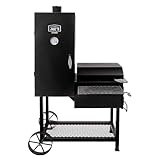
Who it suits: The Bandera is for the cook who needs maximum food volume from minimum ground space. A vertical cabinet smoker stacks multiple cooking grates in a tall, narrow body, so it delivers far more total cooking area per square foot of patio than any horizontal offset. It suits people who host large gatherings, who cook for a crowd once a month rather than twice a week, and whose patio simply cannot accommodate a six-foot offset.
The Bandera is a premium-tier vertical cabinet smoker and grill with an offset charcoal and wood firebox feeding a tall cooking cabinet containing multiple stacked grates. The architecture is different from a horizontal offset in a way that matters: instead of heat traveling the length of a long chamber, heat and smoke rise through a stack of racks, so the lower grates run hotter and the upper grates run cooler. That vertical temperature gradient is both the Bandera’s defining characteristic and the thing you have to learn to use.
Key specs
- Configuration: vertical cabinet smoker with multiple stacked cooking grates
- Fuel: charcoal and wood in an offset firebox
- Capacity profile: high total grate area in a narrow ground footprint
- Temperature profile: warmer lower grates, cooler upper grates — a built-in gradient
- Tier: premium; assembly is a multi-step build given the cabinet structure
That gradient is not a flaw — it is a tool once you understand it. Lower racks work for poultry and sausages that benefit from higher heat; middle racks suit ribs and butts; upper racks are ideal for delicate items, for finishing sauces, or for holding food warm while you load the next batch. Cooks who fight the gradient by trying to make every rack identical spend a lot of energy on it. Cooks who assign food to racks based on temperature get more done per cook than they would on a horizontal chamber of the same total area.
The Bandera’s main practical cost is cleanup and heat management. A cabinet collects grease and ash across multiple levels, so a full clean takes longer than wiping down a single-grate offset chamber. And because the firebox feeds a tall column, the fire needs a steady, well-established coal bed to push heat all the way up — a thin fire produces a big temperature spread between the bottom and top racks. Budget a slightly longer learning curve than a horizontal offset, and expect to build a slightly larger coal base.
Pros
- Highest cooking area per square foot of patio in the entire lineup
- Multiple stacked grates let you cook several different foods at once
- Natural vertical temperature gradient is useful once you plan around it
- Genuine charcoal and wood firebox for real smoke flavor
- Narrow footprint fits patios that cannot take a long horizontal offset
Cons
- Vertical temperature spread requires planning; racks are not interchangeable
- Multi-level cleanup takes longer than a single-chamber offset
- Premium tier pricing
- Needs a well-established coal bed to push heat through the full column
How it compares: Against the Longhorn, the Bandera trades a long horizontal chamber for a tall vertical one. The Longhorn has more even side-to-side temperature; the Bandera has more total capacity in less floor space but a bigger top-to-bottom spread. If you have a wide patio and want even heat, take the Longhorn. If you have a narrow patio and want volume, take the Bandera. Against the Bronco Pro drum, the Bandera offers more total grate area and a real offset firebox, while the drum offers far simpler operation and lower fuel burn.
8. Oklahoma Joe’s Rambler Portable Tabletop Charcoal Grill – Best for Portable and Tailgate Cooking

Who it suits: The Rambler is for anyone whose cooking space is a table, a tailgate, a campsite or a balcony. It suits apartment dwellers, RV owners, campers, small households of one or two, and anyone who wants charcoal flavor without committing patio space to a full smoker. It is also a sensible second cooker for people who already own a large offset and want something quick for weeknights