Our Top Picks
 Backyard Discovery Mount Mckinley Cedar Wood Swing Set186 x 150 x 119 inches308 PoundsCheck on Amazon
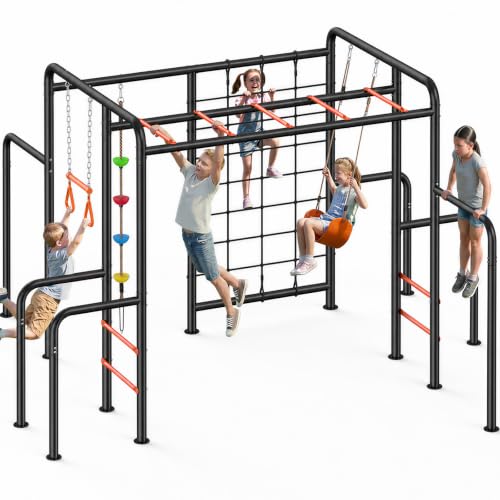 Hapfan 6-in-1 Outdoor Jungle Gym with Monkey Bars132.67 x 130.7 x 79.52 inches145.5 PoundsCheck on Amazon
 Backyard Discovery Buckley Hill Cedar Wood Swing SetMedium76.81 x 17.76 x 7.63 inches136.7 PoundsCheck on Amazon
 Backyard Discovery Cedar Cove Cedar Wood Swing SetLarge220.4 x 183.4 x 119.4 inches492.1 PoundsCheck on Amazon

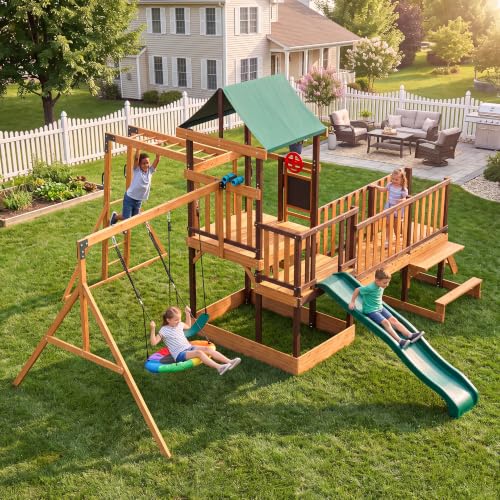
For most families with roughly 20 × 20 feet of level, usable yard, the best outdoor playset is the Backyard Discovery Mount McKinley — a cedar swing set with a raised play deck, wave slide, double rock wall and rope ladder that covers the 3-to-10-year window without the footprint of a full clubhouse model. If you are buying a first playset for toddlers, or you are working to a tight budget, the Step2 Woodland Climber II (graded for ages 2–6) is the simplest and safest place to start. If you would rather buy once and buy big, the Backyard Discovery Cedar Cove is the premium pick, combining a spiral tube slide, a wave slide and a clubhouse in a single structure. The twelve sets below range from about 4 × 4 feet of patio-scale molded plastic to 16 × 13 feet of cedar, and they differ far more in assembly time, anchoring requirements and age grading than the product photos suggest. This guide compares them on the things that actually decide whether a playset gets used for ten years or sits ignored by year two.
Top 3 Picks
Best overall: Backyard Discovery Mount McKinley
The best balance of footprint, play variety and longevity for a family with school-age kids. Cedar construction, a raised deck, a wave slide, a double rock wall and a rope ladder give you climbing, sliding and pretend play in one structure, and it fits a mid-size yard that would feel cramped with a clubhouse set. It is the set most families can grow into rather than out of.
Best budget: Step2 Woodland Climber II
The lowest-commitment real playset on this list. It is molded plastic rather than wood, graded for ages 2–6, and it sets up in well under an hour with no anchoring hardware to buy. It will not survive to your child’s tenth birthday as an interesting toy, but as a first climber and slide for a toddler it is hard to beat on cost per month of use.
Best premium: Backyard Discovery Cedar Cove
Two slides, a clubhouse and a full accessory wall in one cedar structure. It is the pick when you have the yard, the budget and the patience for a weekend-plus build, and when you want a set that will still look like a destination when the kids are eight and nine rather than a plastic relic. Expect the longest assembly time and the largest use zone of anything here.
Quick Comparison
The table below covers all twelve sets in this guide. Figures are class-typical approximations for each product type and model family — dimensions, age grading and weight limits vary by exact configuration, so confirm them on the product page before you buy. Price tiers are relative: budget means the lowest price band in this category, mid-range means the middle, premium means the top band.
| Product | Best for | Material | Age range (approx.) | Footprint (approx.) | Typical assembly | Price tier |
|---|---|---|---|---|---|---|
| Backyard Discovery Mount McKinley | All-round family set, school-age kids | Cedar wood | 3–10 years | 13 × 11 ft | 8–12 hrs, 2 adults | Mid-range |
| Hapfan 6-in-1 Jungle Gym | Climbing-first kids, tighter yards | Powder-coated steel frame | 3–10 years | 10 × 9 ft | 3–6 hrs, 2 adults | Mid-range |
| SunSwell Wooden Swing Set | Buy-once wooden set, larger yard | Wood (cedar/pine class) | 3–10 years | 12 × 10 ft | 6–10 hrs, 2 adults | Premium |
| Backyard Discovery Buckley Hill | Small yards, first wooden swing set | Cedar wood | 3–8 years | 9 × 9 ft | 4–8 hrs, 2 adults | Budget |
| EROMMY 6-in-1 Wooden Swing Set | Compact wooden set with slide | Wood | 3–8 years | 11 × 9 ft | 4–8 hrs, 2 adults | Mid-range |
| Backyard Discovery Cedar Cove | Maximum play value, big yards | Cedar wood | 3–10 years | 16 × 12 ft | 10–16 hrs, 2 adults | Premium |
| Albott Wooden Swing Set | Playhouse-style pretend play | Wood | 3–8 years | 10 × 9 ft | 4–8 hrs, 2 adults | Mid-range |
| MOCUTEEN 8-in-1 Toddler Climber | Toddlers, indoor/outdoor, tiny spaces | Molded plastic | 1–4 years | 5 × 4 ft | 30–60 min, 1 adult | Budget |
| Backyard Discovery Canyon Creek | Pretend play + swings, large yard | Cedar wood | 3–10 years | 15 × 12 ft | 10–14 hrs, 2 adults | Premium |
| Step2 All Around Playtime Patio | Shaded toddler playhouse, patio use | Molded plastic | 2–6 years | 4 × 4 ft | 20–45 min, 1 adult | Budget |
| Backyard Discovery Sterling Point | Bridge + raised clubhouse, biggest yards | Cedar wood | 3–10 years | 16 × 13 ft | 12–18 hrs, 2 adults | Premium |
| Step2 Woodland Climber II | First climber and slide, ages 2–6 | Molded plastic | 2–6 years | 4 × 3 ft | 20–45 min, 1 adult | Budget |
How We Chose
This roundup is built from published product specifications, manufacturer documentation and the safety standards that govern residential play equipment in the United States, principally ASTM F1148 for home playground equipment and the Consumer Product Safety Commission’s guidance on use zones and surfacing. We did not test, assemble or own any of these sets; the judgements here come from comparing what each product is built to do against the situation a buyer is actually in.
Four criteria drove the picks. First, category fit: a molded plastic toddler climber and a 16-foot cedar clubhouse set are not competitors, so each product is judged against sets of its own type rather than against the whole list. Second, age span and upgrade path — a set that holds a child’s interest from three to ten is worth more than one that is outgrown at five, and we flag clearly where each product’s useful life ends. Third, footprint and yard reality, including the use zone a set needs beyond its own frame, because a playset that technically fits but leaves no clear fall space is a bad purchase regardless of quality. Fourth, ownership load: assembly hours, anchoring hardware, surface requirements and ongoing maintenance. Where a manufacturer’s exact figure was not something we could confirm, we describe the spec class instead of inventing a number, and we say so.
1. Backyard Discovery Mount McKinley – Best for Growing Families Who Want One Set That Lasts
As an Amazon Associate we earn from qualifying purchases at no extra cost to you.

The Mount McKinley is the set to buy when you want one structure that a five-year-old can climb and a nine-year-old can still find interesting, and when your yard can spare roughly 13 × 11 feet of frame plus clearance on every side. It sits in the middle of Backyard Discovery’s cedar range: noticeably more substantial than the budget Buckley Hill, considerably less sprawling than the clubhouse models at the top of the line. The listing name spells out the play pattern — wave slide, play deck, double rock wall, rope ladder — and it is a climbing-first layout rather than a slide-first one, which is generally the better bet for longevity, because climbing is the activity kids return to long after a single slide has lost its novelty.
Key specs at a glance
- Material: cedar lumber frame. Cedar is the default for residential wooden swing sets because it resists rot and insect damage more naturally than pine and holds up to weather without constant refinishing.
- Deck height: raised play deck in the region of four feet off the ground — high enough to feel like a lookout, low enough that a supervised five-year-old can get up and down.
- Named play features: wave slide, raised play deck, double rock wall, rope ladder.
- Age range: typically graded for about 3 to 10 years, the standard band for wooden backyard sets of this size.
- Footprint: roughly 13 × 11 feet, before the use zone.
- Assembly: plan on 8–12 hours with two adults, ideally spread over two days.
- Price tier: mid-range.
The double rock wall is the detail that separates this from cheaper wooden sets. Two climbing faces give you a natural progression: the easier side for a younger child, the steeper side as grip strength and confidence build. The rope ladder adds a third route up that rewards coordination rather than strength, so siblings of different ages can use the same deck without one of them being stuck on the sidelines. That variety is what keeps a set in service past the first summer, when the initial novelty of a slide has worn off.
Where the Mount McKinley asks something of you is in installation and siting. A cedar set at this scale should be anchored — either with ground stakes into soil or concrete footings if your ground is loose or sloped — and it needs a level base. Budget the assembly weekend honestly: sorting hardware, squaring the frame and getting the deck level takes longer than most buyers expect, and a set assembled on a slope will rack and loosen over time. Once it is up and level, the maintenance load is modest: re-tighten hardware after the first couple of weeks, then check swing hardware and bolts a few times a season, and expect cedar to weather to a silver-grey if you leave it unfinished, or to hold its colour if you re-seal it every year or two.
Pros
- Three different routes to the deck (two rock walls plus rope ladder) suit siblings of different ages.
- Cedar frame is the most durable material choice in this category for a permanent backyard installation.
- Mid-size footprint fits yards that cannot accommodate a clubhouse set with a bridge.
- Clear upgrade path: it is a legitimate set for a three-year-old and still usable at nine or ten.
- Simple accessory list means fewer parts to fail or replace down the line.
Cons
- Assembly is a full weekend project with two adults, not an afternoon.
- Requires anchoring and a level site; a sloped yard means extra prep work or concrete.
- No clubhouse or enclosed play space, so pretend play is more limited than on the premium models.
- Wood needs periodic hardware checks and optional re-sealing, unlike molded plastic.
Compared with the Buckley Hill, the Mount McKinley costs more and takes twice as long to build, but it buys roughly two extra years of usable age range and a second climbing wall — the better value if your kids are already past four. Compared with the Cedar Cove, it gives up the clubhouse, the second slide and the accessory wall in exchange for a footprint several feet smaller in each direction and a much shorter build. If your yard is generous and your budget stretches, the Cedar Cove is the more exciting set; if you want the sensible middle, this is it.
2. Hapfan 6-in-1 Outdoor Jungle Gym – Best for Climbing-First Kids in Tighter Yards
The Hapfan 6-in-1 is the alternative for a family whose kids care about monkey bars and swinging far more than they care about a clubhouse, and whose yard is measured in feet rather than in fractions of an acre. A steel-framed jungle gym with monkey bars and swings occupies less ground than a wooden swing set with a deck, because there is no elevated platform to build around — the frame is the structure. If your kids are the type who hang upside down from everything, this is a more efficient use of your yard than a cedar deck set.
Key specs at a glance
- Material: powder-coated steel frame. This is the standard construction for backyard jungle gyms because it is strong in tension and does not rot.
- Configuration: six activities in one frame, with monkey bars and swings called out in the listing name; confirm the exact accessory mix for the configuration you buy.
- Age range: typically graded for about 3 to 10 years.
- Footprint: roughly 10 × 9 feet.
- Assembly: 3–6 hours with two adults — the shortest build of any full-size set here.
- Price tier: mid-range.
The practical advantages of a steel frame are assembly time and maintenance. There is no deck to square, no rock wall to bolt on and no wood to re-seal, so a build that would take a full weekend in cedar takes an afternoon. Steel also does not check, splinter or grey the way untreated lumber does, and a powder-coated finish resists rust far better than painted tube. For a family that wants a playset up and running this weekend rather than next month, that is a real difference.
The trade-offs are in play value and permanence. Without an elevated deck, there is no slide platform and no lookout space, so the set skews toward physical, upper-body play — monkey bars, swinging, climbing — rather than pretend play. That is excellent for a seven-year-old and less compelling for a four-year-old who wants a house to hide in. Steel frames also tend to be lighter, which means anchoring matters more rather than less: a light frame that is not secured can tip or walk when a child swings hard, and the listing’s own anchoring hardware should be used exactly as specified, or upgraded to ground anchors set in concrete if your soil is sandy or your yard slopes.
Pros
- Fastest full-size assembly on this list — typically an afternoon, not a weekend.
- Steel frame needs no staining, sealing or wood repairs.
- Compact footprint relative to the number of activities it packs in.
- Monkey bars are the single highest-repetition play feature for school-age kids.
- Less expensive to own long term than a wooden set of equivalent footprint.
Cons
- No deck, slide platform or clubhouse, so pretend play is limited.
- Lighter than a cedar set, so anchoring is essential and must be done properly.
- Metal surfaces get hot in direct summer sun — site it with afternoon shade if you can.
- Upper-body focused, which suits some kids better than others.
Against the Mount McKinley, the Hapfan wins on assembly time, footprint and maintenance, and loses on play variety — no deck, no rock wall, no slide-based pretend play. If your kids are climbers and your weekends are short, take the steel frame. If you want the set that a four-year-old and a nine-year-old can both use in different ways, the cedar deck set is the better long-term purchase. Against the MOCUTEEN toddler climber, it is a completely different product for a completely different age band: the MOCUTEEN is for under-fives and indoor use, the Hapfan for school-age kids outdoors.
3. SunSwell Wooden Swing Set – Best for a Buy-Once Premium Wooden Set

The SunSwell wooden swing set is for the buyer who has decided to spend once and keep the set for a decade. It is a premium-tier wooden playset with a footprint around 12 × 10 feet, which places it above the budget and mid-range wooden sets here in scale but below the sprawling clubhouse models. If you want the look and durability of real timber without committing half your lawn, this is the sensible premium option.
Key specs at a glance
- Material: wood frame, cedar or cedar-class lumber — the standard for premium residential swing sets.
- Configuration: swing set with slide and elevated play platform; confirm the accessory list for the exact bundle.
- Age range: typically about 3 to 10 years.
- Footprint: roughly 12 × 10 feet, plus use zone.
- Assembly: 6–10 hours with two adults.
- Price tier: premium.
What you are paying for at this tier is lumber quality and hardware. Premium wooden sets use thicker beams and better fasteners — often galvanised or coated hardware designed not to rust at the joints — and the difference shows up in year four, not year one. A cheap wooden set wobbles and loosens as the frame racks; a well-built one stays square if it was assembled level and anchored properly. Thicker beams also mean higher per-child weight capacity in practice, and more tolerance for the two-kids-on-the-swing-beam scenario that every set eventually meets.
The honest caveat about premium wooden sets is that the value only materialises if you install them properly. The most common failure mode is not a manufacturing fault — it is a frame assembled on ground that was not levelled, anchored with stakes that pull out in soft soil, and never re-tightened. If you buy at this tier, budget for a proper base: level the ground, use concrete footings if your soil is loose, and plan on re-checking every bolt and bracket a fortnight after the build and again at the start of each season. Do that and a set at this level will comfortably outlast the plastic climbers and most of the mid-range wooden sets in this guide.
Pros
- Substantial timber frame with better hardware than budget wooden sets.
- Footprint stays reasonable for a premium product — around 12 × 10 feet.
- Holds resale or hand-me-down value far better than molded plastic.
- Repairable: individual boards and hardware can be replaced rather than the whole unit.
- Longest realistic service life of any wooden option here if anchored and maintained.
Cons
- Premium price tier for a set that still has no clubhouse or enclosed play space.
- Longer assembly than steel-frame or budget alternatives.
- Requires anchoring, a level site and periodic re-sealing.
- Overkill if your children are already seven or eight and will age out within a few years.
Compared with the Cedar Cove, the SunSwell gives up the clubhouse, the second slide and the accessory wall, but also gives up a good deal of footprint and assembly time. If pretend play is the main draw, the Cedar Cove is the better premium buy; if you mainly want a durable swing-and-slide structure with timber that will still be sound in 2035, the SunSwell is the more focused purchase. Compared with the Mount McKinley, it is a step up in lumber and hardware quality for a similar footprint — the right call if you plan to keep the set permanently rather than pass it on.
4. Backyard Discovery Buckley Hill – Best for Small Yards and First Wooden Swing Sets

The Buckley Hill is the wooden swing set for a yard that cannot host a 16-foot structure. At roughly 9 × 9 feet, it is the most compact cedar set in this guide, and it is priced in the budget tier, which makes it the natural first wooden playset for a family moving up from a plastic climber. The listing name lists a wave slide, play deck, rock wall ladder and belt swings — a complete, classic layout in miniature.
Key specs at a glance
- Material: cedar wood frame.
- Named features: wave slide, play deck, rock wall ladder, belt swings.
- Deck height: lower than the full-size sets — class-typical for compact models is around three to four feet.
- Age range: typically graded for about 3 to 8 years; the compact scale is the limiting factor, not the build quality.
- Footprint: roughly 9 × 9 feet.
- Assembly: 4–8 hours with two adults.
- Price tier: budget.
The case for the Buckley Hill is straightforward: it gives you cedar construction, a real slide and a real deck at the lowest price of any wooden set here, and it fits a yard that would otherwise be limited to molded plastic. Belt swings are the most durable and most universally liked swing type for this age band — they take two children sitting side by side without the pinching risk of some alternatives, and they are simple to replace when the chain or seat eventually wears.
The rock wall ladder is a smart compromise on a compact set. Rather than two full climbing faces, you get one angled climbing route plus a ladder, which keeps the structure narrow enough for a small yard while still giving two ways up. The lower deck height is a genuine safety benefit for younger children, because fall height is the single biggest factor in injury severity on home playsets, and a lower platform means a shorter potential fall.
The limit is age. A compact set with a modest deck will be outgrown sooner than a full-size one — realistically by eight or nine rather than ten or eleven — and the swing beam length constrains how high a child can swing. If your children are three and five, that is fine and the savings are real. If they are already seven and nine, you will be replacing this within a couple of years, and the mid-range Mount McKinley becomes the cheaper decision over the full period of ownership.
Pros
- Smallest footprint of any wooden set in this guide — workable in a modest yard.
- Budget price tier with genuine cedar construction.
- Lower deck height reduces fall severity for younger children.
- Belt swings are durable and easy to replace as consumables.
- Shortest wooden-set assembly time here.
Cons
- Outgrown earlier than full-size sets — realistically around age eight.
- Shorter swing beam limits swing height.
- Fewer play features than mid-range wooden sets at a similar footprint.
- Still needs anchoring and a level base despite the smaller scale.
Against the EROMMY 6-in-1, the Buckley Hill is smaller, cheaper and slightly more limited in activities, but it is a genuine cedar set from a long-established wooden playset manufacturer. Against the Mount McKinley, it is the budget answer to the same question — the Mount McKinley simply lasts two years longer and climbs better. If your yard is tight and your kids are small, take the Buckley Hill; if you have the space, spend the difference.
5. EROMMY Wooden Swing Set 6-in-1 – Best for a Compact Wooden Set With Slide
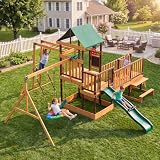
The EROMMY 6-in-1 is the mid-range wooden option for families who want timber rather than steel but do not want a clubhouse-scale structure. At roughly 11 × 9 feet it is a shade larger than the Buckley Hill and a shade smaller than the Mount McKinley, and the listing name highlights the slide as the headline feature alongside the six-activity configuration. It suits a yard of moderate size and children in the three-to-eight range who still want a slide as the centrepiece.
Key specs at a glance
- Material: wood frame.
- Configuration: six play activities in one set, with a slide called out in the listing name; confirm the accessory list for the exact bundle.
- Age range: typically about 3 to 8 years.
- Footprint: roughly 11 × 9 feet.
- Assembly: 4–8 hours with two adults.
- Price tier: mid-range.
Six-in-one configurations are worth understanding properly before you buy, because the number is a marketing convention rather than a standard. It generally counts each distinct activity — slide, swing, climbing element, and so on — as one of the six, so a set with a slide, two swings, a ladder, a climbing wall and a lookout platform would be described as six activities. That is not a trick, but it does mean you should read the accessory list rather than the headline number: six activities can mean six things your child will use weekly, or it can mean six things where two of them are decorative.
On a wooden set at this size, the slide is the piece that determines how much use the set gets in the first two years, and a wave slide is the right choice for younger children — the wavy profile slows the descent slightly compared with a straight slide, which reduces the speed at the bottom and the run-out distance needed. That matters for small yards, where the exit zone is often the tightest constraint.
The maintenance profile is the same as any wooden set: check and re-tighten hardware after the first fortnight, keep the frame anchored, and expect to re-seal every year or two if you want to preserve the colour. Wooden sets in this band are also heavier than steel jungle gyms, which makes them more stable once anchored but harder to move if you decide to reposition them later — pick the site before you build, not after.
Pros
- Wooden construction at a mid-range price with a compact footprint.
- Slide-led layout that suits younger children well.
- Six activities give more variety than a basic swing-and-slide set.
- Shorter assembly than the large cedar clubhouse sets.
- Easier to fit into an average suburban yard than 15-foot-plus models.
Cons
- Age range tops out around eight rather than ten.
- No clubhouse or enclosed pretend-play space.
- Wood requires periodic sealing and hardware checks.
- Accessory mix varies by configuration, so the “six” needs verifying before purchase.
Compared with the Buckley Hill, the EROMMY is bigger, a tier more expensive and slightly longer-lived, with one more activity in the mix — the sensible upgrade if your yard allows it. Compared with the Mount McKinley, it gives up the second climbing face, some deck height and about two years of usable age range, but it costs less and assembles faster. It is the middle of the middle, and it does that job well.
6. Backyard Discovery Cedar Cove – Best for Maximum Play Value in a Large Yard

The Cedar Cove is the premium pick for a family with a big yard and a big appetite for play variety. The listing name lists a spiral tube slide, a wave slide, a clubhouse, a toy grill and a snack stand — two completely different sliding experiences plus an enclosed pretend-play space, all in cedar. If you have roughly 16 × 12 feet to dedicate to a playset and you want the structure that will still be the most interesting thing in the garden when your kids are nine, this is the one.
Key specs at a glance
- Material: cedar wood frame.
- Named features: spiral tube slide, wave slide, clubhouse, toy grill, snack stand.
- Age range: typically about 3 to 10 years.
- Footprint: roughly 16 × 12 feet, plus use zone.
- Assembly: 10–16 hours with two adults — plan on two full days.
- Price tier: premium.
The two-slide configuration is the feature that justifies the price. A spiral tube slide and a wave slide appeal to different ages and different moods: the tube slide is enclosed, which feels faster and more daring to a seven-year-old, while the wave slide is open and reassuring for a four-year-old. Siblings can slide simultaneously without queuing, which sounds trivial until you have watched two children negotiate turn-taking on a single slide for an entire summer.
The clubhouse, toy grill and snack stand shift the set toward pretend play, which is the activity that outlasts everything else. Climbing and sliding peak around ages six to eight; imaginative play with a defined space often continues past ten, especially when there are two or more children to share it. That is the real argument for a clubhouse set over a pure swing-and-slide structure, and it is the argument for spending at this tier rather than the tier below.
The cost is in space and installation. A set at this scale needs a serious use zone — the CPSC’s residential guidance calls for a clear fall zone of about six feet on all sides of stationary equipment, extending further at the exit of a slide — so a 16 × 12 footprint can easily consume a 28 × 24 area once you count clearance. Assembly is a two-day job with two reasonably capable adults, and it should be anchored, ideally with concrete footings given the height of the structure and the loads the slides and swings will take. Set aside the weekend properly; a set this size assembled in a hurry on unlevel ground will loosen and sway within a season.
Pros
- Two distinct slides plus a clubhouse — the widest activity range in this guide.
- Pretend-play features (grill, snack stand) extend the set’s useful life past the climbing years.
- Cedar construction with the durability profile you would expect at the premium tier.
- Large enough for multiple children to play simultaneously without conflict.
- Strong hand-me-down and resale value.
Cons
- Largest use-zone requirement here — not suitable for a small yard.
- Two-day assembly and a genuine anchoring project.
- Highest price tier.
- More surfaces and parts to inspect and maintain each season.
Against the SunSwell, the Cedar Cove is bigger, more expensive and far more playful, but it demands roughly four extra feet in each dimension and several more hours of assembly. If your yard is tight, the SunSwell is the better premium choice; if space is not the constraint, the Cedar Cove gives you materially more to do. Against the Canyon Creek, the difference is emphasis rather than scale: the Canyon Creek leans further into pretend play with a play kitchen and picnic area, while the Cedar Cove leans into sliding with two slides. Pick the one that matches what your kids actually do.
7. Albott Wooden Swing Set – Best for Playhouse-Style Pretend Play

The Albott wooden swing set is the mid-range option for families whose children are more interested in making up games than in climbing higher. The listing name highlights an outdoor playset with a playhouse, which puts it in a slightly different category from the slide-led sets: the enclosed or semi-enclosed space is the centrepiece, and the swinging and sliding support it. At roughly 10 × 9 feet it fits a moderate yard without dominating it.
Key specs at a glance
- Material: wood frame.
- Named feature: playhouse-style play area as the headline element, alongside swing and slide components.
- Age range: typically about 3 to 8 years.
- Footprint: roughly 10 × 9 feet.
- Assembly: 4–8 hours with two adults.
- Price tier: mid-range.
Playhouse-style sets are undervalued in the playset market because they photograph less dramatically than a two-storey clubhouse with a tube slide. In practice, a defined play space is the feature that keeps children outdoors longest. A playhouse becomes a shop, a spaceship, a kitchen or a hideout depending on the day, and it does not require the child to be physically brave. For a cautious four-year-old who is nervous of heights, a playhouse set can deliver more hours of play than a taller, more thrilling structure.
Wooden playhouse sets in this band generally share the same ownership profile as other wooden sets: assembly in the region of half a day with two adults, anchoring required, hardware to re-tighten after the first fortnight, and optional annual re-sealing. The parts that wear first are predictable — swing seats and their chains or ropes, and the high-traffic boards around doorways and ladder rungs. Swings and ropes are consumables and should be inspected every few months; a frayed rope or a cracked seat is cheap to replace and is the single most common safety issue on older wooden sets.
The main limitation is scale. A playhouse set at this footprint tends to have a modest deck height and a shorter slide, and the age range tops out around eight. If your children are already seven, you will get two or three good years out of it. If they are three and five, you will get the full span, and the pretend-play emphasis means the later years are not wasted.
Pros
- Playhouse space supports imaginative play, which outlasts climbing and sliding.
- Good option for cautious children who are not drawn to tall climbing structures.
- Moderate footprint and mid-range price.
- Shorter assembly than the large clubhouse models.
- Wood construction with replaceable, serviceable parts.
Cons
- Less climbing and sliding variety than slide-led sets at a similar price.
- Age range ends around eight.
- Wood needs sealing and hardware checks.
- Playhouse interiors need cleaning — they collect leaves, water and garden debris.
Compared with the EROMMY 6-in-1, the Albott trades some activity count for a dedicated enclosed space; if your child narrates elaborate games, take the Albott, and if they just want to go fast down a slide, take the EROMMY. Compared with the Cedar Cove, it is the same idea at roughly half the scale and a lower price tier, without the second slide or the accessory wall.
8. MOCUTEEN 8-in-1 Toddler Climber and Slide Playset – Best for Toddlers in Tiny Spaces

The MOCUTEEN 8-in-1 is not a backyard swing set in the sense the rest of this guide means — it is a molded plastic toddler activity centre, sized around 5 × 4 feet, graded for roughly ages one to four, and usable indoors as well as out. The listing name lists eight activities including a basketball hoop, which tells you what it is: a compact, self-contained play station for a child who is too young for a climbing frame with a four-foot deck.
Key specs at a glance
- Material: molded plastic.
- Configuration: eight activities in one unit, including a slide, climbing elements and a basketball hoop; the accessory mix varies, so check the exact listing.
- Age range: typically about 1 to 4 years, with a per-child weight limit in the region of 40–50 lb — confirm the stated figure before purchase.
- Footprint: roughly 5 × 4 feet.
- Assembly: 30–60 minutes with one adult, often less.
- Price tier: budget.
The case for a product like this is transition management. A one- or two-year-old cannot safely use a wooden swing set with a raised deck, but they can use a low slide and a small climbing step. Buying a plastic toddler centre first means you are not paying for a large structure two years before your child can use it, and it gives you time to plan the permanent playset properly — site selection, ground levelling, anchoring, surfacing — rather than rushing it.
The practical advantages are obvious: it assembles in under an hour, it needs no anchoring, it can be moved indoors on wet days or into shade in high summer, and it wipes clean. For renters, or for families who are not certain how long they will stay in a property, that portability matters a great deal. A wooden set is effectively a permanent installation; a plastic toddler climber is furniture.
The limits are equally clear. It is outgrown by four, sometimes earlier, and the low slide provides very little challenge for a confident three-year-old. Molded plastic also degrades in prolonged direct sun — UV exposure causes fading and, over years, embrittlement of thin sections, which is why these units last best if stored or shaded when not in use. If you have a toddler and a five-year-old, one product cannot serve both; you would need this plus a proper set, or a wooden set with a very low first stage.
Pros
- Lowest price tier and quickest assembly of anything in this guide.
- Small enough for a patio, balcony or indoor playroom.
- No anchoring, no ground preparation, no maintenance.
- Appropriate for the 1–3 age band that cannot use a full playset.
- Portable, which suits renters and families planning to move.
Cons
- Outgrown by about age four.
- Very limited challenge for confident preschoolers.
- Plastic fades and can become brittle with years of direct sun.
- Low weight capacity compared with any wooden or steel set.
Against the Step2 Woodland Climber II, the MOCUTEEN packs more separate activities into a similar footprint and leans slightly younger, while the Step2 is the more robust, better-known plastic climber for the 2–6 band. Against any wooden set here, it is a different purchase entirely — a first toy rather than a permanent installation. Buy it as a two-year bridge, not as the playset your family keeps.
9. Backyard Discovery Canyon Creek – Best for Pretend Play Plus Swings in a Large Yard

The Canyon Creek is the premium cedar set for families whose children want to cook, host and hide as much as they want to climb. The listing name lists a wave slide, clubhouse, play kitchen, picnic area and belt swings — a structure built around sociable, imaginative play with a swing beam attached. At roughly 15 × 12 feet it needs a large yard, and it is priced at the premium tier.
Key specs at a glance
- Material: cedar wood frame.
- Named features: wave slide, clubhouse, play kitchen, picnic area, belt swings.
- Age range: typically about 3 to 10 years.
- Footprint: roughly 15 × 12 feet, plus use zone.
- Assembly: 10–14 hours with two adults.
- Price tier: premium.
The play kitchen and picnic area are what distinguish this from a standard clubhouse set. A picnic area under or beside the structure turns the playset into a social hub — children eat there, siblings negotiate there, and parents get somewhere to sit that is not a kitchen chair dragged across the lawn. In practice, sets with an integrated seating area get used on more marginal days, because the structure becomes a place to be rather than only a thing to climb.
The clubhouse plus kitchen combination is also the strongest long-term bet in this whole guide for the eight-to-ten age bracket. Sliding and swinging decline in appeal as children get older and heavier; role-play and hangout space does not. If you are buying for a five-year-old and want the set to still matter at ten, pretend-play features are the ones to prioritise, and this set prioritises them deliberately.
What it demands in return is space and preparation. A footprint this size needs a use zone of about six feet clear on all sides under CPSC residential guidance, and more at the slide exit, so the real ground requirement is closer to 27 × 24 feet of level, obstacle-free space. Assembly is a two-day project. Anchoring should be taken seriously — concrete footings are the safer choice for a structure this tall and this heavily loaded — and the ground should be levelled before the first board goes down. Surfacing under and around the set should be shock-absorbing: wood chips, engineered wood fibre or rubber, at a depth appropriate to the fall height of the highest platform, which for a set of this scale typically means several inches of loose-fill material maintained at that depth year-round.
Pros
- Play kitchen and picnic area extend the set’s relevance into the older age range.
- Clubhouse provides genuine enclosed play space.
- Cedar construction with premium-tier durability.
- Integrated seating makes the playset a family gathering point.
- Enough capacity for several children to play at once.
Cons
- Large footprint and a substantial use-zone requirement.
- Two-day assembly and a serious anchoring job.
- Highest price tier.
- More surfaces, nooks and kitchen parts to clean and inspect.
Against the Cedar Cove, the Canyon Creek trades the spiral tube slide and snack stand for a play kitchen and picnic area — same scale, same tier, different play emphasis. Choose the Cedar Cove if your kids are thrill-seekers, the Canyon Creek if they are hosts. Against the Sterling Point, the Canyon Creek is comparable in size but replaces the bridge and raised clubhouse with the kitchen and seating, so the choice again comes down to whether your children prefer traversing and lookout play or domestic role-play.
10. Step2 All Around Playtime Patio with Canopy – Best for a Shaded Toddler Playhouse
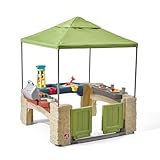
The Step2 All Around Playtime Patio is a molded plastic playhouse with a canopy, sized around 4 × 4 feet, intended for children roughly two to six. It is not a climbing structure at all — it is a shaded pretend-play space with interactive features, and it belongs on a patio or a flat lawn rather than on a play surface. If your child is in the thick of imaginative play and you want something that keeps them out of the sun while they do it, this is the product type to look at.
Key specs at a glance
- Material: molded plastic with a fabric or molded canopy.
- Configuration: playhouse-style unit with interactive indoor-outdoor play features; the exact feature list varies, so check the listing.
- Age range: typically about 2 to 6 years, with a per-child weight limit in the region of 40–50 lb for climbing elements.
- Footprint: roughly 4 × 4 feet.
- Assembly: 20–45 minutes with one adult.
- Price tier: budget.
The canopy is the feature that makes this more than a plastic house. Shade extends usable playtime significantly in summer — a plastic playhouse in full sun becomes uncomfortably hot inside by mid-morning, and molded plastic surfaces can reach temperatures that are unpleasant to touch. A canopy keeps the interior tolerable through the middle of the day, which is exactly when children want to be outside and exactly when direct-sun play is least comfortable.
Step2 is one of the longest-established names in molded plastic play equipment, and the practical benefit of buying from a manufacturer of that scale is part availability. Plastic playsets rarely fail structurally, but panels crack, canopies fade and small parts go missing; a product line that has been on the market for years is more likely to have replacement parts available than a short-run import. That is worth weighing against a slightly lower price elsewhere.
The limitations are the ones that apply to all molded playhouses. There is no real climbing challenge, so a physically adventurous five-year-old will lose interest; the play value depends almost entirely on how much your child enjoys pretend play. It is also light, so in exposed gardens it should be sited out of the prevailing wind or weighted down, and it should be cleaned regularly — enclosed plastic play spaces collect water, leaves and, in some gardens, insects.
Pros
- Canopy provides shade, extending comfortable playtime in summer.
- Small footprint — fits a patio, deck or small lawn.
- Fast assembly with no anchoring required.
- Interactive features support pretend play for the 2–6 band.
- Established manufacturer with better long-term parts availability than short-run imports.
Cons
- No climbing or sliding challenge — physical play is minimal.
- Outgrown by around six.
- Light enough to shift in strong wind if not sited carefully.
- Interior needs regular cleaning.
Compared with the MOCUTEEN 8-in-1, this is the less physical but more sociable option: the MOCUTEEN offers a slide and climbing, the Step2 patio offers a shaded room to play in. Compared with the Step2 Woodland Climber II, the two are complementary rather than competing — the Woodland Climber is the climber, the Patio is