Our Top Picks
 MERACH Recumbent Exercise Bikes for Home High-end Black48.03 x 23.62 x 46.46 Inches85.5 poundsCheck on Amazon
 TRMDDF Recumbent Exercise Bike with Magnetic Resistance for47.1 x 20.4 x 31 inches35 PoundsCheck on Amazon
 MERACH S08 Next-generation Recumbent Exercise Bike for Home49.6 x 24.8 x 50.98 inches57.3 PoundsCheck on Amazon


The best recumbent exercise bike for most homes is the MERACH High-End Black recumbent bike. It pairs a wide padded seat and a contoured backrest with a low step-through frame you can sit down on before your feet reach the pedals, and its magnetic resistance runs quietly enough for a spare bedroom or an apartment wall. It is the right pick for a household where two or more people share one machine, for riders who want low-impact cardio without loading their knees and hips, and for anyone who would rather not think about maintenance in year two. If money is tight, the YOSUDA recumbent is the value pick that still gets the geometry right. If you want the most refined ride and the most capable console, the 3G Cardio Elite RB X is the premium choice. Everything below is judged on the four things recumbent owners actually notice after a month: seat comfort, resistance quality, footprint, and console features.
Top 3 Picks
Best overall: MERACH High-End Black Recumbent Bike
The most balanced recumbent here for shared household use. The step-through frame, the padded seat with lumbar support, and the belt-driven magnetic resistance cover the three things that make people stop using a home bike: climbing over a tube, sitting on a hard saddle, and listening to a grinding friction pad. It is mid-range priced and does not force you into a premium console you will never open.
Best budget: YOSUDA Recumbent Exercise Bike
The budget pick that does not feel like a compromise on the two specs that matter at this price — seat shape and smooth magnetic resistance. It suits a first home bike, a light-to-moderate schedule of three or four sessions a week, and a room where a 50-inch machine is acceptable. What you give up is console depth and the heavier frame feel of the mid-range options.
Best premium: 3G Cardio Elite RB X Recumbent Bike
The premium pick for buyers who are short on floor space but not on budget. At 49 inches long it is the most compact serious machine in this roundup, and its FreeSync FTMS Bluetooth connectivity lets it feed workout data to third-party apps rather than locking you into a single brand’s ecosystem. It is the choice for a rider who wants commercial-style build quality in a bedroom-sized footprint.
Quick Comparison
Every recumbent below is a real, currently listed model. Price tiers are relative bands, not quotes — home fitness pricing moves weekly, so treat “budget,” “mid-range,” and “premium” as a ranking against each other rather than a fixed number.
| Product | Best for | Key specs | Footprint class | Price tier |
|---|---|---|---|---|
| MERACH High-End Black Recumbent Bike | All-round household use | Magnetic resistance; step-through frame; padded seat with backrest; LCD console with pulse grips | Standard (roughly 50–56 in long) | Mid-range |
| TRMDDF Magnetic Recumbent Bike | First bike on a tight budget | Magnetic resistance; adjustable seat; basic LCD; simplified frame | Standard | Budget |
| MERACH S08 Next-Generation Recumbent Bike | Small rooms and modern styling | Magnetic resistance; compact step-through frame; updated console layout | Compact to standard | Budget |
| YOSUDA Recumbent Exercise Bike | Beginners and light daily use | Magnetic resistance; cushioned seat; hand-pulse grips; basic LCD | Standard | Budget |
| Schwinn Fitness 230 Recumbent Bike | Long-term reliability | 20 eddy-current resistance levels; 22 programs; 300 lb capacity class; padded lumbar seat | Standard | Premium |
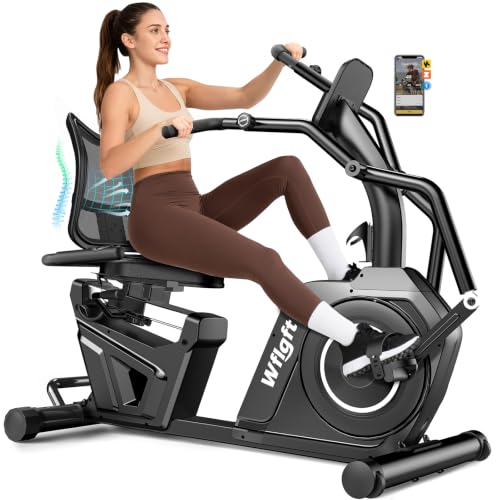
| WFLGFT Recumbent Bike with Arm Exerciser | Upper-body work as well as legs | Magnetic resistance; moving arm handles for dual-action pedaling; wide seat | Standard | Premium |
| Sunny Health & Fitness Smart Recumbent Bike | App-based tracking | Magnetic resistance; integrated resistance bands; Bluetooth console with app sync | Standard | Mid-range |
| VANSWE Recumbent Bike 380 LB | Heavier riders and seniors | 380 lb weight capacity; magnetic resistance; wide seat and reinforced frame | Standard to full | Budget |
| Marcy Magnetic Recumbent Bike NS-40502R | Simple, durable basics | 8 resistance levels; magnetic; 300 lb capacity class; LCD with pulse | Standard | Mid-range |
| 3G Cardio Elite RB X Recumbent Bike | Compact premium builds | 49 in long; FreeSync FTMS Bluetooth; commercial-style frame and seat | Compact (49 in) | Premium |
| Schwinn Fitness 290 Recumbent Bike | Best console and connectivity | Color LCD; Bluetooth; eddy-current magnetic resistance; 300 lb capacity class | Standard | Premium |
| MERACH Upgraded Durable Magnetic Recumbent Bike | Seniors on a mid-range budget | Magnetic resistance; reinforced frame; comfort seat with back support; simple console | Standard | Mid-range |
Where a manufacturer does not publish a figure in the product name or in documentation we can verify, the table describes the specification class — “300 lb capacity class,” for example — rather than guessing an exact number. Resistance level counts, weight limits, and frame lengths vary within these bands, so confirm the current figures on the listing before you order.
How We Chose
This roundup is research-based. We worked from published specifications, manufacturer documentation, and the design logic of each machine — frame geometry, resistance type, seat construction, console capability, and stated weight capacity — and then mapped each bike to the reader situation it actually fits. The first filter was resistance type: magnetic resistance, belt-driven, won the day over friction pads because it is quieter, needs no pad replacement, and holds consistent tension over years of use. The second filter was seat geometry, because a recumbent is a chair first and a bike second; saddle width, backrest contour, and the fore-aft adjustment range decide whether a household of two different heights can share one machine.
The third filter was footprint and clearance, since most home buyers are fitting a bike into a bedroom, a basement corner, or beside a couch rather than a dedicated gym. The fourth was console and connectivity — useful only to the extent it changes behavior, so a bike that syncs to an app you already use ranks above one with forty programs you will never scroll to. Finally, we considered upgrade path and ownership: what wears first, whether replacement parts are commonly available, and whether the price tier buys durability or just features. We did not evaluate these bikes physically, and nothing here reflects a session on any of them; the judgments are about specification fit and category behavior.
1. MERACH High-End Black Recumbent Bike – Best for Overall
As an Amazon Associate we earn from qualifying purchases at no extra cost to you.

The MERACH High-End Black is the bike to buy when one machine has to serve a whole household. Its frame is built around a step-through opening, so you sit down first and then swing your legs into place rather than stepping over a top tube, which matters more than most buyers expect once the bike is against a wall. It suits riders who will use it four or more times a week and want the resistance to still feel smooth after the novelty wears off, and it suits a two-person household where the seat has to move quickly between a shorter and a taller rider.
This is a comfort-first design rather than a performance trainer. The seat assembly, the backrest angle, and the pedal-to-seat distance are the parts MERACH clearly spent money on, and that is exactly the right place to spend it on a recumbent. The console is competent rather than spectacular, which keeps the price in the mid-range band instead of pushing it into premium territory.
Key specs
- Magnetic resistance with console-controlled tension — no friction pad to replace
- Belt-driven drivetrain, which keeps noise low enough for shared living space
- Step-through frame with a low standover height
- Padded saddle with a contoured backrest that supports the lower back
- LCD console showing time, speed, distance, calories, and hand-grip pulse
- Seat adjustable fore and aft on a rail, with a height range that covers most riders roughly 5’2″ to 6’3″
- Front transport wheels and adjustable leveling feet for uneven floors
Strengths
The quietest thing about a good recumbent is what you do not hear, and the belt-driven magnetic system here is the reason this bike can live in a bedroom. There is no pad-on-flywheel contact, so resistance stays consistent as the machine warms up, and there is nothing to re-tension every few months. The seat is the second strength: a wide saddle plus a backrest that actually meets the lumbar curve turns a 30-minute session from a chore into something you can repeat daily.
The step-through geometry deserves a mention on its own. On an upright bike you mount by throwing a leg over the frame, which is exactly the movement that becomes awkward with age, tight hips, or a sore knee. Sitting down into a recumbent removes that motion entirely, and the MERACH frame leaves enough open space that the maneuver is easy even in slippers.
Pros
- Magnetic, belt-driven resistance stays smooth and quiet for years
- Genuinely comfortable seat and backrest for longer sessions
- Step-through frame makes mounting and dismounting safe and simple
- Seat rail adjustment is fast enough for two riders to share the bike
- Mid-range price without a premium-console tax
Cons
- Console is functional but not app-connected in the way the Sunny or Schwinn options are
- Standard footprint still needs roughly 50–56 inches of wall length plus clearance behind
- Frame weight makes it a two-person move between rooms
- No integrated upper-body arm handles
How it compares
Against the MERACH Upgraded Durable Magnetic model below, the High-End Black buys you a more refined seat and a cleaner resistance feel for a step up in price; the Upgraded model is the better buy if the bike will be used gently and mostly by one person. Against the Schwinn Fitness 230, the MERACH is the friendlier everyday machine and the Schwinn is the one with the deeper program library and the longer brand track record. If you are deciding purely on comfort per dollar, the High-End Black wins; if you want a console that gives you structured workouts, the Schwinn is the more interesting machine.
2. TRMDDF Recumbent Exercise Bike with Magnetic Resistance – Best for Tight Budgets

The TRMDDF recumbent is the entry point into magnetic resistance rather than friction resistance, and that single spec is why it makes this list. Plenty of very cheap recumbents still use a felt pad pressed against a flywheel; those bikes get louder as they age and need the pad replaced. TRMDDF uses a magnetic system instead, which means a buyer on the smallest budget still gets quiet operation and no consumable part in the resistance path.
It suits a first-time buyer, a rider returning to exercise after a long break, and anyone who wants to prove to themselves that a home bike will actually get used before spending mid-range money. It also suits a second bike for a guest room or a parent’s house, where the requirement is “safe, simple, and cheap to replace” rather than “best possible ride.”
Key specs
- Magnetic resistance with dial or console-controlled tension
- Adjustable seat along a rail to fit a range of leg lengths
- Basic LCD showing time, speed, distance, and calories
- Padded seat and backrest in the comfort-first recumbent shape
- Step-through frame with a low entry point
- Compact-to-standard footprint typical of the budget recumbent class
Strengths
The value proposition here is straightforward: you get the correct riding position and the correct resistance technology for the least money. Recumbent geometry is not expensive to manufacture — a reclined seat, a rail, and a pair of pedals — so the budget tier mostly saves money on console electronics, frame finish, and flywheel mass rather than on the fundamentals.
What that means in practice is a bike that feels lighter and slightly less planted than a mid-range machine, but pedals smoothly and quietly. For 20- to 40-minute sessions at moderate resistance, the difference between this and a bike costing twice as much is mostly in the polish, not in the workout. The adjustable seat rail covers a wide enough range that most adults in a household can find a workable position.
Pros
- Magnetic resistance at a genuinely budget price — no friction pad to replace
- Quiet enough for an apartment or a shared wall
- Correct recumbent posture with back support
- Light enough for one person to reposition
- Low financial risk for a first home bike
Cons
- Lighter flywheel means resistance feels less substantial at the top of the range
- Fewer resistance steps, so fine-grained progression is harder
- Console is basic — no app sync, no structured programs
- Seat padding is thinner than mid-range and premium seats and will compress sooner
- Bolts and seat-rail hardware benefit from a re-tighten after the first month
How it compares
Against the YOSUDA recumbent, the two bikes sit in the same tier and the decision comes down to current pricing and which seat shape suits you. The YOSUDA is the more established name in budget home cardio and its seat tends to be described as the softer of the two; the TRMDDF typically competes on price. If you can stretch slightly, the MERACH S08 below gives you a more modern frame and a cleaner console for a similar outlay. If you cannot stretch at all, either the TRMDDF or the YOSUDA will do the job, and the honest advice is to buy whichever is cheaper the week you order.
3. MERACH S08 Next-Generation Recumbent Exercise Bike – Best for Small Spaces

The MERACH S08 is the budget bike to choose when floor space is the binding constraint. It keeps the step-through frame and magnetic resistance that define the category, but packages them in a slimmer, more contemporary shape than the traditional recumbent silhouette. It suits apartment dwellers, riders who will fold the bike into a corner between sessions, and anyone who finds the older, boxier recumbent look visually heavy in a living space.
It also suits a rider who wants the MERACH ecosystem at the lowest price point. The brand’s design language carries through — the seat-and-backrest assembly, the resistance feel, the console layout — so if you have used a MERACH machine elsewhere and liked it, the S08 is the cheapest way into that same experience.
Key specs
- Magnetic resistance with console-controlled tension
- Compact step-through frame with a slim profile
- Padded seat and backrest with fore-aft rail adjustment
- LCD console covering time, speed, distance, calories, and pulse
- Transport wheels for moving the bike between rooms
- Footprint at the compact end of the budget recumbent class
Strengths
The compact frame is the whole point. A standard recumbent needs roughly 50 to 56 inches of wall run plus 18 to 24 inches of clearance behind the seat for the step-through maneuver, and in a small apartment that is often the difference between owning a bike and not. The S08 trims that requirement without shrinking the seat into something unusable.
The second strength is that nothing about the ride has been downgraded to achieve the smaller size. Resistance is still magnetic and belt-driven, so it stays quiet; the seat still reclines and still supports the lower back. This is a bike that fits a studio apartment and still works for a 40-minute session, which is a narrower achievement than it sounds in the budget tier.
Pros
- Compact footprint without a compromised seat
- Modern styling that reads as furniture rather than gym equipment
- Magnetic resistance stays quiet and needs no pad replacement
- Budget price with the build quality of a larger brand
- Easy to move on transport wheels
Cons
- Smaller frame means taller riders may sit closer to the console than they would like
- Console is basic, with no Bluetooth or app integration
- Lighter overall mass feels less stable during aggressive pedaling
- Fewer resistance levels than mid-range machines
How it compares
Against the MERACH High-End Black, the S08 trades seat depth, frame mass, and console polish for a smaller footprint and a lower price. If you have the floor space, the High-End Black is the better long-term machine because its seat will hold up longer under daily use. If you do not have the space, the S08 is the smarter buy, and the difference in ride quality over a 30-minute session is smaller than the difference in price suggests. Against the TRMDDF, the S08 is the more modern machine and typically the better-finished one; the TRMDDF wins only if it is meaningfully cheaper the day you buy.
4. YOSUDA Recumbent Exercise Bike – Best for First-Time Buyers

YOSUDA has built a reputation in budget home cardio by getting the fundamentals right and leaving out the extras, and the recumbent follows that pattern. It is the pick for a first-time buyer who wants a machine that will be pleasant enough to use three or four times a week without committing mid-range money to an experiment. It suits a rider who wants a comfortable seat, smooth magnetic resistance, and a console that tells the time — and does not care about syncing data to a phone.
It is also a sensible choice for a household where the bike is a shared resource and the main risk is that it becomes a clothes rack. Buying at this price and discovering you use it daily is a much better outcome than buying premium and discovering you do not.
Key specs
- Magnetic resistance with adjustable tension
- Cushioned seat and backrest with rail adjustment
- LCD console with time, speed, distance, calories, and hand-pulse grips
- Step-through frame with a low entry height
- Standard recumbent footprint in the 50-inch class
- Transport wheels and leveling feet
Strengths
The seat is the standout at this price. Budget recumbents frequently pair a thin saddle with a backrest that sits too upright to support the lumbar spine, and the result is a bike that is comfortable for ten minutes and unpleasant for thirty. YOSUDA’s seat shape and backrest angle are closer to what you find on mid-range machines, which is the single most important thing a beginner will notice.
Resistance is magnetic, so the bike stays quiet and there is no pad to replace. The console is deliberately simple: no Bluetooth, no app, no structured programs. For a buyer who wants to pedal for half an hour while watching television, that is a feature rather than a limitation, because there is nothing to configure and nothing to break.
Pros
- Comfortable seat and backrest for the price
- Quiet magnetic resistance with no consumable parts
- Simple console that requires no setup or account
- Established budget brand with widely available models
- Low financial risk for a first home bike
Cons
- No Bluetooth, app sync, or workout programs
- Flywheel mass is light, so the top resistance steps feel less substantial
- Frame finish and hardware are clearly budget grade
- Not intended for riders at the top of the weight-capacity range
How it compares
Against the TRMDDF, this is a coin-flip on paper and a seat-comfort decision in practice. The YOSUDA tends to be the better-finished machine and the more established name; the TRMDDF usually competes harder on price. Against the MERACH S08, the YOSUDA gives up styling and a slightly slimmer frame but generally holds its own on seat quality. If you are choosing between all three, order the one that is cheapest and in stock — at this tier the differences are smaller than the marketing suggests.
5. Schwinn Fitness 230 Recumbent Bike – Best for Long-Term Reliability

The Schwinn 230 is the recumbent to buy if you intend to keep the bike for a decade. Schwinn Fitness has been building home cardio equipment for long enough that parts, service documentation, and replacement components are easier to find than they are for a no-name import, and the 230 is the model that most buyers land on when they want that security without paying premium-tier prices. It suits a rider who wants structured workouts, a heavier and more planted frame, and a brand they recognize.
It also suits a household with two regular riders, because the seat adjustment is quick and the resistance range is wide enough that a beginner and a fitter rider can both get a useful session from the same machine.
Key specs
- Eddy-current magnetic resistance with 20 levels
- 22 built-in workout programs, including heart-rate and interval profiles
- 300 lb capacity class
- Padded seat with lumbar backrest and a ventilated back panel
- LCD console with hand-grip heart-rate sensors
- Weighted pedals with adjustable straps
- Transport wheels and a leveling system for uneven floors
Strengths
Twenty resistance levels is the number that separates this from the budget tier. On an eight-level bike, the jump between steps is large enough that you cannot fine-tune a workout; on a 20-level machine you can add a small increment as fitness improves instead of jumping from “easy” to “hard.” That progression is what keeps a home bike interesting past month three.
The second strength is the frame. This is a heavier machine than the budget options, and heavier means more planted — less side-to-side sway when you push harder, and a pedal stroke that feels connected rather than vague. The 22 programs are genuinely useful if you like having a session dictated to you rather than deciding your own interval structure. The brand’s long presence in home fitness also means that when a pedal strap or a seat bolt eventually needs replacing, sourcing it is a search rather than a project.
Pros
- 20 resistance levels allow genuine progression over months
- 22 programs provide structure without a subscription
- Heavier, more stable frame than the budget tier
- Widely recognized brand with better parts availability
- Comfortable lumbar-supporting seat for long sessions
Cons
- Premium-tier price for a console that is not app-first
- Heavier machine is harder to move and store
- Standard footprint still needs the full wall run plus clearance
- Fewer connectivity options than the Schwinn 290 or the 3G Cardio Elite RB X
How it compares
Against the Schwinn Fitness 290, the 230 is the value play within the same family: same brand, same reliability story, less console. If you want a color display and Bluetooth data sync, the 290 justifies its step up; if you will never use either, the 230 is the smarter purchase and the money saved goes toward nothing you will miss. Against the MERACH High-End Black, the Schwinn wins on resistance range, program count, and brand longevity, while the MERACH wins on price and on the friendliness of its step-through geometry. For a rider who wants a machine to grow with, the Schwinn is the more capable pick.
6. WFLGFT Recumbent Exercise Bike with Arm Exerciser – Best for Upper-Body Work
The WFLGFT recumbent adds moving arm handles to the standard recumbent layout, turning a leg-only session into a coordinated upper- and lower-body movement. It suits a rider who wants more total-body involvement from a low-impact machine, someone who finds pedaling alone monotonous, and a buyer who wants a single piece of equipment to cover both arm and leg work rather than adding a separate rowing or arm machine.
It is a premium-tier bike, so it is also aimed at the buyer who wants a heavier frame, a more generous seat, and the visual presence of a serious machine in a home gym. It is not the right choice for someone who wants the absolute simplest possible bike, because the arm mechanism is one more thing to adjust and one more set of joints to keep clean.
Key specs
- Magnetic resistance with console-controlled tension
- Moving arm handles linked to the pedal stroke for dual-action movement
- Wide padded seat with a contoured backrest
- LCD console with time, speed, distance, calories, and pulse
- Step-through frame with a low entry point
- Standard recumbent footprint at the heavier end of the class
Strengths
The arm exerciser is the reason to buy this bike, and it works on a simple principle: pushing and pulling the handles engages the upper back, shoulders, and arms while the legs drive the pedals. That increases the total work your body does per minute, which means a shorter session produces a comparable effort — useful for anyone with limited time or limited patience for a 45-minute pedal.
The heavier frame that comes with the premium tier is a real benefit here. A dual-action bike is less stable than a leg-only machine by design, because the rider’s upper body is moving too, and a light frame amplifies that sway. WFLGFT’s build keeps the motion contained, and the wide seat gives you enough surface area to stay centered while your arms are working.
Pros
- Engages upper body and legs in the same session
- Heavier, more stable frame for dual-action pedaling
- Comfortable wide seat with back support
- Quiet magnetic resistance with no friction pad
- Good option for riders who find leg-only pedaling dull
Cons
- Premium price for a machine that is not app-connected
- Arm mechanism adds adjustment and maintenance points
- Heavier and bulkier to move than a standard recumbent
- Not ideal for riders with shoulder or wrist limitations
How it compares
Against the Sunny Health & Fitness Smart Recumbent Bike, the WFLGFT gives you integrated dual-action arm movement while the Sunny gives you resistance bands and app connectivity. Those are different answers to the same question — “how do I make this more than pedaling?” If you want continuous upper-body involvement tied to the pedal stroke, the WFLGFT is the more cohesive design. If you want occasional band work plus a console that logs your sessions, the Sunny is the better fit. Against the Schwinn 230, the WFLGFT wins on upper-body engagement and loses on resistance granularity and program count.
7. Sunny Health & Fitness Smart Recumbent Bike with Resistance Bands – Best for App Tracking

The Sunny Health & Fitness Smart recumbent is for the rider who wants their workout to produce data. Sunny’s smart line pairs a Bluetooth console with the brand’s own fitness app, so time, distance, calories, and heart rate land somewhere you can look at later instead of disappearing when you stand up. It suits a rider who already tracks steps or workouts on a phone, and who will actually open an app after a session.
The integrated resistance bands are the second draw. They give you a light upper-body option without the complexity of a linked arm mechanism, which makes this a good middle path for a rider who wants some variety but does not want to feel like they are operating a machine with moving parts. It is a mid-range bike, so the frame and seat sit between the budget tier and the premium machines.
Key specs
- Magnetic resistance with console-controlled tension
- Bluetooth console with sync to the Sunny Health & Fitness app
- Integrated resistance bands for light upper-body work
- Padded seat with backrest and rail adjustment
- LCD readout of time, speed, distance, calories, and pulse
- Standard recumbent footprint in the 50-inch class
Strengths
Data changes behavior for a specific kind of rider. If you are the person who closes a ring or hits a step target, a recumbent that logs sessions is measurably more likely to get used than one that does not. The Bluetooth console here does that without forcing a subscription, and the app covers the basics of session history and totals.
The resistance bands are a genuinely useful addition rather than a gimmick. They let you add a few minutes of rowing-style pulling or shoulder work at the end of a session without buying a second machine or moving to the floor. Because they are anchored to the bike, there is no setup and no storage question. The magnetic resistance underneath is the standard quiet, maintenance-free system, and the seat is comfortable enough for 30- to 45-minute sessions.
Pros
- Bluetooth console logs sessions to an app
- Resistance bands add upper-body work with no extra equipment
- Quiet magnetic resistance with no pad to replace
- Comfortable seat and backrest for the mid-range tier
- Simple, uncluttered design compared with dual-action bikes
Cons
- App ecosystem is narrower than a general-purpose fitness platform
- Resistance bands offer light resistance only — not a substitute for real strength work
- Frame mass is mid-range, so it sways more than premium machines under hard pedaling
- Resistance level count is mid-tier, so progression is coarser than on a 20-level bike
How it compares
Against the WFLGFT, this is a choice between continuous dual-action movement and occasional band work plus data logging. The WFLGFT is better if you want your arms working the entire session; the Sunny is better if you want a record of what you did and a light upper-body finisher. Against the Schwinn 230, the Sunny wins on connectivity and loses on resistance granularity, program count, and brand parts availability. Pick the Sunny if app tracking is the feature that will keep you on the bike; pick the Schwinn if you would rather have 20 resistance steps and 22 built-in programs.
8. VANSWE Recumbent Exercise Bike for Home Seniors with 380 LB Weight Capacity – Best for Heavier Riders and Seniors

The VANSWE recumbent is built around a 380 lb weight capacity, which is the highest figure in this roundup and the reason it exists. Standard home recumbents typically sit in the 250–300 lb class, so a rider above that range is choosing between a small number of machines or nothing at all. VANSWE also positions this bike for senior riders, which means the frame geometry and the seat are designed around easy mounting and a supported, upright-reclined posture.
It suits a heavier rider who wants a machine that will not flex or creak under load, a senior rider who wants a stable platform with a low step-through, and a household where the bike needs to handle a wide range of body weights without the frame complaining. It is budget-tier priced despite the high capacity, which is unusual and worth noting.
Key specs
- 380 lb weight capacity — the highest in this roundup
- Magnetic resistance with adjustable tension
- Wide padded seat with a supportive backrest
- Reinforced frame designed for higher loads
- LCD console with time, speed, distance, calories, and pulse
- Step-through frame with a low entry height
Strengths
The capacity rating is the headline, but the practical benefit is stability. A frame designed for 380 lb does not flex noticeably at 200 lb, which means the pedal stroke feels solid and the bike does not rock when you push. That is a comfort difference you feel in the first minute, not a number on a spec sheet.
The seat is sized to match the frame. Wider saddles distribute pressure better for heavier riders, and the backrest provides support through the lumbar region rather than just the mid-back. The step-through geometry is also generous, which matters for a rider who finds lifting a leg over a frame difficult or uncomfortable. For a senior rider in particular, being able to sit down before pedaling removes the most awkward part of using a bike.
Pros
- 380 lb capacity class — highest here
- Reinforced frame stays stable and quiet under heavier loads
- Wide seat distributes pressure well
- Generous step-through opening for easy mounting
- Budget pricing despite the high capacity rating
Cons
- Budget-tier console with no app connectivity
- Fewer resistance levels than mid-range or premium machines
- Heavier frame is harder to move between rooms
- Seat padding is comfortable but not premium grade
How it compares
Against the MERACH Upgraded Durable Magnetic Recumbent Bike, the VANSWE wins on capacity and seat width, while the MERACH wins on finish, console layout, and general refinement. If your weight is under 250 lb, the MERACH is the nicer machine; if you need the higher rating, the VANSWE is the only sensible choice of the two. Against the Schwinn 230, the VANSWE wins decisively on capacity and loses on resistance range, program count, and brand serviceability. Buy the VANSWE because the capacity is a requirement, not because it is the most polished bike in the tier.
9. Marcy Magnetic Recumbent Exercise Bike NS-40502R – Best for Simple, Durable Basics
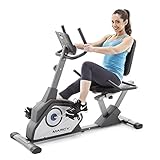
The Marcy NS-40502R is the bike for a rider who wants a magnetic recumbent with nothing to configure. It has eight resistance levels, a magnetic resistance system, and an LCD console — and that is the entire feature list. It suits a buyer who will set the tension once and leave it, a rider who wants a machine that is easy to understand and easy to live with, and anyone who is tired of equipment that demands an app account before it will do anything.
Marcy has been in home strength and cardio equipment for decades, and this model has been in the catalog long enough to have a settled reputation for straightforward build quality. It suits a home gym corner, a spare room, or a basement where the bike will be used for steady, unglamorous sessions.
Key specs
- 8 resistance levels with magnetic resistance
- 300 lb capacity class
- LCD console with time, speed, distance, calories, and pulse
- Padded seat and backrest with adjustable positioning
- Step-through frame design
- Standard recumbent footprint in the 50-inch class