Key takeaways
- Mount: Fujifilm X, APS-C coverage
- Focal length: 28mm, roughly 42mm in full-frame terms after the 1.5x crop
- Angle of view: approximately 54 degrees diagonal in equivalent terms
- Maximum aperture: f/4.5, fixed — there is no aperture mechanism to stop down or open up
- Autofocus: yes, driven electronically by the body
- Form factor: ultra-thin, body-cap class; typically under 20mm thick and in the 60–90g range for this class of lens
- Price tier: budget
The best pancake lens for most compact camera kits in 2026 is the TTArtisan AF 27mm F2.8 for Fujifilm X-mount: it combines a genuinely slim barrel with an f/2.8 aperture, working autofocus and a mid-range price, which makes it the most versatile single choice for travel and street photography on an APS-C Fujifilm body. If you shoot full-frame Sony and image quality matters more than cost, the VILTROX AF 26mm F2.8 EVO is the stronger lens, because it covers a full-frame sensor at the same f/2.8, focuses quickly and is thin enough to leave mounted permanently. On a tighter budget with Fujifilm, the VILTROX 28mm F4.5 XF is the slimmest lens here and the cheapest way to turn a camera into something you actually carry. Sony shooters watching spending have the lightdow 24mm f/3.8, and anyone who wants soft, imperfect film-look images rather than sharpness should look at the Retropia repurposed disposable-camera lens. The sections below compare thickness, weight, focal length, autofocus behaviour, low-light performance and image quality so you can match one to your own kit.
Top 3 Picks
Best overall: TTArtisan AF 27mm F2.8
The 27mm f/2.8 hits the balance point that most pancake lenses miss. It is small enough to live on the camera, fast enough for evening street work, and its roughly 40.5mm full-frame equivalent field of view matches the way most people naturally frame a scene. If you only want to read one recommendation, this is it for Fujifilm X-mount shooters.
Best budget: VILTROX 28mm F4.5 XF
This is the lens you buy when the goal is a camera that fits in a coat pocket and costs as little as possible while still autofocusing. The fixed f/4.5 aperture is a genuine limitation, but in daylight it is a non-issue, and the 42mm-equivalent perspective is forgiving for beginners.
Best premium: VILTROX AF 26mm F2.8 EVO
For Sony full-frame bodies, this is the pancake that does not ask you to give up sensor coverage or aperture speed. It is the most expensive option here, and it is the only one that pairs a true full-frame image circle with f/2.8 in an ultra-thin barrel.
Quick Comparison
The table below covers every lens in this guide. Thickness and weight are given as classes rather than exact figures where a manufacturer’s published numbers vary by mount version, because a few millimetres or grams rarely changes a buying decision but a wrong number misleads.
| Product | Best for | Mount / coverage | Focal length (35mm equiv.) | Max aperture | Autofocus | Price tier |
|---|---|---|---|---|---|---|
| VILTROX 28mm F4.5 XF Pancake | Smallest possible Fujifilm travel kit | Fujifilm X / APS-C | 28mm (approx. 42mm) | f/4.5, fixed | Yes | Budget |
| TTArtisan AF 27mm F2.8 | Fujifilm street shooting after dark | Fujifilm X / APS-C | 27mm (approx. 40.5mm) | f/2.8 | Yes | Mid-range |
| VILTROX AF 26mm F2.8 EVO | Full-frame Sony image quality in a thin barrel | Sony E / full-frame | 26mm (26mm) | f/2.8 | Yes | Premium |
| Retropia Repurposed Disposable Camera Lens | Film-look, lo-fi character shots | Mirrorless mount / varies | Disposable-camera class, typically wide-normal | Fixed, small (f/8–f/11 class) | No | Budget |
| lightdow FE/E 24mm f3.8 Pancake | Affordable full-frame Sony walkaround | Sony E / full-frame | 24mm (24mm) | f/3.8 | Yes | Mid-range |
Two things stand out. First, every autofocus lens here lands between 24mm and 28mm, which is not a coincidence: that range lets a designer keep the barrel short while still covering a useful field of view. Second, the two budget-tier lenses sit at opposite ends of the philosophy spectrum — one is a modern electronic pancake, the other is an optical toy. They are not substitutes for each other.
How We Chose
Selection was based on published specifications, mount coverage, and how each lens behaves in the two scenarios this category exists to serve: travel and street photography. We weighted six factors. Thickness and weight came first, because a pancake lens that is not meaningfully smaller than a standard prime has no reason to exist. Focal length usefulness came second, judged by the 35mm-equivalent field of view rather than the number engraved on the barrel, since 27mm on APS-C and 27mm on full frame are very different lenses. Aperture speed came third, because it determines whether the lens is a daylight-only tool or something you can shoot with after sunset. Autofocus presence and type came fourth. Price tier came fifth, expressed as budget, mid-range or premium rather than a figure, because listings move daily. Finally we considered the upgrade path: whether the lens is a sensible first prime, a permanent second lens, or a specialist tool you buy deliberately. No lens was included on the basis of hands-on evaluation, and nothing here is described as a tested result — these are category-based assessments drawn from the specifications each product is listed with and from well-established facts about how pancake optics work.
1. VILTROX 28mm F4.5 XF Pancake – Best for the Thinnest Possible Fujifilm Kit
As an Amazon Associate we earn from qualifying purchases at no extra cost to you.

This is the lens for the photographer who has stopped carrying their camera because the bag got heavy. On a Fujifilm X-mount body it barely protrudes past the grip, which means an X-E, X-T or X-S series camera becomes something you can drop into a jacket pocket or a small sling and forget about until you need it. It suits daylight travel shooters, casual documentarians, and anyone who wants a second lens that weighs close to nothing when the main zoom stays at home. It does not suit people who shoot indoors, in the evening, or who want control over depth of field.
Key specifications as listed:
- Mount: Fujifilm X, APS-C coverage
- Focal length: 28mm, roughly 42mm in full-frame terms after the 1.5x crop
- Angle of view: approximately 54 degrees diagonal in equivalent terms
- Maximum aperture: f/4.5, fixed — there is no aperture mechanism to stop down or open up
- Autofocus: yes, driven electronically by the body
- Form factor: ultra-thin, body-cap class; typically under 20mm thick and in the 60–90g range for this class of lens
- Price tier: budget
The core strength is the form factor, and it is not a trivial one. A lens this thin changes behaviour: you stop deciding whether to bring the camera and start simply bringing it. The 42mm-equivalent field of view is the classic “normal” perspective, close to how the human eye prioritises a scene, which makes it forgiving for people moving up from a phone. Framing is intuitive, distortion is minimal, and the results look like a photograph rather than a wide-angle effect. Autofocus on a lens with so little glass to move is quick in good light, and because there is no aperture mechanism and no extending barrel, there is very little inside that can fail.
The trade-offs are real and worth stating plainly. A fixed f/4.5 aperture means you cannot open up for a shallow depth of field, and you cannot stop down for a long exposure without an ND filter. In bright conditions the body compensates with a fast shutter, which is fine. In dim conditions you are pushed toward high ISO and slower shutter speeds, and at around 1.3 stops behind an f/2.8 lens you will notice the difference the moment the sun goes down. Because the aperture is fixed and the design is minimal, several lenses in this class also omit a filter thread entirely, which rules out screw-on ND and polarising filters — check that detail against your own needs before buying. There is no weather sealing, and the plastic-heavy construction reflects the price tier. Finally, 42mm equivalent is not wide. Indoors, in a small room, or in a tight alley, you will find yourself backing into walls.
Pros
- Among the thinnest autofocus lenses available for Fujifilm X, to the point of being pocketable on a small body
- Very light, so it adds almost nothing to a kit’s carry weight
- 42mm-equivalent perspective is natural and easy to compose with
- Autofocus makes it usable for casual snapshots and moving subjects in daylight
- Minimal internal mechanism means fewer long-term failure points
- Lowest cost entry into the pancake category
Cons
- Fixed f/4.5 aperture — no depth-of-field control, no stopping down for sharpness
- Weak low-light performance; it forces high ISO and slow shutter speeds indoors
- No aperture ring, so Fujifilm’s tactile dial workflow is only half present
- Often lacks a filter thread, which limits ND and polariser use
- No weather sealing and a plastic-dominant build
- Not wide enough for cramped interiors or large group shots
How it compares with the TTArtisan AF 27mm F2.8: these two are the closest pair in this guide and the choice comes down to one question — do you shoot after dark? The TTArtisan gives you roughly 1.3 stops more light, a mechanical aperture you can control, and a near-identical field of view, at the cost of a slightly thicker barrel and a higher price tier. If your photography happens mostly on trips, in daylight, with the camera in a pocket, the VILTROX wins on pure portability and cost. If you want one lens that covers evenings, cafés, and dim streets as well as daylight, the TTArtisan is the more complete tool and the extra outlay is justified.
2. TTArtisan AF 27mm F2.8 – Best for Fujifilm Street Shooters Who Want a Faster Aperture

This is the lens for someone who wants the pancake form factor without the daylight-only compromise. On a Fujifilm X body it delivers the same natural, slightly-wide-of-normal framing as the VILTROX, but with an aperture fast enough to keep hand-held shutter speeds reasonable under street lighting, in restaurants, and in the blue hour. It suits street photographers, travellers who shoot into the evening, and anyone building a small prime-only kit around a single body. It is less suited to anyone who wants a genuinely wide angle, and it is not the cheapest route into the category.
Key specifications as listed:
- Mount: Fujifilm X, APS-C coverage
- Focal length: 27mm, approximately 40.5mm in full-frame equivalent terms
- Angle of view: approximately 56 degrees diagonal in equivalent terms
- Maximum aperture: f/2.8, adjustable
- Autofocus: yes, stepping-motor class autofocus driven by the body
- Form factor: compact pancake, typically 20–30mm thick and around 90–150g in this class
- Price tier: mid-range
The headline advantage over the f/4.5 option is light gathering. Going from f/4.5 to f/2.8 is about 1.3 stops, which in practice means shooting at ISO 3200 instead of roughly ISO 8000 for the same shutter speed, or holding 1/60s where the slower lens would need about 1/25s. That is the difference between a usable evening street shot and a blurry one. The extra aperture also buys a little separation between subject and background, which matters more than people expect at a 40mm-equivalent focal length — you will not get creamy bokeh, but you can isolate a face from a wall.
The second advantage is control. An adjustable aperture means you can stop down to f/5.6 or f/8 for maximum sharpness across the frame, which is exactly what you want for architecture and landscape work, and it means the lens is not fighting you when you want more depth of field for a street scene with foreground and background interest. For Fujifilm users, an aperture ring on the lens also restores part of the handling pleasure that makes the system appealing in the first place — aperture on the ring, shutter on the dial, ISO on the other dial.
The compromises are the usual third-party ones. Autofocus is competent but generally not as decisive as a first-party lens in poor light; stepping motors are quick for their size but can hunt when contrast is low, and a body relying on contrast detection rather than phase detection will be slower still. Corner sharpness wide open is typically softer than the centre, which is normal at this price and focal length but worth knowing if you shoot flat subjects at f/2.8. There is no weather sealing, so rain and dust require care. Firmware compatibility is the quiet risk with any third-party autofocus lens: a brand-new camera body can arrive before the lens firmware catches up, so budget a few minutes for updates after buying a new body.
Pros
- f/2.8 aperture makes it a genuine all-day, all-evening lens rather than a daylight accessory
- Roughly 1.3 stops more light than an f/4.5 fixed-aperture pancake
- Adjustable aperture allows stopping down for peak sharpness
- Approximately 40.5mm equivalent — the most natural general-purpose perspective available here
- Autofocus makes it practical for candid and moving subjects
- Compact enough to stay mounted permanently on a small body
Cons
- Higher price tier than the fixed-aperture budget option
- Autofocus can hunt in low-contrast, low-light scenes
- Corner performance wide open is not its strongest point
- No weather sealing
- Third-party firmware sometimes lags behind new camera bodies
- 27mm is a normal perspective, not a wide one — cramped spaces remain awkward
How it compares with the VILTROX 28mm F4.5 XF: the VILTROX is thinner and cheaper and makes a stronger case as a permanent body-cap replacement for daylight travel. The TTArtisan is the better single lens. If you can only own one and you shoot at varied times of day, pay for the f/2.8. If the lens is a secondary, ultra-light companion to a zoom you already trust, the f/4.5 is the smarter purchase because its only job is to be small.
3. VILTROX AF 26mm F2.8 EVO – Best for Full-Frame Sony Image Quality in a Thin Barrel
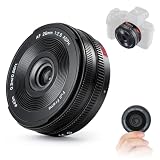
Full-frame pancake lenses are rare, and full-frame pancake lenses that autofocus at f/2.8 are rarer still. This is the option for Sony E-mount shooters who want a compact body like an a7C-series or a ZV-E10-class camera to stay compact without dropping to an APS-C image circle or a slow fixed aperture. It suits travellers, street photographers and documentary shooters who want the full-frame look in the smallest possible package, and it suits anyone who wants one wide-ish prime that can stay on the camera for a whole trip.
Key specifications as listed:
- Mount: Sony E, full-frame coverage
- Focal length: 26mm, which is 26mm in full-frame equivalent terms
- Angle of view: approximately 80 degrees diagonal
- Maximum aperture: f/2.8
- Autofocus: yes, electronically driven
- Form factor: ultra-thin pancake by full-frame standards, typically in the 100–170g class
- Price tier: premium
Twenty-six millimetres is an unusually well-judged focal length for travel. It is wide enough to take in a street, a market, a train carriage or a building facade without the stretched corners that a 16mm or 18mm produces, and it is long enough that people at conversational distance still look like people rather than caricatures. An 80-degree diagonal field of view is the sweet spot where architecture stays vertical, interiors feel spacious, and environmental portraits still read as portraits. On a full-frame sensor you also get the tonal smoothness and high-ISO latitude that full-frame bodies are bought for, which partly offsets the modest f/2.8 aperture: a clean ISO 6400 on full frame often beats an ISO 3200 crop-frame file, and that narrows the practical low-light gap between this lens and faster APS-C alternatives.
The autofocus system is the other reason this lens justifies the premium tier. A full-frame pancake has a small, light focus group to move, which is inherently easier to drive quickly than a large multi-element group, and modern Sony bodies pair with third-party lenses well enough that everyday street and travel autofocus is not a frustration. It is not a sports or wildlife lens, and no pancake is, but for the subjects this category serves it is responsive.
The costs are straightforward. Premium tier pricing means you are paying a significant premium over the budget and mid-range options for the privilege of full-frame coverage and a thin barrel — that is the whole point of the product, and if you do not need full-frame coverage you are overpaying. There is no optical stabilisation, so video work relies on the body’s stabilisation or on a gimbal, and in-body stabilisation on a small body is less effective than on a large one. Wide-open corner sharpness on any pancake involves optical compromise, and this lens is no exception; stop down to f/5.6 and the frame tightens up considerably. Most ultra-thin designs also give up weather sealing and sometimes the filter thread, so you should confirm those details against how you actually shoot. Finally, 26mm is wide: for tight portraits you will get noticeable perspective distortion at close range.
Pros
- Genuine full-frame coverage in a pancake barrel, which is uncommon in this category
- f/2.8 aperture keeps it usable indoors and at dusk
- Approximately 80-degree field of view is ideal for travel, street and architecture
- Autofocus makes it a practical everyday lens rather than a specialist
- Keeps a compact full-frame body genuinely compact
- Full-frame high-ISO latitude partially compensates for the moderate aperture
Cons
- Premium tier price — the most expensive lens in this guide
- No optical stabilisation
- Corner softness wide open; best results require stopping down
- Typically no weather sealing and sometimes no filter thread
- 26mm is too wide for tight portrait framing without care
- Overkill if your camera is APS-C, where the same money buys more speed
How it compares with the lightdow 24mm f/3.8: both are full-frame Sony pancakes that autofocus, and both are aimed at the same person. The lightdow is wider at 24mm and sits a tier lower on price; the VILTROX is faster at f/2.8, is the more premium build, and is the safer long-term purchase if you plan to keep using it for years. Choose the lightdow if the budget is fixed and you want the widest field of view; choose the VILTROX if you want the faster aperture and do not mind paying for it.
4. Retropia Repurposed Disposable Camera Lens – Best for Lo-Fi Instant-Film Looks

This is not a lens you buy for sharpness, and judging it by sharpness misses the point entirely. It is a repurposed disposable-camera optic mounted for mirrorless bodies, and it exists to produce the soft, low-contrast, slightly vignetted, colour-shifted images that a single-use camera produced in the 1990s. It suits photographers who already own a technically excellent lens and want a second, deliberately imperfect one; people shooting personal projects, zine work, band photos or social content where mood beats resolution; and anyone who finds the clinical rendering of modern glass boring. It does not suit a first-time buyer looking for a do-everything prime, and it does not suit anyone who needs autofocus.
What the listing tells you, and what the category implies:
- Mount: mirrorless, offered for common mirrorless mounts
- Optics: a repurposed disposable-camera lens element, plastic-bodied by nature
- Focal length: disposable-camera optics are typically in the wide-normal 30–35mm class; the listing should be checked for the specific figure
- Aperture: fixed and small, generally in the f/8–f/11 class, which is what makes the deep-focus snapshot look possible
- Focus: fixed or very simple — disposable cameras used fixed focus with huge depth of field
- Electronics: none; no autofocus, no electronic aperture, no communication with the body
- Price tier: budget
The strengths are all about character and cost. The rendering is unrepeatable by modern glass: veiling flare when you point anywhere near a light source, colour fringing at the edges, a soft centre that firms up slightly when stopped down, and heavy vignetting that pulls the eye to the middle of the frame. Because the aperture is small and fixed, almost everything from a metre to infinity is acceptably in focus, which means you can shoot from the hip and pre-frame without touching focus at all. That is genuinely liberating for street work and it is the reason disposable cameras were so popular. The lens is also tiny and light — a plastic optic in a simple barrel weighs next to nothing — and the cost is the lowest here.
The limitations are equally clear. There is no autofocus, so anything moving quickly or requiring critical focus is out of reach unless your body offers focus peaking and you are comfortable with manual work. Sharpness and micro-contrast are low by any modern standard; you will not crop heavily and you will not print large. Flare is uncontrolled and will wash out contrast when the sun is in frame, which is either the entire appeal or an annoyance depending on your intent. The build is plastic, there is no sealing, and the mount fit on repurposed optics can feel less precise than a machined lens. Exposure control also shifts: with a fixed small aperture, bright scenes require fast shutter speeds or an ND filter, and dim scenes push ISO hard.
Pros
- Distinctive film-look rendering that modern lenses cannot replicate
- Fixed small aperture and fixed focus make it extremely fast to shoot with
- Extremely small and light — negligible addition to any bag
- Lowest cost option in this guide
- Unlimited shots, unlike an actual disposable camera
- Forces deliberate composition because you cannot rely on autofocus or cropping
Cons
- No autofocus and no electronic communication with the camera
- Low sharpness, low contrast, strong vignetting and uncontrolled flare
- Plastic construction with no weather sealing
- Not usable as a primary or only lens
- Mount fit and sample-to-sample consistency can vary
- Fixed aperture limits both low-light use and depth-of-field control
How it compares with the VILTROX 28mm F4.5 XF: both are budget, both are tiny, and they could hardly be more different. The VILTROX is a modern corrected lens that happens to be thin; the Retropia is a deliberate optical throwback whose flaws are the product. If you want small and clean, buy the VILTROX. If you want small and characterful, buy the Retropia. Many photographers who shoot this category seriously end up owning both, using one for client work and the other for personal projects, and there is no overlap in what they deliver.
5. lightdow FE/E 24mm f3.8 Pancake – Best for an Affordable Full-Frame Sony Walkaround

This is the value play for Sony full-frame shooters. It pairs a 24mm field of view with autofocus and full-frame coverage at a mid-range price, and it is compatible with a wide spread of current Sony bodies including the a7 IV, a7 III, a7R IV, a7R V, a7C II and the ZV-E10, which the listing names directly. It suits travellers who want one wide prime for a whole trip, vloggers who want a small lens for a compact body, and anyone who wants full-frame coverage without paying premium-tier money. It is not the lens for someone who needs the fastest possible autofocus or the best corner sharpness.
Key specifications as listed:
- Mount: Sony E, full-frame coverage (the FE designation refers to full-frame E-mount)
- Focal length: 24mm, i.e. 24mm in full-frame equivalent terms
- Angle of view: approximately 84 degrees diagonal
- Maximum aperture: f/3.8
- Autofocus: yes, electronically driven
- Form factor: pancake; thin and light for a full-frame lens
- Price tier: mid-range
Twenty-four millimetres is the widest option in this guide, and that matters for two specific uses. The first is interiors and architecture, where an 84-degree field of view lets you include a whole room or facade from a workable distance, and where a pancake’s small front element is less intimidating to subjects than a large zoom. The second is video and vlogging, where a 24mm lens on a full-frame body gives you a stable, wide framing that survives digital stabilisation cropping, and where the light weight helps on a handheld rig or gimbal. On an APS-C Sony body the same lens behaves like a 36mm equivalent, which is a perfectly reasonable walkaround perspective — though if that is your plan, an APS-C-native lens will be smaller and cheaper.
The f/3.8 aperture is the defining compromise. It is about two-thirds of a stop slower than f/2.8, so it gathers roughly 1.8 times less light than the premium VILTROX 26mm, and it will not deliver much subject separation. For daylight travel and street work that is irrelevant; for evening interiors it means leaning on stabilisation and higher ISO. The build reflects the price tier, and as with any third-party lens you should expect sample variation, so buying from a seller with a straightforward return policy is sensible. Autofocus is functional rather than class-leading, and continuous tracking of fast subjects is not what this lens is for.
Pros
- Full-frame coverage at a mid-range price
- Widest field of view here at approximately 84 degrees diagonal
- Autofocus keeps it practical for candid and travel shooting
- Compatible with a broad range of current Sony full-frame and APS-C bodies
- Small and light enough to leave mounted on a compact body
- Good choice for video and vlogging thanks to the wide, stable framing
Cons
- f/3.8 is modest — roughly two-thirds of a stop behind f/2.8
- Little subject separation; background blur is minimal
- Build quality and sample consistency are not premium-tier
- No weather sealing and no optical stabilisation
- Autofocus is adequate rather than fast for moving subjects
- Wider than some shooters want for people photography
How it compares with the VILTROX AF 26mm F2.8 EVO: the two overlap heavily, and the decision is a straight trade of money against aperture speed and build. The VILTROX is faster, better built and the more confident long-term purchase; the lightdow is wider, cheaper, and entirely capable in daylight. If your photography is mostly outdoor travel, the lightdow is the rational buy and the saved money is better spent on a trip. If you shoot a lot indoors or at dusk, the extra two-thirds of a stop and the better construction of the VILTROX will be worth the premium.
How to Choose
Choosing between these five lenses is easier once you separate the decision into four questions: what sensor you shoot, what field of view you actually need, how much light you need the lens to gather, and how much you value size over everything else. Work through them in that order and the shortlist usually collapses to one or two options.
Start with sensor format, not the focal length on the barrel
The single most common mistake in this category is comparing focal lengths across formats. A 28mm lens on APS-C and a 28mm lens on full frame are completely different tools. Fujifilm X-mount bodies use a 1.5x crop, so the 28mm VILTROX behaves like a 42mm lens and the 27mm TTArtisan like a 40.5mm lens. Sony full-frame bodies use no crop, so the 26mm VILTROX stays at 26mm and the lightdow at 24mm. Put simply: the Fujifilm options are normal-perspective lenses, and the Sony full-frame options are wide-angle lenses. They are not interchangeable recommendations.
| Lens | Native focal length | Format | 35mm equivalent | Diagonal angle of view (approx.) |
|---|---|---|---|---|
| lightdow 24mm f3.8 | 24mm | Full frame | 24mm | 84° |
| VILTROX AF 26mm F2.8 EVO | 26mm | Full frame | 26mm | 80° |
| TTArtisan AF 27mm F2.8 | 27mm | APS-C | 40.5mm | 56° |
| VILTROX 28mm F4.5 XF | 28mm | APS-C | 42mm | 54° |
| Retropia disposable-camera optic | Typically 30–35mm class | Varies by mount | Wide-normal | Roughly 55–65° in equivalent terms |
As a rule of thumb: if you shoot on APS-C, a 40–42mm equivalent is the most useful single focal length for travel and street, because it matches natural vision and lets you frame without moving your feet. If you shoot full frame, 24–26mm is the sweet spot, because full-frame bodies reward a slightly wider perspective and you can crop later without losing much. If you shoot mostly interiors, vlogs or architecture, go wider; if you shoot mostly people, go narrower.
Work out the aperture maths before you decide
Aperture is where the practical differences between these lenses live. Going from f/4.5 to f/2.8 is about 1.3 stops, which means either 2.5 times the shutter speed at the same ISO, or the same shutter speed at roughly ISO 8000 instead of ISO 3200. In real terms, an f/4.5 lens at dusk gives you a blurry photograph where an f/2.8 lens gives you a sharp one. Going from f/2.8